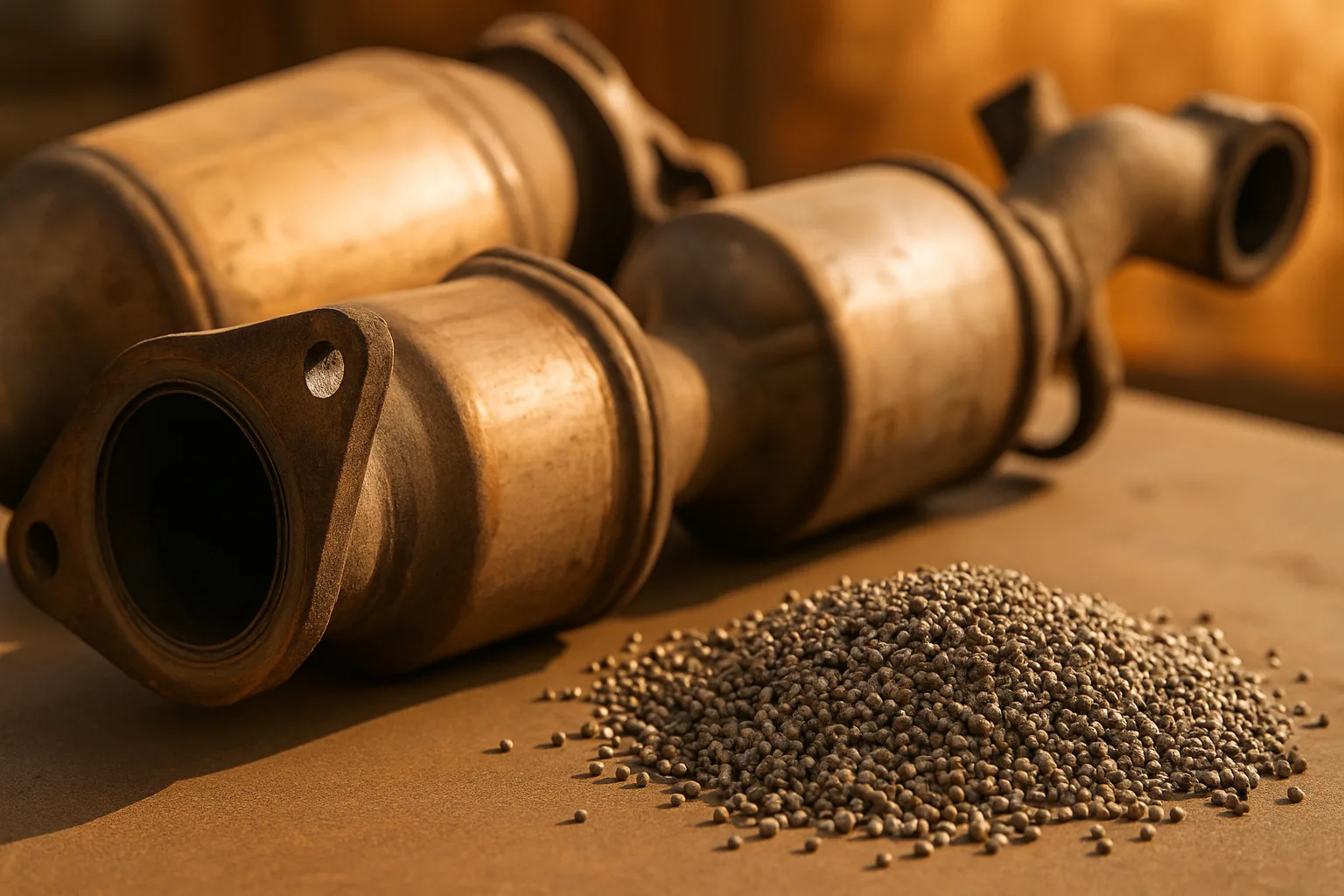
OEM vs. Aftermarket Catalytic Converters: Why the Scrap Value Gap Is Bigger Than You Think
Most people assume a catalytic converter is a catalytic converter. Pull it off, weigh it, get paid. But if you've ever brought in two cats that look nearly identical and walked away with wildly different payouts, you already know that's not how it works. The difference between an OEM catalytic converter value and what you'd get for an aftermarket unit can be hundreds of dollars — sometimes more. Understanding why that gap exists puts real money back in your pocket.
Whether you're a yard operator in St. Catharines processing a mixed load, or a seller trying to make sense of a catalytic converter price list that seems all over the map, this breakdown will help you sort the high-value units from the low ones — before you take a bad deal.
What Makes an OEM Catalytic Converter More Valuable?
OEM stands for Original Equipment Manufacturer. These are the converters built to the exact specs of the vehicle maker — Toyota, Ford, GM, Honda, and so on. They're installed at the factory or as factory-authorized replacements. And the reason OEM catalytic converter value is so much higher at scrap comes down to one thing: precious metal content.
OEM converters are engineered to meet strict emissions standards. To do that reliably over the life of a vehicle, manufacturers load the substrate — the honeycomb ceramic or metallic core inside — with meaningful quantities of platinum, palladium, and rhodium. These are the three platinum group metals (PGMs) that make catalytic converters worth scrapping in the first place. No PGMs, no payout. More PGMs, bigger cheque.
Here's what that looks like in practice:
- Platinum: Helps oxidize hydrocarbons and carbon monoxide
- Palladium: Highly effective at oxidizing hydrocarbons, especially during cold starts — palladium loadings in modern OEM cats have increased significantly
- Rhodium: Reduces nitrogen oxides; rhodium is rare and commands premium prices
OEM units from manufacturers like Toyota, BMW, and certain Ford and GM trucks are known for higher PGM loadings. That's why a used OEM cat from a late-model Prius or an F-250 diesel can fetch several hundred dollars at scrap, while a comparable-looking aftermarket unit might bring in a fraction of that.
Why Aftermarket Catalytic Converters Pay So Little at Scrap
Aftermarket cats are built to pass emissions tests — not to maximize precious metal content. Manufacturers competing on price have every incentive to use the minimum amount of PGMs needed to meet legal requirements. Some use cheaper substrate materials. Some coat the washcoat (the layer that holds the PGMs) with less loading per unit than the OEM spec.
The result? You might be holding a cat that looks the same size and weight as an OEM unit but contains a fraction of the recoverable platinum, palladium, and rhodium. Refiners know this. Buyers know this. And when you bring in an aftermarket unit thinking it's worth OEM money, you're going to be disappointed.
A few other factors that drive aftermarket values down:
- Cheaper substrate materials — some aftermarket cores use formulations that are harder to process, reducing refinery yield
- Inconsistent PGM loading — quality varies by brand and production run, making aftermarket units harder to price accurately
- No serial number data — OEM units have manufacturer codes that buyers can cross-reference against assay databases; aftermarket units often lack this
- Faster degradation — aftermarket cats often wear faster, meaning less PGM is recoverable by the time the unit reaches scrap
If you're trying to get a fair price for your scrap catalytic converters in Canada, the first step is knowing what you have. OEM versus aftermarket is the single biggest factor in that determination.
How to Tell OEM from Aftermarket Before You Sell
This is where yards in St. Catharines and across Ontario can gain a serious edge over sellers who just lump everything together. Accurate identification before you quote or sell means no surprises at settlement.
Here's how to separate OEM from aftermarket in your inventory:
- Check the stamping or heat shield markings. OEM units typically carry manufacturer codes, part numbers, or OEM identifiers stamped directly on the body or heat shield. Aftermarket units may have generic codes or brand names like "Walker," "MagnaFlow," or "Bosal."
- Use a VIN lookup. If you know the vehicle the cat came off, the VIN tells you the factory spec — which means you can confirm whether the unit is OEM or a replacement. Platforms like SMASH include VIN lookup tools that connect the converter to the source vehicle.
- Compare weight and size against known OEM specs. Heavy, dense substrates generally indicate higher PGM loading. Lightweight units are a red flag for aftermarket.
- Reference a price list database. Reputable buyers and auction platforms maintain assay-backed price lists that distinguish OEM from aftermarket values by make and part number. This is far more reliable than guessing by visual inspection alone.
- Look for foil cats. Some aftermarket units use metallic foil substrates rather than ceramic honeycomb. These are easy to identify by sound (they rattle differently) and often have lower scrap value.
Good documentation here isn't just about getting paid properly on a single load. It's about building a reputation as a seller who knows their inventory — which means buyers compete harder for your loads. That's exactly the kind of position that makes the SMASH Recycling auction platform work in your favour.
How Catalytic Converter Prices Today Reflect PGM Markets — Not Just Category
Even within the OEM category, values swing based on live PGM spot prices. Palladium has been one of the most volatile of the three metals over the past several years. Rhodium, despite being less well-known, has seen price swings that dwarf most commodities. These moves hit converter payouts directly.
When palladium prices rise, gasoline engine OEM cats — which tend to be palladium-heavy — pay more. When rhodium spikes, diesel and certain European OEM units see bigger bumps. Knowing your converter breakdown by PGM content, not just OEM versus aftermarket, is the next level of price awareness.
That's why serious sellers in Ontario don't rely on a single phone call to one buyer to set their price. The old way — one contact, one quote, take it or leave it — doesn't work when markets move daily. The SMASH model brings multiple vetted buyers into competition on a documented load, which means you're getting a price that reflects what the market actually looks like today, not what one buyer wants to pay today.
If you want to stay current, read Canadian scrap catalytic converter guides that break down how PGM price shifts flow through to converter payouts — it's some of the most practical information you'll find if you're selling volume.
Scrap Metal Inventory Management — The Hidden Advantage for Cat Sellers
Here's what separates yards that consistently get strong payouts from those that don't: documentation. Scrap metal inventory management for catalytic converters isn't paperwork for the sake of it. It's a competitive tool.
When you present a load — whether you're in St. Catharines or anywhere else across Ontario — with photos, part numbers, OEM identification, vehicle source data, and accurate counts, buyers can price with confidence. Confident buyers bid higher. It's that straightforward.
Platforms like SMASH are built around this principle. The inventory tool lets you log cats by type, attach photos, record serial numbers, and build a documented load that buyers can evaluate before the auction opens. That's not just good record-keeping. That's price leverage. Compare that to calling a single local buyer, describing your load over the phone, and hoping for a fair number. There's no comparison.
For sellers processing mixed loads — a combination of OEM, aftermarket, and foil units — proper categorization before listing can mean the difference between getting blended pricing on the whole load versus getting accurate pricing on each category. Don't let your high-value OEM units drag down to aftermarket rates because a buyer couldn't tell the difference.
If you're in St. Catharines or the surrounding Niagara region and you're doing any volume at all, getting your inventory documented properly is one of the fastest ways to improve your returns. You can find the best scrap cat prices in Canada when buyers have the information they need to compete — and that starts with knowing what you have.
OEM Catalytic Converter Value: What to Expect by Category
Without inventing specific prices — because catalytic converter prices today fluctuate with PGM markets and you should always check current rates — here's a general hierarchy of OEM value that holds across most market conditions:
- High-value OEM units: Toyota Prius (hybrid cats with elevated palladium and platinum loadings), large-displacement domestic truck cats (Ford F-Series, GM 6.0L), BMW and Mercedes diesel OEM units
- Mid-range OEM units: Standard domestic sedans and crossovers, Honda and Toyota non-hybrid OEM, import OEM from mainstream makes
- Lower OEM range: Small-displacement import OEM units, older OEM cats with significant substrate wear, units with damaged cores
- Aftermarket (all categories): Significantly below OEM equivalents; value varies by brand and condition but rarely approaches OEM payouts
- Foil/metallic substrate aftermarket: Generally the lowest scrap value category
This hierarchy exists because refiners pay based on what they can actually extract. No assay, no premium. The documented OEM provenance — backed by part numbers, VIN data, and photo records — is what justifies the higher payout.
Disclaimer: Catalytic converter prices fluctuate with PGM spot markets. Always check current rates before selling. The categories above reflect general market positioning, not fixed prices.
If you're ready to stop guessing and start getting competitive offers on documented loads, the process is straightforward. Bring your inventory to a platform that connects you with vetted buyers and lets the market set your price — not one buyer's mood on a Thursday afternoon. That's what SMASH does, and it's available to sellers across St. Catharines and the rest of Ontario right now.
The best way to know you're getting the right price is to let multiple buyers tell you at the same time. Get a free quote at best-scrap-cat-prices.ca and find out what your load is actually worth in today's market.
Frequently Asked Questions
Q: How much more is an OEM catalytic converter worth compared to an aftermarket unit?
It depends on the vehicle and current PGM prices, but the gap can be significant — in many cases, OEM units fetch several times the payout of a comparable aftermarket unit. This is because OEM converters contain substantially higher loadings of platinum, palladium, and rhodium. Always have your units identified before selling to avoid blended pricing that undervalues your OEM inventory.
Q: How can I tell if a catalytic converter is OEM or aftermarket before I sell it in Ontario?
Check for manufacturer part numbers or OEM stamps on the body or heat shield. If you have the source vehicle, a VIN lookup will confirm the factory-installed spec. Aftermarket units often carry brand names like MagnaFlow or Walker rather than OEM identifiers. Yards and platforms with assay databases can cross-reference part numbers to confirm OEM status.
Q: Are catalytic converter prices in St. Catharines different from the rest of Ontario?
The underlying value is driven by PGM spot prices, which are global — not local. However, local buyer competition does affect your actual payout. In St. Catharines and the broader Niagara region, using a competitive auction platform rather than a single local buyer ensures you're getting a market-reflective price rather than one buyer's offer. St. Catharines scrap metal services connected to platforms like SMASH give sellers access to buyers competing nationally, not just locally.
Q: What is the best way to get accurate catalytic converter prices today in Canada?
The most reliable approach is to document your inventory — photos, part numbers, OEM identification — and submit it to a platform that connects you with multiple vetted buyers. Single-buyer phone quotes are one data point; competitive auction pricing reflects the actual market. PGM prices move daily, so always check current rates before committing to a sale.
Q: Does SMASH buy catalytic converters directly, or is it an auction platform?
SMASH operates as an auction platform connecting sellers with vetted buyers — it's not a single end-buyer. That structure means competition on your load, which supports better price discovery than a direct one-buyer transaction. Sellers across Canada, including Ontario, can list documented converter loads and let qualified buyers compete. Reach out directly at jeff@smashscrap.com to get started.
Stay current on scrap metal market trends and PGM pricing shifts — follow SMASH on LinkedIn for industry updates, market insights, and practical guidance for scrap cat sellers across North America.