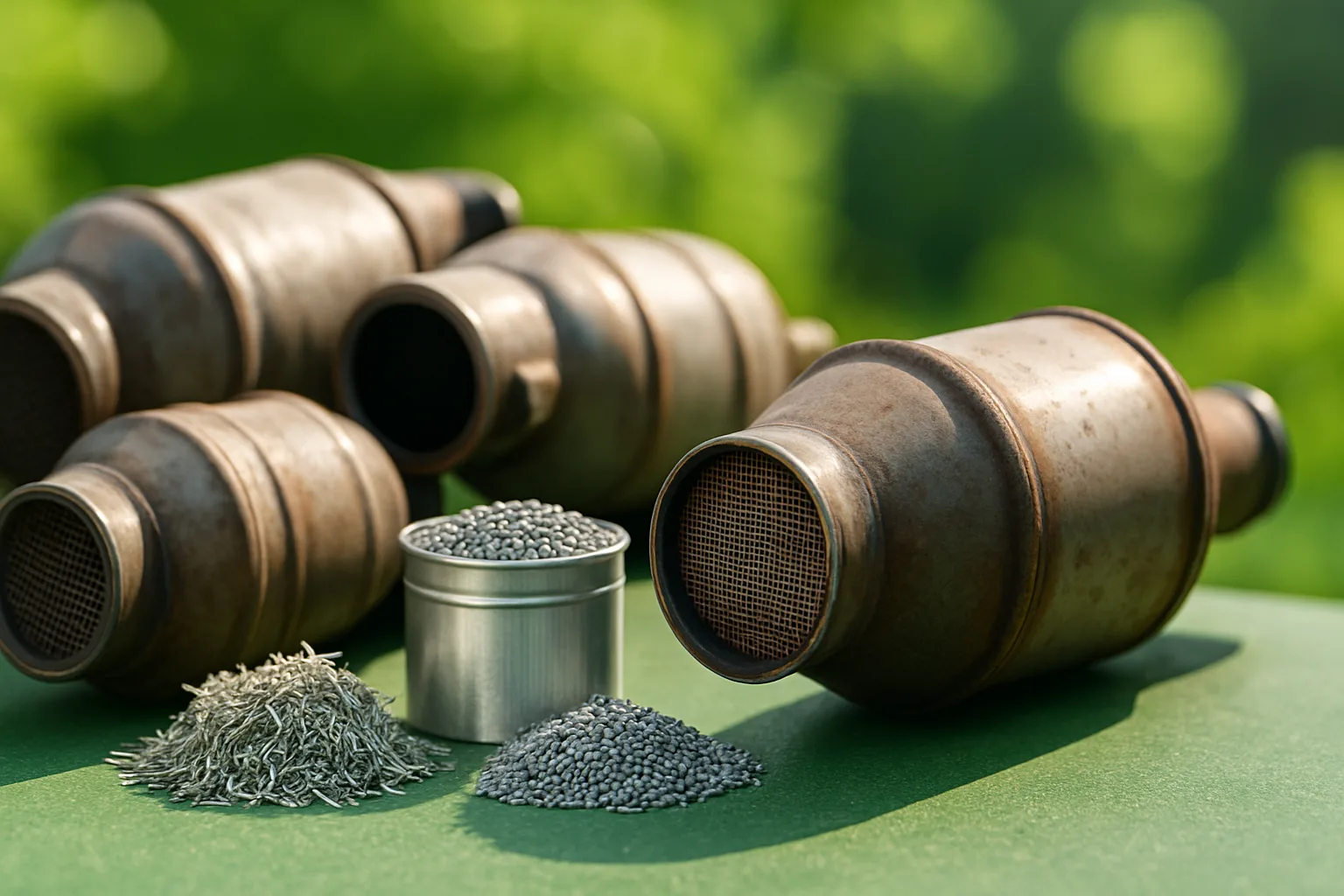
Most scrap yards will buy your catalytic converter. Very few will tell you what it's actually worth. That gap — between what you're offered and what your cat is genuinely worth on the precious metals market — is where sellers lose real money, especially when they're sitting on high-value units from the vehicles listed below.
If you're looking to sell catalytic converters online and want to stop guessing, this guide breaks down which vehicle makes and models consistently produce the most valuable cats, what drives that value, and how to make sure you're getting a competitive price before you hand anything over.
Why Vehicle Make and Model Determine Scrap Cat Value
A catalytic converter's scrap value comes almost entirely from its platinum group metals (PGMs) — platinum, palladium, and rhodium. These are the active ingredients that reduce exhaust emissions. The amount of each metal loaded into a converter varies significantly by manufacturer, engine type, emissions standard the vehicle was built for, and vehicle class.
Trucks, SUVs, and performance vehicles tend to run hotter or produce more exhaust volume, which typically requires more PGM loading to hit emissions targets. Diesel vehicles use a different emissions strategy and often contain significant platinum content. Hybrid vehicles are in a category of their own — more on that below.
The substrate type also matters. Ceramic substrate cats are the standard. Foil or metallic substrates — found in older European performance vehicles — have different recovery profiles. Buyers who understand this will grade your cat accordingly. Buyers who don't will offer you a flat, low number and pocket the difference.
The Most Valuable Catalytic Converters by Make and Model
This is the section most sellers actually need. These are the vehicle categories and specific makes and models that consistently produce high-value catalytic converters based on PGM loading and market demand.
Toyota Prius (All Generations)
The Prius is the most well-known high-value cat in the scrap world, and for good reason. Because the combustion engine in a Prius runs intermittently and never fully warms the converter, manufacturers load the cat with higher concentrations of PGMs to compensate for the inconsistent operating temperatures. The result is a converter worth significantly more than cats from standard gasoline vehicles of similar engine size.
Prius cats — particularly from 2004 to 2021 model years — are among the most targeted for theft in British Columbia and across North America. That alone tells you something about their street value. When you're ready to find the best scrap cat prices in Canada, a Prius unit should always be quoted individually, never lumped in with a generic price list.
Ford F-250 and F-350 Super Duty (6.2L and Diesel)
Full-size diesel and heavy-duty gas trucks carry large converters designed to handle significant exhaust volume. The 6.7L Power Stroke diesel in late-model Super Duty trucks includes a diesel oxidation catalyst (DOC) with meaningful platinum content. The 6.2L gas-powered units also carry well above average PGM loads.
If you operate a fleet yard in the Okanagan or anywhere in British Columbia, Super Duty units are worth separating out and quoting individually rather than batching them with mixed loads.
Dodge Ram 2500 and 3500 (Cummins Diesel)
Cummins-powered Ram trucks have substantial platinum content in their diesel oxidation catalysts. The heavy-duty towing and work demands on these trucks means their emissions systems are built to last and built to process high exhaust volumes — both of which correlate with higher PGM content.
Ram diesel cats are high-demand units for buyers on a B2B scrap metal marketplace. If you're moving multiple units, auction-style pricing through a platform like SMASH creates competition among buyers — which is exactly the environment that drives better price discovery on high-value lots.
Lamborghini, Ferrari, and High-End European Performance Vehicles
High-revving, high-temperature V8, V10, and V12 engines in European performance vehicles require precisely engineered exhaust systems. Their converters are often paired units (one per bank), and each can carry elevated PGM loads relative to their physical size. These are not common yard finds, but when they do come through, misidentifying them or bundling them as regular foreign cats is an expensive mistake.
Honda Accord and Acura TL / MDX
Honda and Acura units — particularly the large-frame Accord V6 and the Acura TL and MDX — produce consistently strong scrap cat values. The Acura MDX, in particular, is a common vehicle in Canadian cities including Kelowna, which means these cats come through yards with regularity. They're worth knowing on sight.
Toyota Tacoma and 4Runner (V6)
Toyota's V6 platform — shared across the Tacoma and 4Runner — produces well-loaded converters that grade consistently higher than average. These vehicles are extremely common in British Columbia given their off-road popularity, which makes them a regular item in regional scrap yards. If you're in Kelowna handling vehicles from the interior, Tacoma and 4Runner cats are worth a dedicated look at Kelowna scrap metal services for competitive pricing.
How Precious Metal Markets Affect Your Scrap Cat Offer
Even with a high-value cat in hand, timing matters. The platinum price today — along with palladium and rhodium — directly affects what any honest buyer will offer you. Rhodium, in particular, has historically been the most volatile of the three, swinging dramatically based on automotive production levels and supply from South Africa and Russia.
When rhodium climbs, cats with higher rhodium loading — often from Japanese and Korean manufacturers — spike in value. When palladium is the stronger performer, gasoline-engine cats from North American vehicles tend to track higher. Platinum movements matter most for diesel units.
This is why a static price list from a local yard isn't good enough for high-value units. You need pricing tied to the actual spot market on the day you're selling. Platforms that pull current PGM data give you a transparent baseline — which is exactly the kind of environment where SMASH operates. When you get a fair price for your scrap catalytic converters in Canada, it should be grounded in today's numbers, not last month's.
The Case for Selling High-Value Cats Through a Competitive Platform
Here's the problem with the single-buyer model: one buyer has no incentive to offer you more than the floor. Whether you're at a local yard in Kelowna or calling a broker from a mobile number posted on a Kijiji ad, a single offer is just one person's guess — or strategy.
Competition changes that. When multiple vetted buyers see the same lot and bid against each other, the price moves toward actual market value. That's not a sales pitch — it's how price discovery works in every other commodity market. A B2B scrap metal marketplace like SMASH Recycling — where verified buyers bid on your metal brings that dynamic to catalytic converter selling.
SMASH supports photo documentation, serial tracking, and detailed inventory tools — all of which matter for high-value cats. A documented Prius cat or a properly identified diesel DOC commands more buyer confidence than an unverified mixed lot. More confidence means better bids.
If you've been curious about how this works in practice, read Canadian scrap catalytic converter guides that walk through real-world scenarios from identification to final sale.
How to Maximize the Catalytic Converter Scrap Price in Canada
If you're sitting on a batch of high-value units, these steps directly affect your outcome:
- Identify before you sell. Know whether you have a foreign, domestic, exotic, or diesel cat. Each grades differently. Mixing them into a generic lot hides value.
- Document with photos. Show the unit clearly — both ends, the substrate face if possible, and any visible serial numbers. Buyers price with more confidence when they can see what they're bidding on.
- Track serial numbers. Many high-value cats carry traceable serials that confirm vehicle of origin. This matters both for value and for compliance — particularly given ongoing legislative attention to converter theft across Canada.
- Check current PGM prices before accepting an offer. The catalytic converter scrap price Canada on any given day is tied directly to platinum, palladium, and rhodium spot prices. A strong offer last Tuesday may not reflect today's market.
- Get multiple bids. Whether through a marketplace or by shopping three buyers, a single offer is not a market. You need competition to find the actual price.
- Know your buyer. Vetted, established buyers — not anonymous cash offers — are the baseline for legitimate, traceable transactions, especially as provincial regulations around cat documentation tighten.
Yards in the Kelowna area and throughout British Columbia have access to competitive national buyers through platforms built for this — no subscription required, no lock-in. SMASH charges no monthly fees. You pay when you sell, and only then.
Frequently Asked Questions
Q: Which catalytic converter is worth the most money as scrap?
Toyota Prius converters consistently rank among the highest-value units due to elevated PGM loading designed to compensate for the hybrid engine's intermittent operation. Ferrari, Lamborghini, and other high-performance European vehicles also produce premium cats. Heavy-duty diesel units from Ford Super Duty and Ram Cummins trucks are valuable as well, particularly for their platinum content.
Q: Where can I sell catalytic converters online in Canada?
You can sell catalytic converters online through platforms like SMASH, which connect sellers with vetted buyers across Canada in a competitive auction environment. This typically produces better price discovery than calling a single local buyer. Make sure any platform you use is transparent about how pricing is calculated and ties offers to current PGM spot prices.
Q: How do I get the best catalytic converter scrap price in Canada?
Identify your cats accurately, document them with photos and serial numbers, check current platinum and palladium prices, and get multiple bids before accepting an offer. Using a competitive B2B scrap metal marketplace puts buyers in competition with each other, which can help reveal the true market value of your units.
Q: Are there scrap cat buyers in Kelowna, British Columbia?
Yes — Kelowna has local scrap buyers and recycling facilities that handle catalytic converters. For high-value or large-volume lots, connecting with national buyers through a verified online platform often produces stronger offers than local-only pricing. Check Kelowna scrap metal services for regionally relevant options.
Q: Does the platinum price today affect what I get for my scrap cat?
Directly and significantly. Catalytic converter scrap prices in Canada are tied to live PGM spot markets — platinum, palladium, and rhodium. A buyer offering you a flat rate without referencing current metals prices is either working from outdated data or pricing in a margin for themselves. Always verify against current spot prices before accepting an offer.
Disclaimer: Catalytic converter scrap prices fluctuate daily based on precious metals markets. All pricing is subject to change. Verify current rates before selling.
If you're sitting on high-value units — Prius cats, diesel DOCs, or performance vehicle converters — don't settle for a number that doesn't reflect the actual market. The best way to know what your cats are worth is to put them in front of buyers who compete for them. Find the best scrap cat prices in Canada with a free quote at best-scrap-cat-prices.ca, and find out what your converters are actually worth today.
Stay sharp on scrap metal markets — follow SMASH on LinkedIn for industry updates, PGM market insights, and news that actually matters to Canadian recyclers and cat sellers.