Most scrap yards treat all catalytic converters the same. That's a mistake — and it could be costing you money every time you bring in a load.
If you're selling scrap cats in Richmond or anywhere else in British Columbia, understanding the difference between diesel and gasoline converters isn't just trivia. It directly affects your cat converter prices in Richmond and how buyers assess what you're bringing to the table. Diesel units — specifically DPFs (Diesel Particulate Filters) and DOCs (Diesel Oxidation Catalysts) — are fundamentally different animals from standard gasoline converters. Different construction, different precious metal loading, different scrap value.
Here's what you need to know before your next sale.
Gasoline vs. Diesel Converters: The Basic Difference
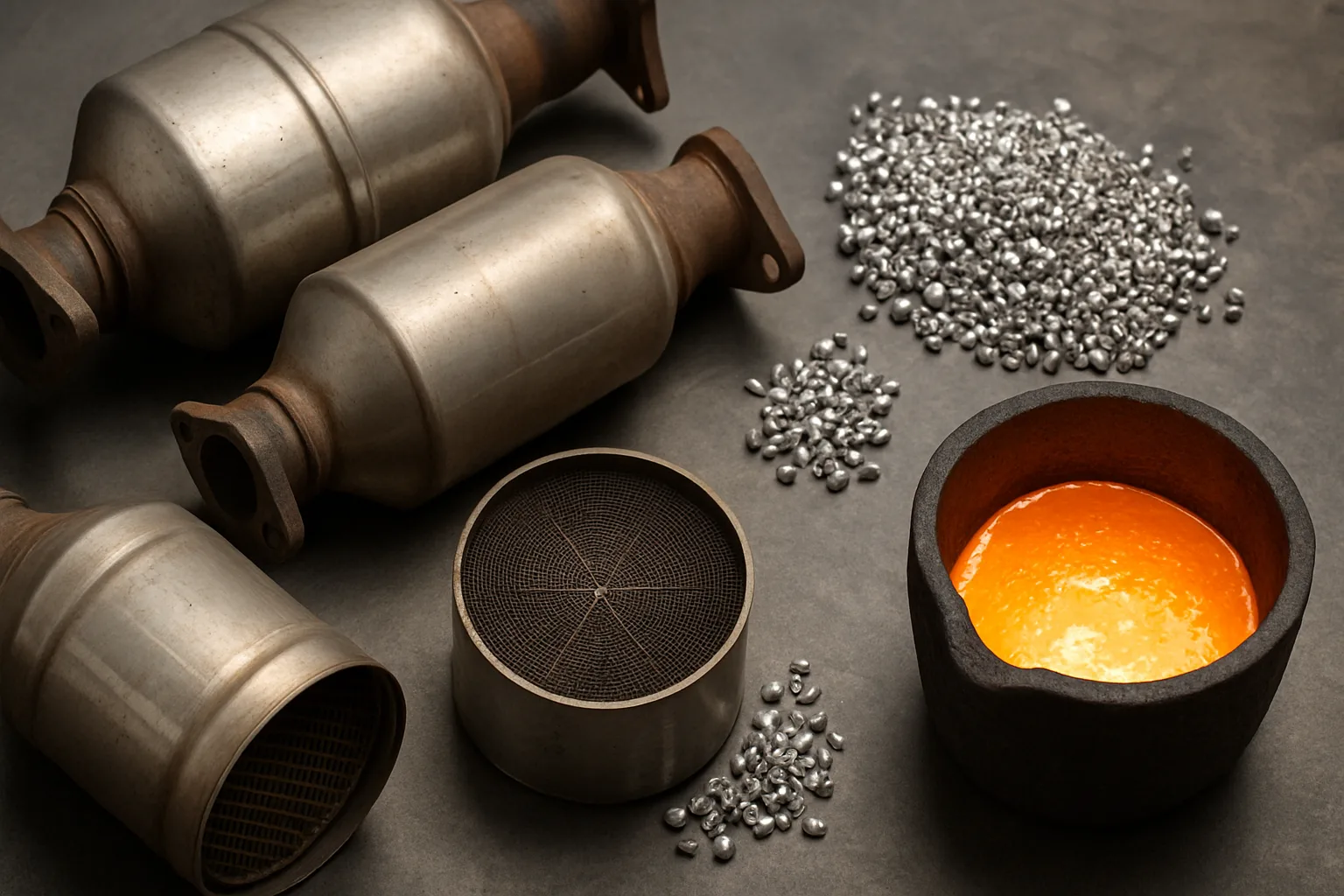
A standard gasoline catalytic converter does one primary job: it converts harmful exhaust gases — carbon monoxide, hydrocarbons, unburned fuel — into less harmful outputs using a ceramic honeycomb substrate coated with precious metals. The big three are platinum (Pt), palladium (Pd), and rhodium (Rh). Rhodium is the heavy hitter here. It's rare, expensive, and present in meaningful quantities in gasoline cats. That's what drives catalytic converter scrap value in most consumer vehicles.
Diesel engines work differently. Diesel exhaust contains far less unburned hydrocarbons but far more particulate matter — soot. You can't run that through a traditional honeycomb-style converter and expect the same chemistry to work. So diesel emission systems use a different setup entirely, usually involving two separate components working in sequence:
- DOC (Diesel Oxidation Catalyst): Similar in concept to a gasoline cat — it oxidizes CO and hydrocarbons. It contains platinum and palladium but typically no rhodium.
- DPF (Diesel Particulate Filter): Physically traps soot particles. It uses a wall-flow substrate (not a flow-through honeycomb) and may contain small amounts of platinum as a catalyst to help burn off trapped soot during regeneration cycles.
These are not interchangeable with gasoline converters. They don't process the same gases, they aren't built the same way, and they don't contain the same precious metal profiles. That distinction matters enormously when you're trying to get accurate catalytic converter scrap value from a buyer.
Why DPFs and DOCs Have Different Scrap Value Than Gasoline Cats
Here's where sellers often get confused — or get taken advantage of. Because DPFs are physically large (sometimes much larger than a gasoline cat), people assume they must be worth more. That's not always true. Size doesn't equal precious metal content.
A DPF's wall-flow filter substrate is primarily cordierite or silicon carbide. These materials trap soot mechanically. The platinum loading exists to assist with regeneration, but the concentration per unit of substrate can be lower than what you'd find in a comparable gasoline converter. That means a heavy DPF isn't necessarily a high-value DPF. Buyers who know what they're doing will assess the specific unit — its make, model, application, and the actual assay data on its precious metal content — not just its weight.
DOCs tend to sit closer to traditional converter economics. Platinum and palladium are both present, and some heavy-duty DOCs from fleet trucks, agricultural equipment, or off-road machinery can carry meaningful precious metal loads. The variation by application is wide. A DOC from a light-duty pickup is a different unit than a DOC pulled from a Class 8 long-haul truck.
The bottom line: lumping DPFs, DOCs, and gasoline cats together in a single price bucket is sloppy recycling. If your buyer does this, you're likely leaving money on the table.
How Proper Identification Affects Cat Converter Prices in Richmond
Whether you're running a Richmond scrap metal services operation or selling individual units from a shop, proper identification is everything. The gap between a correctly identified cat and a misidentified one can be significant on a per-unit basis — and on a full load, that adds up fast.
For gasoline converters, serial numbers stamped on the unit are typically the most reliable identification method. Serial tracking links a converter to the vehicle it came from, which in turn links it to a known precious metal assay for that specific OEM part. That's how buyers price with confidence.
Diesel units are trickier. DPFs and DOCs are often larger, heavier, and may carry part numbers rather than traditional serial formats. Aftermarket diesel emission units (common in the rebuild market) may have different precious metal content than OEM equivalents — sometimes dramatically so. Aftermarket units often have lower PGM loading. If you're selling aftermarket DPFs and expecting OEM pricing, you'll hit a wall with any buyer who actually knows the market.
Platforms like SMASH — Canada's B2B scrap recycling marketplace — approach this with structured inventory tools that support photo documentation and unit-level tracking. That kind of documentation means buyers aren't guessing. When buyers have confidence in what they're bidding on, competition happens. Competition is how you find the best scrap cat prices in Canada.
Catalytic Converter Scrap Price Ontario, Edmonton, and British Columbia: Does Location Change Value?
Yes and no. The underlying precious metal markets are global — platinum, palladium, and rhodium trade on international commodity exchanges. A DOC from a Kenworth in Edmonton isn't worth more at the metal level than the same unit in Richmond. The PGMs don't care where they're located.
What changes by location is buyer access and competition. If you're in a market with fewer active buyers — or if you're relying on a single local buyer with no competitive pressure — you may be getting priced at whatever that buyer decides is fair, not what the market actually supports. This is true whether you're trying to get the catalytic converter scrap price in Ontario, sell a catalytic converter in Edmonton, or move a full load of mixed diesel and gasoline cats from a shop in Richmond, British Columbia.
The difference between markets isn't the metal value. It's the infrastructure — or lack of it — around connecting sellers to buyers who compete for the material. That's the problem SMASH was built to solve. Multiple vetted buyers, an auction format, and no subscription fees. We only win when you win. Get a fair price for your scrap catalytic converters in Canada by making sure more than one buyer sees what you're selling.
What Sellers Get Wrong About Diesel Emission System Scrap
A few common mistakes show up repeatedly when sellers bring in diesel emission components:
- Pricing by weight alone. DPFs are heavy. That weight is mostly substrate and filter media, not precious metal. Weight-based pricing for DPFs is almost always a bad deal for the seller.
- Mixing OEM and aftermarket units without disclosure. Buyers who discover aftermarket units in a load they priced as OEM will adjust — usually aggressively. Disclose upfront. Better to get the right price quoted than to have a dispute on settlement.
- Treating a DOC as a DPF or vice versa. These are different units with different PGM profiles. Know what you have before you quote a price or accept one.
- Selling to the first buyer who offers a number. In any market — Richmond, Ontario, Edmonton — the first offer is rarely the best offer. It's a starting point.
- Skipping documentation. A clean load with photos, serial numbers, and a solid packing list moves faster and attracts more competitive bids than a mystery pile. This is true in scrap metal recycling across Canada, not just for cats.
If you're serious about getting strong returns on diesel emission system scrap, fix these habits first. The mechanics of the market reward sellers who do the work.
Getting the Best Scrap Cat Prices in British Columbia: The Practical Approach
Knowing your material is step one. Step two is making sure the right buyers see it — not just one, not just whoever's closest. The scrap metal recycling Canada market has consolidated in some regions and fragmented in others. Depending on where you operate in British Columbia, your natural buyer pool might be smaller than you think.
That's where structured platforms change the math. When you list a load of properly documented diesel and gasoline cats — separate, identified, photographed, serial-tracked where applicable — you give every buyer in the network a reason to bid competitively. One buyer guessing at your material value is not the same as five vetted buyers competing for it.
SMASH connects sellers across Canada to verified buyers through an auction format that creates genuine price discovery. No subscription. No cold calls. No guessing. If you want to read Canadian scrap catalytic converter guides and sharpen your knowledge before your next sale, that's a smart move. But knowledge only converts to money when it meets a competitive market.
If you're in Richmond or anywhere in British Columbia selling diesel emission components, you owe it to yourself to see what real competition looks like. Head to best-scrap-cat-prices.ca for a free quote — it's the straightforward way to find out what your material is actually worth today.
Disclaimer: Precious metal prices fluctuate daily. All scrap catalytic converter values are subject to current market rates. Always check current pricing before selling.
Frequently Asked Questions
Q: Are DPFs worth scrapping in Canada?
Yes, but value varies significantly by unit. OEM DPFs from heavy-duty applications tend to carry more precious metal content than aftermarket or light-duty units. Proper identification and documentation will give you a much more accurate picture of what your DPFs are worth before you accept any offer.
Q: How do I know if I have a DOC or a DPF?
A DOC (Diesel Oxidation Catalyst) uses a flow-through honeycomb substrate and looks visually similar to a gasoline converter, though often larger. A DPF (Diesel Particulate Filter) uses a wall-flow substrate designed to trap soot — you typically cannot see light through it end-to-end. When in doubt, reference the part number or VIN of the source vehicle to confirm.
Q: Why are cat converter prices in Richmond different from other cities?
The precious metal value in any converter is the same regardless of geography — those markets are global. What varies locally is buyer competition and market access. Richmond and the broader British Columbia market may have fewer active buyers for diesel emission components specifically, which is why reaching buyers through a competitive platform can make a meaningful difference in your final settlement price.
Q: Do aftermarket catalytic converters have scrap value?
Yes, but typically less than OEM units. Aftermarket converters and aftermarket diesel emission components are often manufactured with lower PGM loading than OEM equivalents, which directly affects scrap value. Always disclose whether units are OEM or aftermarket — buyers who find out mid-transaction will adjust pricing, and not in your favour.
Q: How do I get the best price when selling catalytic converters in British Columbia?
Document your material thoroughly — photos, serial numbers, OEM vs. aftermarket status, and unit counts separated by type. Then make sure more than one buyer sees it. Single-buyer pricing without competition is the most common way sellers leave money behind. Platforms like SMASH create the competitive environment where price discovery actually happens.
---Follow SMASH on LinkedIn for ongoing market insights, scrap metal industry updates, and practical guidance on getting the best value from your material across Canada.