From Your Yard to the Smelter: How Catalytic Converter Assaying and Smelting Actually Works
Most scrap yards in Canada collect catalytic converters without fully understanding what happens next — and that gap costs them money. The palladium price today directly determines what your cats are worth, but only after a refiner runs your material through assay and smelting to find out exactly what's inside. Knowing how that process works gives you a serious edge when negotiating prices.
This breakdown covers the full journey — from the moment your cats leave the yard to the point where precious metal content gets confirmed and priced. If you're selling converters in Red Deer or anywhere else in Alberta, this is how your payout actually gets calculated.
Why the Precious Metal Content Inside Your Cat Determines Everything
A catalytic converter isn't just a chunk of metal. Inside the ceramic or metallic substrate sits a washcoat loaded with platinum group metals (PGMs): platinum (Pt), palladium (Pd), and rhodium (Rh). These three metals do the emissions work — and they're also worth serious money on the commodities market. Palladium in particular has seen significant price swings over the past several years, making the palladium price today one of the most important numbers a cat seller can track.
The amount of PGM inside each converter varies widely based on make, model, engine size, and emissions standards at the time of manufacture. A diesel particulate filter from a heavy truck contains a very different PGM loading than a small passenger car cat. This is why serious buyers don't offer flat rates — they grade and categorize by unit, using data and assay history to estimate yield before they bid.
- Platinum: Used heavily in diesel converters
- Palladium: Dominant in gasoline engine converters — often the highest-value PGM per unit
- Rhodium: Present in smaller quantities but historically commands extremely high prices
Getting paid fairly for this mix requires a buyer who understands the process — and a platform that brings competitive offers to the table. That's where smashrecycling.ca fits in for recyclers who want real market competition on their loads.
Step-by-Step: How Catalytic Converter Assaying Works
Assaying is the process of determining exactly how much of each PGM your material contains. It's a rigorous, multi-stage procedure — not a quick visual estimate. Here's how it typically works at a licensed refinery or toll processor.
1. Decanning and Sorting
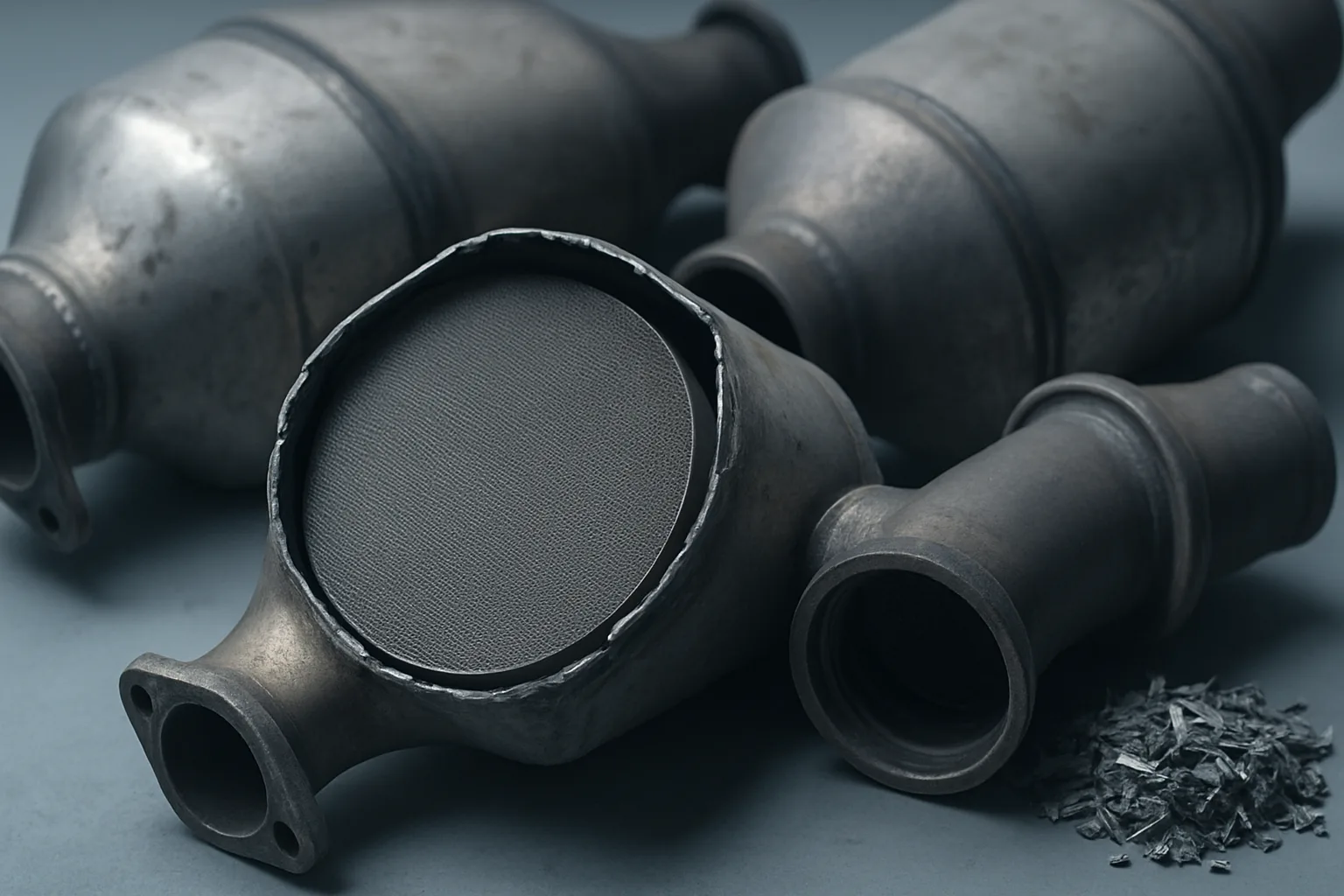
Before assay begins, converters get decanned — the shell is cut open and the substrate (the ceramic or metallic honeycomb inside) is separated from the steel housing. Substrates get sorted into groups: ceramic foil, metallic foil, and diesel particulate filters (DPFs). Mixing types throws off assay accuracy, so this stage matters more than most sellers realize.
2. Crushing and Sampling
Substrates are then crushed into a fine powder. The entire batch gets blended to create a homogeneous sample. A small, precisely weighed sample is pulled from that batch — typically a few grams — for chemical analysis. This is called the representative sample, and it's the foundation of the entire assay. If the sample isn't truly representative, the results won't reflect your actual load.
3. Fire Assay or ICP Analysis
Two main methods are used to measure PGM content:
- Fire assay: A traditional process where the sample is fused in a furnace with lead oxide and other fluxes. The lead collects the PGMs and sinks to the bottom. The lead is then cupelled off, leaving behind a bead of precious metals that gets weighed and analyzed. Highly accurate for gold and silver — also applied to PGMs.
- ICP-OES (Inductively Coupled Plasma – Optical Emission Spectrometry): The sample is dissolved in acid (usually aqua regia) and run through a plasma torch. The light spectrum emitted identifies and quantifies each element. Faster than fire assay and extremely precise for platinum, palladium, and rhodium.
Most modern refiners use ICP analysis for PGMs due to speed and accuracy. Results come back in grams per tonne (g/t) or troy ounces per tonne — and that number, multiplied by current spot prices for each metal, determines your payout.
4. Settlement Calculation
Once assay results are confirmed, the refiner calculates your settlement. They apply a payable percentage (typically 85–98%, depending on the contract and volume) to the confirmed PGM content. They then multiply by that day's London Bullion Market Association (LBMA) or LPPM benchmark price for each metal — including the palladium price today. Deductions for processing, freight, and refining fees are applied, and you receive a settlement statement showing the full breakdown.
If you're selling cats from Red Deer without understanding this settlement structure, you may be accepting offers that don't reflect actual PGM yields. Finding the best scrap cat prices in Canada means knowing what you're giving up in payable percentages and fees.
What Smelting Actually Does to Your Catalytic Converters
Assay tells you what's there. Smelting is how you get it out at scale.
After the full lot is assayed and lots are approved for processing, the bulk material goes into a high-temperature furnace — typically an electric arc furnace or a rotary kiln. At temperatures exceeding 1,400°C, the ceramic substrate melts and the PGMs dissolve into a collector metal (often copper or iron). The slag — essentially the non-metallic waste — floats to the top and gets removed.
The resulting alloy (sometimes called a matte or a collector alloy) is then refined further through hydrometallurgical processes: leaching with acids, solvent extraction, and precipitation to isolate each PGM as a pure sponge or powder. That refined metal is what gets sold on the commodities market. The price you see quoted as the palladium price today reflects that final refined product.
The whole process — from receiving your material to final settlement — typically takes 30 to 90 days depending on refinery volume, contract terms, and whether a spot assay or a custom lot assay was used. That timeline matters if you're managing cash flow at a busy yard in Alberta.
How Scrap Metal Inventory Management Affects Your Assay Accuracy
Here's something most sellers don't think about: your documentation practices directly affect how accurately your material gets assayed — and whether you can dispute results if something looks off.
When you ship a load without proper records, you're relying entirely on the refiner's process and goodwill. When you ship with detailed inventory — serial numbers, VINs, photo documentation, part categorization — you create a paper trail. That trail gives you the leverage to question low returns and cross-reference your own data against assay results.
This is where scrap metal inventory management tools genuinely change the game. Platforms like SMASH include inventory tracking, photo documentation, and serial/VIN lookup built directly into the workflow. If you're running a yard in Red Deer or anywhere across Alberta, that kind of documentation isn't just administrative — it's financial protection.
When buyers on SMASH bid on a documented load, they're working from real data, not guessing. Better data leads to more confident bids, which means better price discovery for the seller. Getting a fair price for your scrap catalytic converters in Canada starts before the load ever leaves your yard.
What This Means for Cat Sellers in Red Deer and Across Alberta
Understanding the assay and smelting process changes how you sell. You stop accepting vague per-unit offers and start asking the right questions: What payable percentage are you offering? What benchmark price are you using for palladium settlement? What's your processing timeline?
Sellers in Red Deer who work with Red Deer scrap metal services tied to a competitive marketplace get real bids from vetted buyers — not a single take-it-or-leave-it quote from one contact. That's the structural difference between the old way of selling cats and a platform built around competition and transparency.
If you want to see how this stacks up against what you're currently getting for your cats, read Canadian scrap catalytic converter guides to understand how pricing works across different grades and regions.
Palladium prices, rhodium swings, and platinum fluctuations all affect your bottom line — but so does who's buying your material and what percentage they're actually paying you. Don't leave the second half of that equation to chance.
Disclaimer: Precious metal prices fluctuate daily. Always check current palladium, platinum, and rhodium spot prices before accepting settlement offers. The figures referenced here are illustrative of market dynamics, not guaranteed pricing.
If you're ready to stop guessing and start getting competitive offers on your cats, find the best scrap cat prices in Canada — get a free quote at best-scrap-cat-prices.ca and see what your material is actually worth.
Frequently Asked Questions
Q: How does the palladium price today affect what I get paid for scrap catalytic converters?
The palladium price today sets the benchmark used in your settlement calculation. After assay confirms how many grams of palladium are in your lot, the refiner multiplies that by the current LBMA spot price — less processing fees and the agreed payable percentage. A higher palladium price means a higher gross return, but your net depends heavily on the payable terms you negotiated upfront.
Q: How long does it take to get paid after shipping cats to a refiner?
Settlement timelines vary by refiner and contract type. Most standard toll refining arrangements settle within 30 to 90 days from receipt. Some buyers offer advance or provisional payments against estimated PGM content — but those advances are calculated conservatively, so the final settlement reflects the true assay result. Always confirm the timeline before shipping.
Q: Where can I find competitive catalytic converter buyers near Red Deer, Alberta?
Rather than cold-calling buyers and hoping for fair pricing, using a platform that connects vetted buyers to your documented inventory gives you more options and better price discovery. Sellers in Red Deer can use SMASH to list loads and receive competitive bids — no subscription fees, and no single buyer controlling your price.
Q: What's the difference between a spot assay and a custom lot assay?
A spot assay estimates value based on visual grading and database averages — it's faster but less precise. A custom lot assay processes your specific material through crushing, sampling, and ICP or fire assay analysis, giving you exact PGM content for your load. Custom lot assays take longer but typically result in a more accurate — and often higher — settlement for mixed or high-volume loads.
Q: How do I know if my scrap cat buyer is using accurate assay results?
Ask for the full assay certificate, including the sample weight, method used (ICP or fire assay), results in grams per tonne for each PGM, and the settlement calculation showing which benchmark prices were applied. A reputable buyer will provide this without hesitation. If you're not getting a transparent settlement statement, that's a red flag worth acting on.
Follow SMASH on LinkedIn for scrap metal market insights, PGM price updates, and industry news relevant to recyclers across North America: linkedin.com/company/scrap-metal-auction-sales-hub.