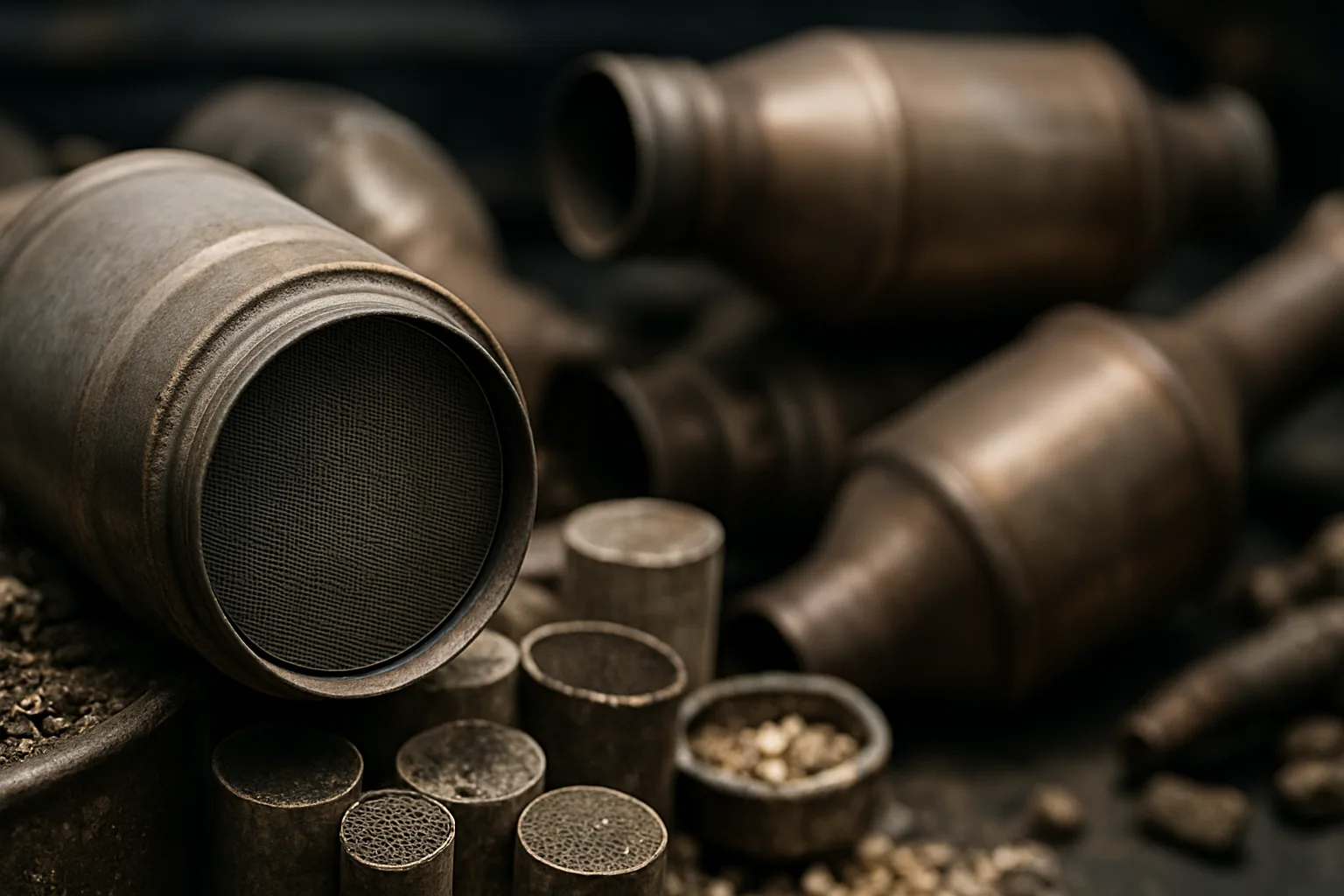
Why Your Cat's Serial Number Is Worth More Than You Think
Most sellers in Sydney, Nova Scotia hand over a catalytic converter and hope for a fair price. The buyer quotes a number. The seller accepts it. Nobody questions it. But here's the thing — that serial number stamped on your cat is the difference between getting market value and leaving money on the table. If you can't read it, you can't verify the quote.
Learning to identify catalytic converter serial numbers isn't complicated. It's a skill that takes about ten minutes to learn and pays off every single time you bring a load to market. This guide walks you through exactly how to read them, what they mean, and how to use that information to find the best scrap cat prices in Canada.
Where to Find the Serial Number on a Catalytic Converter
The serial number — sometimes called a part number or OEM number — is stamped, engraved, or printed directly on the converter's body or heat shield. Location varies by manufacturer, but there are reliable places to check first.
- Top or side of the body: Most common. Look for a stamped or engraved alphanumeric string on the metal casing.
- Heat shield: Some OEM converters carry the number on the thin metal shield wrapped around the body. Check both sides.
- Inlet or outlet pipe: Aftermarket units often stamp the number near the welded pipe flanges.
- Label or foil sticker: Some units — particularly newer vehicles — use a barcode label. These degrade over time, so photograph them immediately.
- Underneath the vehicle: On some trucks and SUVs, the number is stamped facing downward. A flashlight and a flat mirror help here.
Grime, rust, and heat damage are your enemies. Use a wire brush or a rag with brake cleaner to clear the area before you try to read it. If the number is partially obscured, photograph it in strong natural light and zoom in. A partial serial number is still more useful than none — buyers can often cross-reference partials against their databases.
How to Read a Catalytic Converter Serial Number — OEM vs. Aftermarket
Not all serial numbers are created equal. The format tells you whether you're holding an OEM (original equipment manufacturer) unit or an aftermarket replacement. This matters a lot for pricing because OEM converters typically carry higher precious metal loadings — more platinum, palladium, and rhodium — than their aftermarket equivalents.
OEM serial numbers usually follow the vehicle manufacturer's part numbering system. A Ford unit might read something like F81A-5E212-AA. A Toyota might show 17150-0P060. These follow predictable structures: a combination of letters, numbers, and dashes that correspond to the vehicle model, engine code, and production revision. If you know the vehicle the converter came off, cross-referencing the VIN with the part number confirms you have the right unit — and gives buyers confidence in the precious metal content.
Aftermarket serial numbers look different. Brands like Walker, Magnaflow, and Eastern use their own internal numbering. A Walker number might be a simple five or six-digit code. These are indexed against their own databases and can still be priced accurately — they just don't carry the same precious metal value as OEM units. Don't assume aftermarket means worthless. Some high-quality aftermarket units carry reasonable loadings. Know what you have before you agree to a price.
Here's a quick reference for reading the number:
- Count the characters. OEM numbers tend to be longer and more complex. Short numeric strings are often aftermarket.
- Look for letter prefixes. Vehicle manufacturer codes often appear at the start (e.g., "GM," "BMW," or a numeric prefix tied to a platform).
- Note dashes and separators. OEM numbers use structured separators. Random strings without separators lean aftermarket.
- Search it. Type the full number into a scrap cat price list tool or ask your buyer to look it up before you agree to a number.
Why Serial Number Identification Directly Affects the Price You Get
Here's the blunt version: buyers who can't identify what they're buying pay less. It's not malicious — it's risk management. When a buyer can't confirm the serial number, they price conservatively to protect their margin. That conservative price comes out of your pocket.
Precious metal content — specifically platinum, palladium, and rhodium — is what drives scrap cat value. Rhodium in particular has historically commanded significant premiums, and while rhodium price today fluctuates with market conditions, even small variations in the rhodium loading between two converters can mean a meaningful price difference per unit. A verified serial number removes the guesswork. The buyer knows exactly what's inside the substrate without cutting it open.
For sellers in Sydney and across Nova Scotia bringing in multiple units at once, this adds up fast. Ten converters where you can verify the serial numbers versus ten unknowns — the documented load consistently attracts stronger offers. That's not an opinion. That's how competitive bidding works. Compare scrap metal bids from Canadian buyers and see the difference documentation makes in real time.
Platforms like SMASH are built around exactly this principle. When you document your inventory properly — serial numbers, photos, condition notes — buyers can bid with confidence. Confidence drives competition. Competition drives price discovery. No subscription fees, no guessing.
Practical Tools for Identifying and Cross-Referencing Serial Numbers
You don't need specialized equipment to identify a converter accurately. You need a process.
For physical identification:
- Wire brush or rag and brake cleaner for surface prep
- Flashlight and inspection mirror for hard-to-reach positions
- Smartphone camera with strong zoom for photographing worn or partial numbers
For cross-referencing:
- Scrap cat price databases — several buyers maintain searchable lists where you enter the serial number and get a reference price range
- VIN lookup tools — if you know the donor vehicle, a VIN lookup confirms the OEM part number, which you can then match to the physical unit
- SMASH's inventory tool supports serial number tracking, making it straightforward to document loads before they go to auction
For sellers who handle volume — auto wreckers, recycling yards, body shops — building a habit of photographing every serial number before the unit leaves your hands is basic protection. If a dispute arises over what was in the load, your documentation is your proof. To get a fair price for your scrap catalytic converters in Canada, documentation isn't optional — it's the foundation.
If you're researching how other markets handle pricing, tools like a catalytic converter price list from international sources can provide useful context about how precious metal content translates to value — but always anchor your expectations to current Canadian market rates, not foreign benchmarks. Scrap metal prices today in Nova Scotia reflect North American spot markets, not overseas figures.
How SMASH Turns Serial Number Data Into Better Offers for Sydney Sellers
The old process for selling scrap cats in Sydney, Nova Scotia looked like this: pull the units, call one buyer, accept whatever number they quoted, load the truck. No documentation. No comparison. No leverage.
SMASH changes the dynamic. When you enter your inventory into the platform — serial numbers, photos, unit count, condition — you're not just organizing data. You're building a documented load that vetted buyers can evaluate and bid on competitively. The SMASH scrap metal auction format means multiple buyers see the same information at the same time. That competition is where real price discovery happens.
For sellers who previously relied on a single relationship or a single phone call, the difference is tangible. More eyes on a documented load means buyers price to win, not to protect themselves from uncertainty. And because SMASH only charges when a sale completes — no subscription fees — there's no cost to listing. You bring the serial numbers. SMASH brings the buyers.
If you're looking for catalytic converter buyers near me prices that reflect actual market conditions rather than a single buyer's margin, an auction-based approach is the most direct way to find out what your load is actually worth. Read Canadian scrap catalytic converter guides to go deeper on pricing strategy and market trends.
Frequently Asked Questions
Q: How do I find the serial number on a catalytic converter if it's too corroded to read?
Start with a wire brush and brake cleaner to clear rust and grime. If the stamped characters are still illegible, try photographing the area at a low angle in strong light — raking light often reveals stamped text that looks invisible face-on. A partial number is still useful; many buyers can cross-reference partial strings against their databases.
Q: Does the serial number tell me what precious metals are in the converter?
Not directly, but it points to the vehicle application and OEM part number, which correlates to known substrate loadings for platinum, palladium, and rhodium. That's why documented serial numbers allow buyers to price more precisely — and typically more competitively — than unidentified units.
Q: Where can I get the best catalytic converter price in Sydney, Nova Scotia?
The best prices come from competitive offers, not single-buyer quotes. Document your units with serial numbers and photos, then use a platform like SMASH to let vetted buyers bid against each other. That competition gives you real market price discovery rather than one buyer's internal margin calculation.
Q: How does rhodium price affect what I get for my scrap cat?
Rhodium is one of the three primary precious metals recovered from catalytic converters, alongside platinum and palladium. Its spot price directly influences the offer you receive — converters with higher rhodium loadings are worth more when rhodium prices are elevated. Checking current spot prices before you sell gives you a reasonable reference point for evaluating quotes.
Q: Is the process for selling scrap cats in Sydney different from other parts of Canada?
The fundamentals are the same across Canada — precious metal content drives value, documentation improves offers, and competitive bidding beats single-buyer quotes. Local logistics (who picks up, how quickly) may vary, but the pricing mechanics and the benefit of using a platform like SMASH apply whether you're in Sydney, Nova Scotia or anywhere else in the country.
If you're sitting on a load of cats and wondering whether you're getting a fair number, the answer is probably to get more information before you commit. Document your serial numbers, photograph your units, and let competition do the work. You can start right now — find the best scrap cat prices in Canada and get a free quote at best-scrap-cat-prices.ca.
Stay current on scrap metal market movements and pricing shifts by following SMASH on LinkedIn — practical industry updates, no filler.