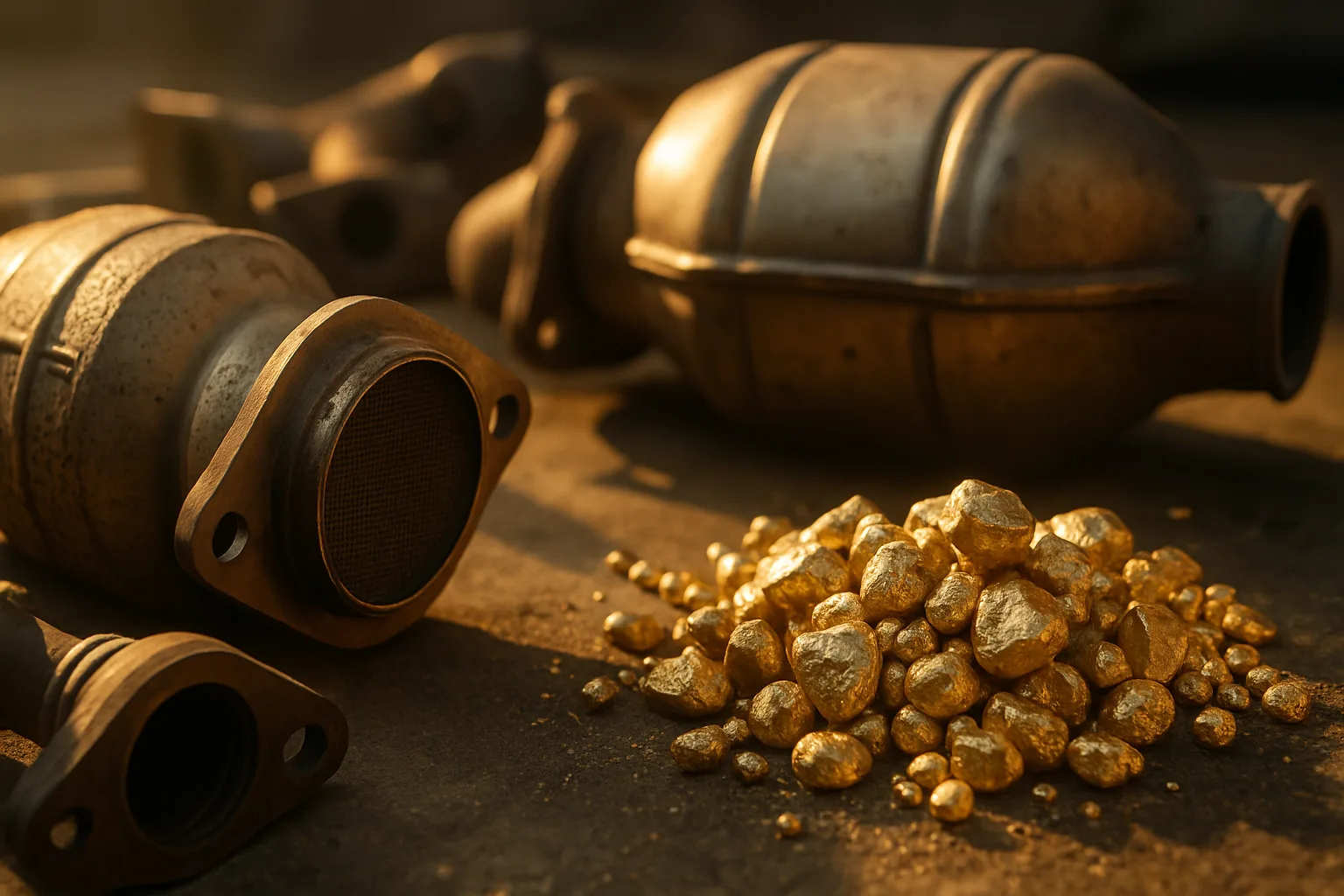
Why Precious Metal Markets Drive OEM Catalytic Converter Value More Than You Think
Most scrap cat sellers focus on what's happening at their local yard. That's understandable. But the number on the scale sheet isn't decided locally — it starts in mining reports, commodity exchanges, and industrial demand forecasts happening thousands of miles away. If you want to consistently get strong money for your converters, you need to understand what's actually moving the needle on OEM catalytic converter value in 2026.
This article breaks down how global precious metal markets connect directly to the price you get for your cats — and what you can do with that knowledge as a seller in Langley or anywhere else in British Columbia.
The Three Metals Inside Every Converter — and Why They Matter
Every catalytic converter contains a combination of platinum group metals (PGMs): platinum (Pt), palladium (Pd), and rhodium (Rh). These are the active ingredients that make converters work — they trigger the chemical reactions that reduce harmful emissions. They're also what make scrap cats worth recovering in the first place.
The concentration of these metals varies significantly by converter type. OEM converters — those made by the original vehicle manufacturer — typically contain higher PGM loadings than aftermarket units. That's the core reason OEM catalytic converter value tends to run higher than aftermarket equivalents on the scrap market. A strong OEM unit off a late-model truck or luxury vehicle can contain meaningful amounts of all three metals. A cheap aftermarket replacement? Often a fraction of that content.
Here's why the global market matters so much:
- Platinum is heavily tied to diesel vehicle manufacturing and industrial applications. Demand shifts in European automaking or hydrogen fuel cell development can swing platinum prices noticeably.
- Palladium is primarily used in gasoline engine converters. Supply is dominated by Russia and South Africa — geopolitical disruption in either country creates immediate market volatility.
- Rhodium is the most volatile of the three. It trades in a thin market with limited supply, which means price swings can be dramatic — sometimes hundreds of dollars per troy ounce in a short window.
When any of these metals moves, your converter's scrap value moves with it. This isn't theoretical. Sellers who understand the PGM cycle can time their sales more strategically rather than just cashing out whenever they have a load ready.
How Global Supply Chains and Mining Output Set Catalytic Converter Prices Today
The global PGM supply chain is tight and geographically concentrated. South Africa produces the majority of the world's platinum and rhodium. Russia is a dominant palladium supplier. Any disruption — labor strikes, power grid instability, export controls, or sanctions — ripples through the market fast. Recycled PGMs from scrap converters fill part of that gap, which is one reason secondary supply (i.e., your scrap cats) is genuinely valuable to refiners.
In 2026, the EV transition continues to reshape demand, but not as rapidly as some forecasts predicted a few years ago. Hybrid vehicles — which still require catalytic converters — remain a massive and growing segment of the North American fleet. That sustained demand for PGMs in autocatalysts is keeping scrap converter values relevant for sellers across the continent, including those running loads out of British Columbia.
Key global factors currently influencing catalytic converter prices today include:
- Ongoing tightness in rhodium supply from South African mines
- Palladium market adjustments as automakers continue shifting formulations
- Industrial platinum demand from hydrogen economy infrastructure projects
- Currency fluctuations between CAD, USD, and major trading currencies
- Refinery capacity and processing timelines in the secondary PGM market
Prices fluctuate constantly based on these variables. That's why getting a current quote — not relying on a figure you heard last month — is critical every time you're ready to move a load. Find the best scrap cat prices in Canada before you commit to any buyer.
OEM vs. Aftermarket: Why Converter Origin Changes the Math
Not all converters are created equal, and the scrap market prices them accordingly. If you've ever been surprised by a low offer on what looked like a decent converter, the likely culprit is that it was an aftermarket unit — or wasn't identified correctly at the point of sale.
OEM catalytic converter value is higher for a straightforward reason: OEM units are engineered to meet specific emissions standards using precise PGM loadings. Aftermarket converters often substitute lower concentrations of precious metals or use different chemical formulations to hit a lower price point. When refiners assay the material, the OEM unit will consistently yield more recoverable PGMs per unit.
This matters practically when you're selling:
- Correct identification drives correct pricing. A buyer who can't tell an OEM unit from an aftermarket knock-off may low-ball you — or buy everything at a blended rate that undervalues your best pieces.
- VIN-based lookup tools help. Platforms with serial tracking and VIN lookup functionality can verify converter identity, giving both the seller and buyer confidence in the valuation.
- Documentation protects you. Photo documentation and accurate inventory records prevent disputes and support stronger offers when buyers are competing for your material.
If you're sitting on a mixed load and wondering how much is my catalytic converter worth, the answer depends heavily on accurate identification. That's where proper inventory tools — not just a guess — make a real difference to your bottom line. You can also get a fair price for your scrap catalytic converters in Canada through services built specifically to value your material correctly.
Scrap Metal Inventory Management: The Discipline That Separates Casual Sellers from Smart Ones
Here's where a lot of yards and independent sellers leave money on the table. They accumulate converters over weeks or months, then move them all at once without any documentation — no photos, no serial numbers, no verification of OEM vs. aftermarket status. That puts the buyer in control of the valuation conversation. You lose leverage.
Strong scrap metal inventory management flips that dynamic. When you can show a buyer exactly what they're getting — converter by converter, with photos and serial data — they can price with confidence. Confidence in the material typically translates to stronger offers. It also speeds up the transaction because there's less back-and-forth about what's actually in the load.
For sellers in Langley moving regular volume, the discipline of proper documentation isn't just administrative housekeeping — it's a pricing strategy. Documented inventory gives buyers more confidence, and more confidence supports better price discovery. Platforms like SMASH are built around this principle: structured inventory, vetted buyers, and a competitive format where your documentation does the selling for you.
Practical steps for better inventory management:
- Photograph each converter individually, including serial numbers and end faces
- Note whether units are OEM or aftermarket at the time of removal
- Record vehicle make, model, and year for VIN-verifiable units
- Group inventory by type before going to market — don't mix premium OEM units with low-grade aftermarket in a single lot if you can avoid it
- Use digital tools to track lot composition over time
Want to go deeper on the process? Read Canadian scrap catalytic converter guides to build a smarter approach to documentation and selling.
How the SMASH Scrap Metal Auction Format Applies to Cat Sellers in British Columbia
The traditional way of selling scrap cats in Langley or anywhere in British Columbia looks like this: call one buyer, get one number, take it or leave it. Maybe you call two or three places to shop around. But you're still working off verbal quotes, and you have no way of knowing if the market could bear a better price with more competition in the room.
The SMASH scrap metal auction format changes that. Instead of one buyer making you an offer in isolation, vetted buyers compete for your material. Competition can help reveal the market — that's not a guarantee of a higher price on every load, but it's a structurally better process than one-on-one negotiations where you're the one without pricing data.
SMASH supports proper inventory documentation, serial tracking, and photo records — exactly the kind of infrastructure that makes converters easier to value accurately and sell competitively. There's no subscription fee. SMASH only wins when the seller wins. If you're moving regular converter volume, that alignment of incentives matters.
You can also sell your scrap metal on SMASH Recycling to access a broader buyer network across North America, not just local options.
Timing Your Cat Sales Around Precious Metal Market Conditions
You don't need to be a commodities trader to benefit from PGM market awareness. A basic habit — checking the direction of platinum, palladium, and rhodium prices before moving a significant load — gives you context for the offers you receive. If rhodium has dropped 15% in the past month, a lower offer isn't your buyer squeezing you. It's the market. If palladium is trending up, that's a signal worth noting before you sell.
Free PGM spot price resources are available online, updated daily. Combine that general market awareness with accurate inventory documentation, and you're in a much stronger position than sellers who just react to whatever number they're given. The goal isn't to time the market perfectly — it's to make informed decisions rather than guessing.
Disclaimer: Precious metal prices fluctuate daily based on global market conditions. All converter values should be verified with a current quote before any transaction. Past prices are not indicative of future returns.
Frequently Asked Questions
Q: What determines OEM catalytic converter value compared to aftermarket converters?
OEM converters carry higher PGM loadings than most aftermarket units because they're engineered to meet strict factory emissions specifications. When refiners process the material, OEM units consistently yield more recoverable platinum, palladium, and rhodium per unit — which is why they command higher scrap prices. Aftermarket converters may use substitute formulations with lower precious metal content, reducing their scrap value significantly.
Q: How do I find out what my catalytic converter is worth before selling?
The most accurate approach is to identify the converter using its serial number or VIN data, then get a current quote from a reputable buyer or platform. General price guides and free calculator tools can give you a rough range, but actual offers depend on current PGM spot prices and the specific converter type. Getting multiple quotes — through a competitive platform rather than a single buyer — gives you the best read on actual market value.
Q: Are catalytic converter prices in Langley different from the rest of Canada?
The base PGM values that drive converter pricing are the same globally, but local market conditions — buyer competition, transportation costs, and regional demand — can create variation in the quotes you receive. Sellers in Langley and across British Columbia benefit from accessing buyers beyond just local yards, which is where online auction platforms add real value.
Q: Does the type of vehicle affect how much my catalytic converter is worth?
Yes, significantly. Trucks, SUVs, and luxury vehicles often contain higher-grade OEM converters with more precious metal content than compact economy cars. Diesel vehicles typically carry platinum-heavy converters, while gasoline engines lean more toward palladium. VIN lookup tools can help identify the specific converter type tied to a given vehicle, which supports more accurate pricing.
Q: How often do catalytic converter scrap prices change?
PGM spot prices update daily on commodity markets, and converter scrap prices move in response — sometimes significantly within a short window. Major market events, mining disruptions, or shifts in automotive manufacturing demand can cause meaningful price moves in days. Always request a current quote rather than relying on a price you received weeks or months ago.
If you're ready to stop guessing and start selling with real market data behind you, now's the time to act. Find the best scrap cat prices in Canada — get a free quote at best-scrap-cat-prices.ca and see what competitive pricing actually looks like for your converters.
Stay sharp on the market. Follow SMASH on LinkedIn for industry updates, PGM market insights, and scrap metal pricing news you can actually use.