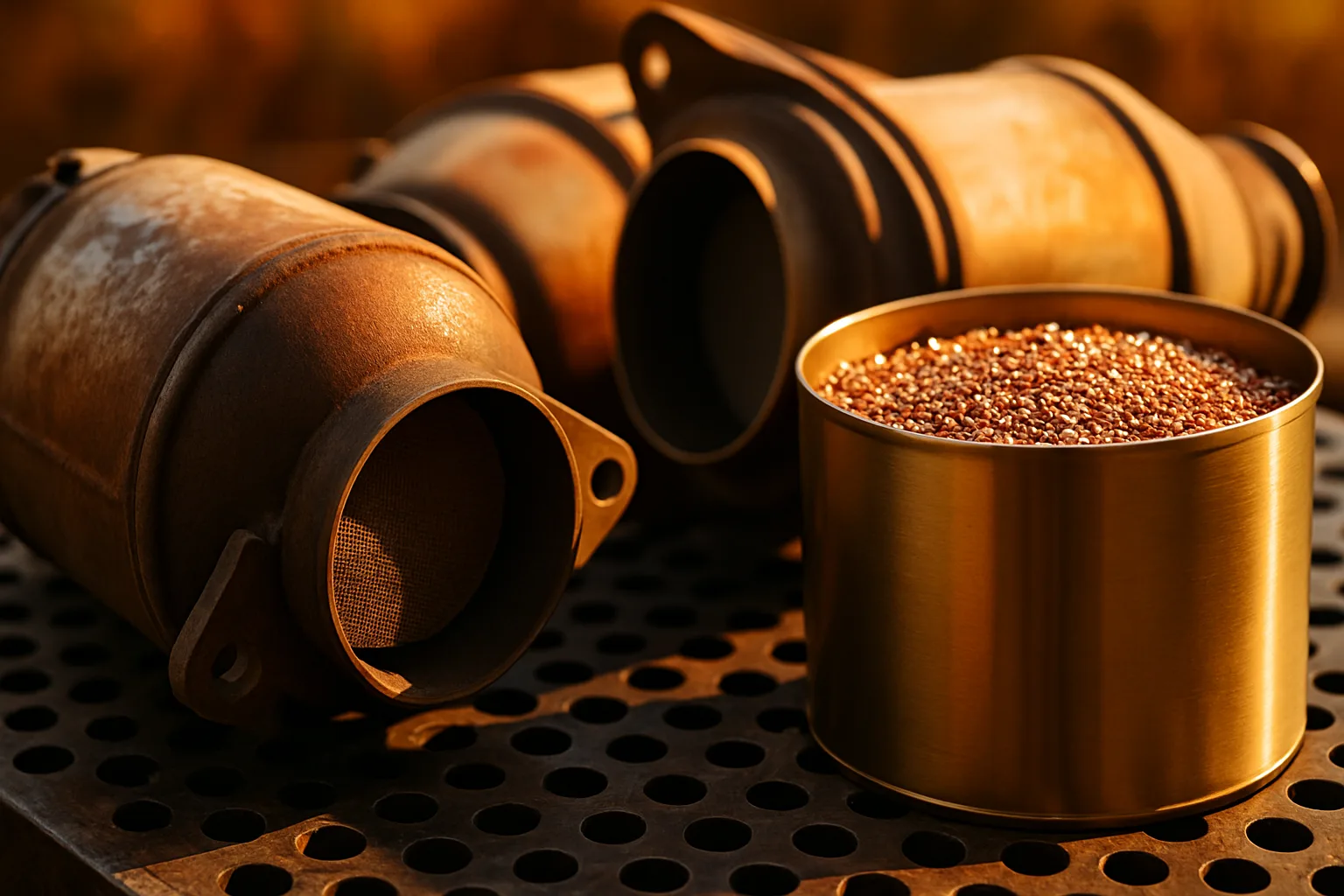
What Actually Happens to a Catalytic Converter After You Sell It?
Most people hand over a catalytic converter and never think about it again. That's fair — you got paid, the transaction's done. But if you're trying to find the best scrap cat prices in Canada, understanding what happens between your hands and the precious metal refinery gives you serious leverage. You'll know what buyers are actually paying for, and you'll stop leaving money on the table.
If you're sitting on a load of cats in Fort McMurray, Alberta — pulled off fleet vehicles, work trucks, or trade-ins — this guide is for you. The lifecycle of a catalytic converter is more valuable than most sellers realize. Let's walk through every stage.
Stage 1: The Converter in the Vehicle — Where the Value Starts
A catalytic converter's job is to reduce harmful exhaust emissions. It sits in your vehicle's exhaust system and uses a ceramic or metallic substrate coated with platinum group metals (PGMs) — specifically platinum, palladium, and rhodium — to convert toxic gases into less harmful compounds. That's the chemistry. The economics are different.
The PGM content in a single converter can range from just a few grams in a small domestic car unit to over 15 grams in a diesel or high-output truck catalyst. Rhodium in particular has traded at extraordinary values in recent years, making even modest-looking converters worth serious attention. The substrate type, the vehicle make and model, and the original equipment manufacturer (OEM) all influence how much PGM loading is inside.
This is why VIN data and serial numbers matter to serious catalytic converter buyers. They're not just inspecting the outside of the unit. They're cross-referencing the converter's identity against assay databases that track actual precious metal content by part number. Platforms like sell your scrap metal on SMASH Recycling help connect sellers with buyers who use that data to make transparent, defensible offers — not guesswork.
Stage 2: Removal and Collection — What Happens at the Yard Level
Once a vehicle reaches end-of-life — whether it's a retired fleet truck from the oil sands, a written-off pickup, or a high-mileage trade — the catalytic converter gets pulled before the vehicle is crushed or shredded. This is standard practice at any legitimate recycling yard. The converter is separated out because it represents a disproportionately high value relative to its size.
In Fort McMurray, the industrial vehicle population is large. Heavy-duty trucks, equipment support vehicles, and diesel-powered fleet units cycle through the region constantly. That means the local supply of catalytic converter scrap metal is substantial — and so is the incentive to find a buyer who prices accurately.
At this stage, condition matters less than identity. A converter that looks beat up on the outside can still carry full PGM value inside. What degrades value is physical damage to the substrate — crushed, rattled-out, or water-damaged interiors that have lost catalyst material. That's why photo documentation and accurate description at the point of collection directly affects the offers you receive later.
Stage 3: Identification and Grading — The Part That Separates the Best Prices From the Average Ones
This is where most sellers get shortchanged, and it's worth slowing down on.
After collection, converters need to be identified. Every unit has a serial number, a part number, or a recognizable shape that links it to known PGM assay data. Buyers use this data to calculate what the metals inside are worth at current spot prices. If you hand a load to a buyer who can't — or won't — identify your units properly, you're pricing by appearance, not by content. That's the old way. It costs you money.
The grading process generally sorts converters into categories:
- Domestic foil converters — lightweight, found in smaller North American vehicles, generally lower PGM content
- Foreign (import) converters — ceramic substrate, higher PGM loading, typically more valuable per unit
- High-value aftermarket and OEM units — often from European or Japanese vehicles, or newer emissions-compliant trucks
- Large diesel and DPF units — diesel particulate filters with significant PGM content
- Small foil and bead units — lower value but still worth proper identification
Getting this grading right requires access to good data. That's where working with a platform built around serial tracking and documented inventory — rather than a single buyer making verbal offers — changes the outcome entirely.
Stage 4: The Auction or Offer Process — Where Competition Drives Price Discovery
Once your converters are identified and documented, they go to market. In the traditional model, that means one phone call to one buyer who gives you a take-it-or-leave-it number. There's no way to know if that number reflects actual market value. You hope it does. You move on.
The smarter model involves competition. When multiple vetted buyers bid on your documented load, the price reflects what the market is actually willing to pay — not what a single buyer is willing to offer. More buyers means better price discovery. That's not a theory; it's basic economics applied to catalytic converter recycling and scrap metal markets.
SMASH operates on exactly this principle. The platform connects sellers with vetted buyers who have access to the same inventory data, the same photos, the same serial numbers. They compete. You get a real price. For yards and collectors in Fort McMurray looking to get a fair price for your scrap catalytic converters in Canada, this kind of competition matters — especially when you're moving volume.
No subscription fees. No guessing. SMASH only wins when the seller wins.
Stage 5: Processing and Precious Metal Recovery — The Final Destination
After purchase, converters move to a processor. This is where the physical converter gets broken down and the substrate is extracted, crushed, and sampled. The resulting powder — called catalyst powder or spent catalyst — is then sent to a smelter or refinery that uses pyrometallurgical or hydrometallurgical processes to recover the platinum, palladium, and rhodium.
The refining step is the most technical and capital-intensive part of the chain. It requires specialized equipment and takes time — which is why settlement periods between buyer and smelter can run several weeks. For you as the original seller, this is important context: the buyer quoting your load is pricing against futures data and their downstream refinery relationship. Understanding that helps you evaluate offers more critically.
The recovered PGMs re-enter the commodity market. They go into new vehicle catalysts, electronics, medical equipment, and jewelry. The cycle closes. What started as exhaust emissions control becomes refined platinum sitting in a refinery account — and the difference between what you received and what it was worth often comes down to how well you documented your load and how many buyers competed for it.
Want to understand how the full process connects to pricing in the Canadian market? Read Canadian scrap catalytic converter guides for practical breakdowns on what drives value at every stage.
How Fort McMurray Sellers Can Get More From Every Load
Alberta's industrial economy creates a steady supply of end-of-life vehicles and converter scrap. But supply doesn't automatically translate to competitive pricing — not without the right process on your end.
Here's what separates sellers who consistently get strong prices from those who settle:
- Document everything before it ships. Photos, serial numbers, unit counts. Buyers pay more for loads they can price accurately. Documented inventory gives buyers more confidence to bid aggressively.
- Don't sell to one buyer by default. If you've been calling the same buyer for years, you don't know if you're getting market value. You know you're getting their value. That's different.
- Understand the units you have. A mix of domestic foils and foreign ceramics should be priced differently. If your buyer treats them all the same, you're losing on the ceramics.
- Use a platform that creates competition. This is the single biggest lever most sellers aren't pulling. Competitive bidding on documented loads is how you find the best scrap cat prices in Canada — not by haggling with one contact.
- Time your sales with market awareness. Palladium and rhodium prices fluctuate. You don't need to be a trader, but knowing when spot prices are elevated relative to recent history gives you a reason to move product or hold briefly.
Fort McMurray sellers who treat their converter inventory like the commodity it is — documented, identified, competitively priced — consistently outperform those who treat it like a nuisance to offload. The infrastructure work you put in before the sale determines the outcome of the sale.
Disclaimer: Precious metal spot prices fluctuate daily. Catalytic converter scrap values are directly tied to platinum, palladium, and rhodium market prices. Always check current rates before committing to a sale. Prices referenced in any guide reflect general market context, not guaranteed offers.
If you're ready to move a load and want real competition on it, visit best-scrap-cat-prices.ca for a free quote — no subscription, no obligation, just a transparent look at what your converters are worth in today's market.
Frequently Asked Questions
Q: How do I find a catalytic converter buyer in Fort McMurray?
You have a few options — local scrap yards, regional buyers, and online platforms that aggregate vetted buyers across Canada. For competitive pricing, platforms that create bidding competition on your documented load consistently outperform single-buyer phone calls. If you're in the Fort McMurray area, SMASH connects you with buyers who price based on actual PGM content, not a visual estimate.
Q: Is catalytic converter recycling legal in Alberta?
Yes. Selling scrap catalytic converters is legal in Alberta when you can demonstrate legal ownership of the units. Most legitimate buyers and platforms require documentation of origin — typically a bill of lading, vehicle title information, or a yard inventory record. If you're pulling converters from vehicles your yard legally owns or processes, you're operating within the rules.
Q: What affects the scrap price of a catalytic converter in Canada?
Three main factors: the current spot prices for platinum, palladium, and rhodium; the specific converter model and its known PGM content; and the condition of the substrate inside the unit. External condition matters far less than internal catalyst integrity. A buyer who can identify your units by serial number will almost always offer more than one pricing by appearance alone.
Q: Are there catalytic converter buyers near me within 8.1 km of Fort McMurray?
Proximity matters less than you might think. Local buyers may be convenient, but the real question is whether they're pricing your load competitively. Online platforms like SMASH allow vetted buyers across Canada to bid on your documented inventory — which often results in stronger offers than whatever's closest to you on a map. Logistics can be arranged; a better price is worth a little extra coordination.
Q: How long does it take to get paid for scrap catalytic converters in Canada?
Payment timelines vary by buyer and platform. Many immediate-purchase transactions settle within a few business days once the load is received and inspected. Toll-refining arrangements — where your converter is processed and you receive a cut of the refined metal value — can take several weeks. For most sellers, a prompt cash-equivalent payment from a vetted buyer through a transparent platform is the most practical path.
Stay sharp on scrap metal market trends and precious metal pricing — follow SMASH on LinkedIn for regular industry updates, market insights, and scrap recycling news across North America.
```