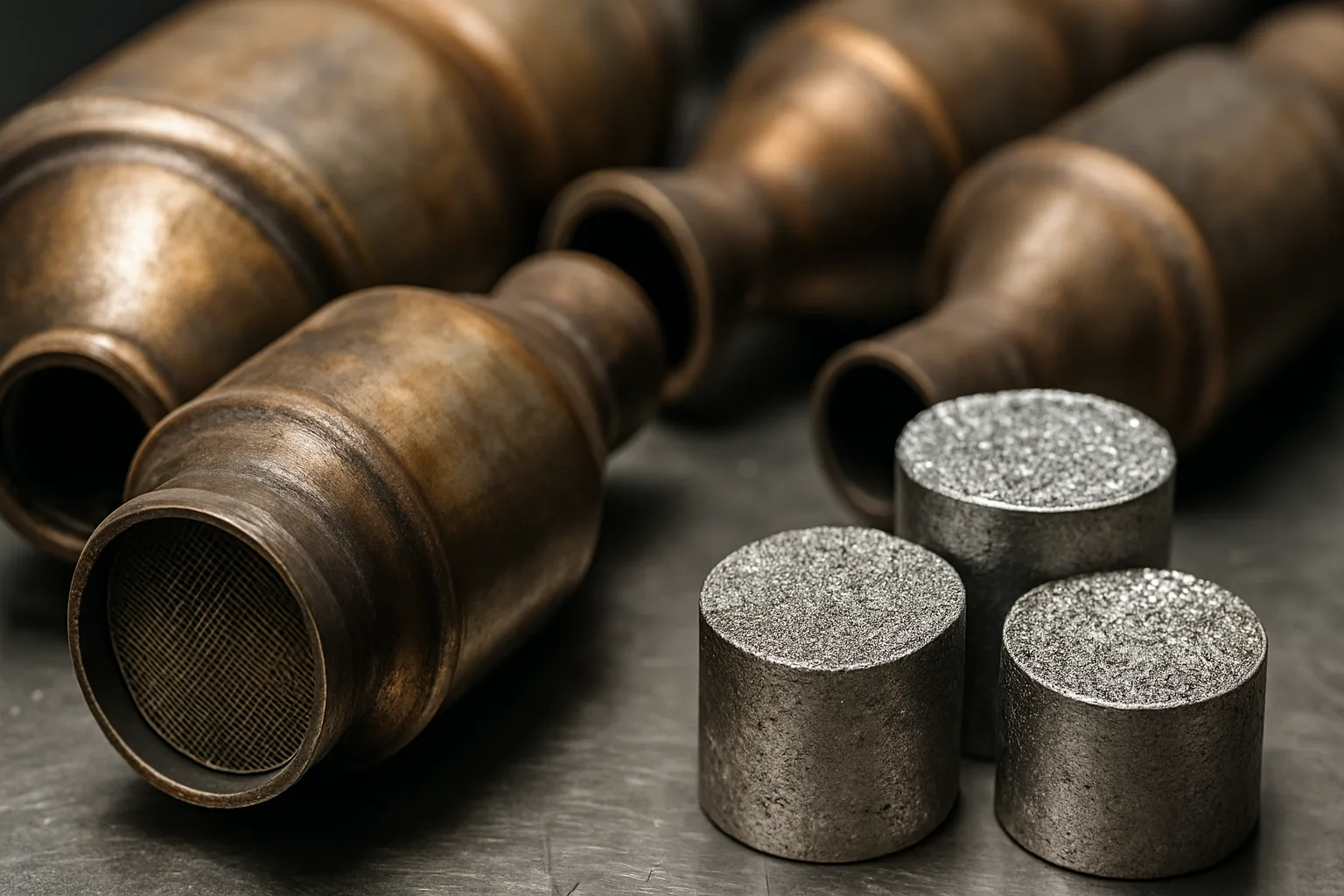
What Actually Drives Catalytic Converter Scrap Prices in 2026
Most people selling scrap catalytic converters focus on the wrong thing. They call around, get a handful of quotes, and take the highest number — without understanding why prices differ so dramatically from one buyer to the next. If you're trying to get the best catalytic converter price in Yorkton, you need to understand what's actually inside your converter and what drives its value.
Three precious metals sit at the heart of every cat price: platinum, palladium, and rhodium. Their concentrations — and the daily spot prices those metals trade at on global commodity markets — determine what your converter is actually worth. Everything else is noise.
Platinum, Palladium, and Rhodium: The Metals That Set Your Price
Catalytic converters work by forcing exhaust gases through a ceramic or metallic substrate coated with precious metals. Those metals act as catalysts — they trigger chemical reactions that break down harmful emissions without being consumed themselves. When the converter reaches end-of-life and gets pulled from the vehicle, the substrate still holds those metals. That's what recyclers are buying.
Each of the three metals plays a specific role:
- Platinum (Pt): Used heavily in diesel converters. Platinum is stable at high temperatures and effective at oxidizing carbon monoxide and hydrocarbons. It typically trades in a wide range and is one of the more stable of the three metals in terms of price volatility.
- Palladium (Pd): The dominant metal in gasoline converters. Palladium hit historic highs in the early 2020s as automakers shifted away from diesel. In 2026, palladium pricing has moderated but still represents a significant portion of converter value in high-volume gasoline cats.
- Rhodium (Rh): The wildcard. Rhodium is found in smaller concentrations but carries the highest price per troy ounce of the three. It's critical for reducing nitrogen oxides (NOx). The rhodium price today can swing dramatically — and a rhodium spike can push cat prices up sharply even when platinum and palladium are flat.
The ratio of these three metals varies by vehicle make, model, engine type, and even model year. A high-content OEM converter from a late-model truck can contain significantly more precious metal than a cheap aftermarket replacement. That's why two converters that look identical on the outside can have very different scrap values.
How Buyers Calculate What Your Cat Is Worth
Legitimate buyers don't guess. They use assay data — either from direct lab sampling or from large proprietary databases that catalog the precious metal content of thousands of converter types. When a buyer looks up your converter by serial number or VIN, they're pulling actual assay data and applying current spot prices to estimate value.
Here's the basic formula:
- Identify the converter — by serial number, appearance, or vehicle VIN.
- Pull the assay profile — how many grams of Pt, Pd, and Rh does this unit typically contain?
- Apply spot prices — multiply the gram weight of each metal by today's market price per gram.
- Apply a recovery percentage — smelters don't recover 100% of the metal. Buyers factor in their processing costs and recovery rates.
- Subtract the buyer's margin — this is where price differences between buyers come from.
Steps 1 through 4 should produce a similar number across buyers working with accurate data. Step 5 is where competition matters. A buyer with no competition has little incentive to reduce their margin. A buyer competing in an auction environment has every incentive to sharpen their offer.
Platforms like the SMASH Recycling auction platform are built around exactly that dynamic. When multiple vetted buyers are bidding on the same load, margins compress and sellers see better price discovery. That's not a promise — it's basic economics.
Why Rhodium Volatility Matters More Than Most Sellers Realize
If you've been selling scrap cats for a few years, you've seen how fast the market can move. Rhodium in particular has a history of extreme price swings. Supply is geographically concentrated — most of the world's rhodium comes from South African platinum group metal (PGM) mines. Any disruption to that supply chain, any shift in emissions regulations, or any surge in EV adoption affecting diesel demand can move the rhodium price sharply.
In practical terms: a load you quote on Monday might be worth more or less by Friday. That's not hypothetical — it's a real risk in scrap metal recycling Canada-wide, and it affects sellers in Yorkton just as much as it affects yards in major metros.
This volatility makes timing and speed important. Getting a quote is one thing. Converting that quote into a closed transaction quickly is another. Slow processes that involve multiple phone calls, mailed samples, and extended back-and-forth expose sellers to spot price movement. Faster, documented, auction-based processes reduce that exposure.
What Sellers in Yorkton Need to Know About Getting Competitive Quotes
Selling scrap cats from Yorkton, Saskatchewan comes with a real challenge: proximity to fewer buyers means less natural competition. If you're relying on one local contact or a single regional buyer, you're likely leaving value on the table — not because the buyer is dishonest, but because there's no competitive pressure on their margin.
The solution isn't to drive your load to a major centre. It's to connect to a buyer network that comes to you — digitally. If you want to find the best scrap cat prices in Canada, the answer isn't more phone calls. It's more buyers bidding on your material at the same time.
When you document your load properly — photos, serial numbers, converter identification — you give remote buyers the confidence to bid aggressively. Poorly documented loads attract lower, risk-adjusted bids. Well-documented loads attract real competition. That documentation process is something reading Canadian scrap catalytic converter guides can walk you through, but the short version is: serial numbers matter, photos matter, and accurate identification matters.
For Yorkton scrap metal services, connecting to a national buyer network changes the equation entirely. You're no longer limited to whoever is within driving distance.
How SMASH Connects Scrap Cat Sellers to the Right Buyers
SMASH operates a vetted buyer network across North America. Sellers list their loads — including cats — through a structured process that captures inventory detail, photos, and documentation. That load then goes in front of multiple buyers simultaneously. Buyers compete. Sellers see real bids based on real data.
There are no subscription fees. SMASH earns when sellers do. That alignment matters — it means the platform has a direct incentive to help sellers get competitive outcomes, not just to collect platform fees regardless of results.
The SMASH scrap metal auction model applies the same competitive logic to catalytic converters that it does to ferrous and non-ferrous loads. Whether you're selling a handful of domestic cats or a large volume of high-content foreign units, the process is the same: document the load, list it, let buyers compete.
If you're trying to sell catalytic converter price-compare across multiple buyers without spending a week on the phone, this is the format that makes that possible. And if you've ever searched sell catalytic converter near me and come up short in a smaller market like Yorkton, a national auction platform solves the geography problem directly.
Seller Tips: Getting the Most Out of Your Cat Load
Before you list or quote any load, a few practical steps will consistently improve your outcomes:
- Don't remove the substrate. Foiled, damaged, or tampered converters lose significant value. Buyers apply steep discounts for compromised units.
- Photograph every unit clearly. Both ends, the serial number area, and any identifying marks. Blurry or incomplete photos lead to conservative bids.
- Know your serial numbers. Many converters have identifiable serials stamped on the body. These let buyers pull accurate assay data rather than guessing.
- Separate your grades. High-content foreign cats, domestic cats, aftermarket cats, and foiled units should be listed separately. Mixing grades benefits buyers, not sellers.
- Move quickly once you have a strong quote. Given rhodium and palladium volatility, locking in a strong offer quickly is usually better than waiting for a potentially higher one later.
None of these steps require specialized equipment or expertise. They just require a bit of discipline and an understanding of what buyers are actually evaluating when they price your load. To get a fair price for your scrap catalytic converters in Canada, preparation is as important as the platform you use.
Saskatchewan sellers — whether you're in Yorkton, Regina, Saskatoon, or anywhere in between — have access to the same national buyer networks as sellers in major metros. The gap isn't geography anymore. It's process.
Precious metal markets move daily. Prices in this article reflect general market dynamics as of July 2026 — always check current spot prices before finalizing any transaction. The best time to get a quote is when your load is documented, identified, and ready to move.
If you want the best Canadian scrap cat prices without relying on a single buyer or guessing at market rates, start at best-scrap-cat-prices.ca for a free quote — and let competition do the work.
Frequently Asked Questions
Q: What determines the best catalytic converter price in Yorkton?
The price is driven by the precious metal content of your converter — specifically platinum, palladium, and rhodium — combined with current commodity spot prices and how many buyers are competing for your load. In a smaller market like Yorkton, connecting to a national buyer network through a platform like SMASH significantly increases your buyer pool and competitive pressure.
Q: How does the rhodium price today affect my scrap cat value?
Rhodium is present in smaller quantities than platinum or palladium, but it trades at a much higher price per troy ounce. Even a small movement in the rhodium spot price can meaningfully change the value of a high-content converter. Always check current spot prices before quoting or accepting an offer on a load.
Q: Can I sell catalytic converters remotely from Saskatchewan without delivering to a buyer in person?
Yes. Properly documented loads — with serial numbers, clear photos, and accurate identification — can be quoted and sold through national platforms without requiring in-person delivery up front. The SMASH auction model is designed for exactly this scenario, connecting Saskatchewan sellers with vetted buyers across North America.
Q: Why do two identical-looking converters sometimes have very different scrap values?
Appearance doesn't determine value — precious metal content does. OEM converters from high-emission-control vehicles often contain significantly more platinum, palladium, and rhodium than aftermarket replacements. The vehicle make, model, engine type, and even production year affect content levels. Accurate identification through serial numbers is the most reliable way to get the right price.
Q: Is there a subscription fee to sell through SMASH?
No. SMASH does not charge subscription fees to sellers. The platform earns when sellers do — meaning there's a direct incentive to help you get competitive offers, not just to process transactions.
Follow SMASH on LinkedIn for industry updates, precious metal market insights, and scrap recycling news across North America.