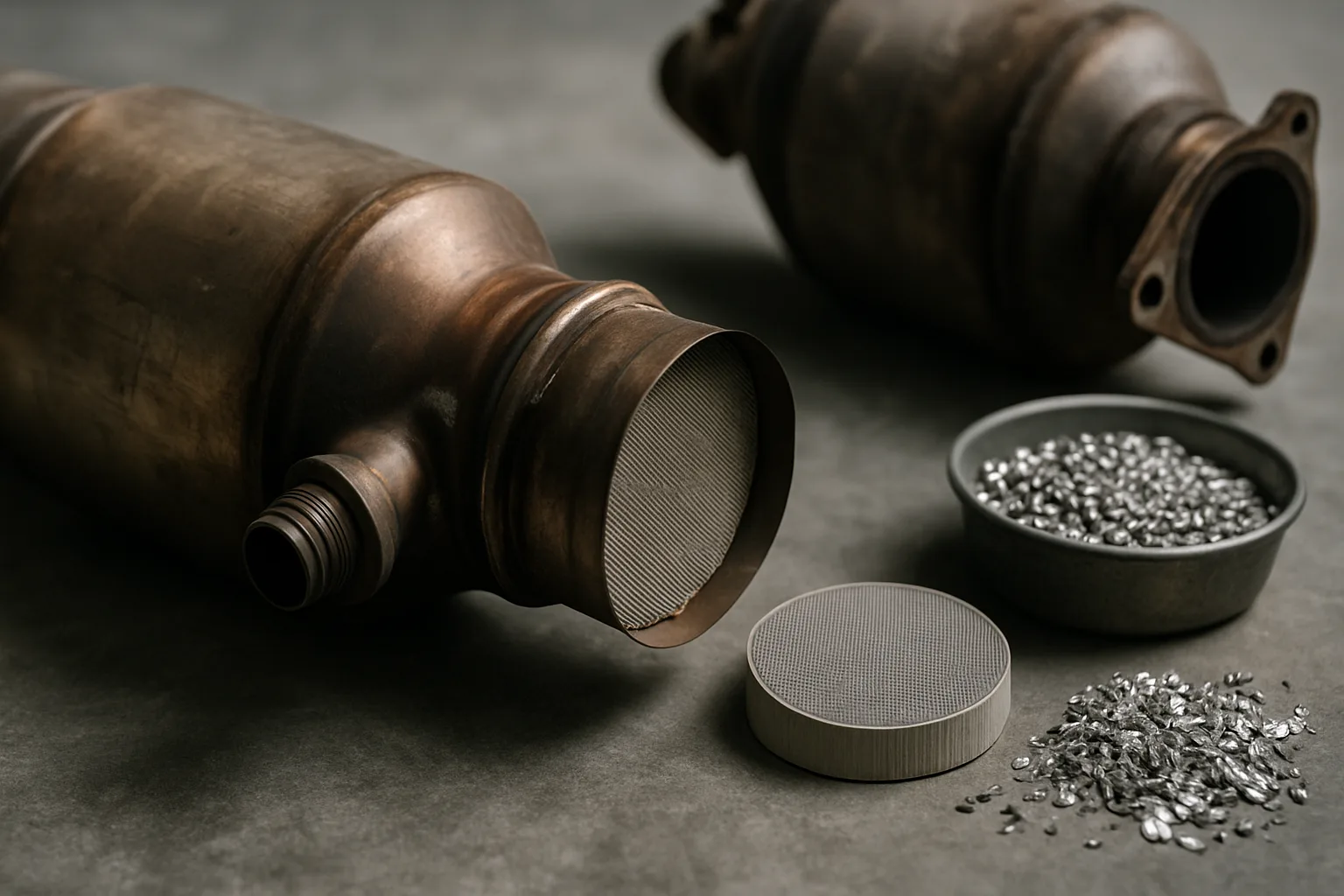
What Actually Happens to a Catalytic Converter After You Scrap It?
Most people pull a cat off an old vehicle, get paid, and never think about it again. But the journey from your yard to finished precious metal is more complex — and more valuable — than most sellers realize. Understanding that journey helps you make smarter decisions about cat converter prices in Kamloops and across British Columbia.
Here's the full lifecycle, step by step. And more importantly: where value gets captured, where it gets lost, and how to make sure you're on the right side of that equation.
Stage 1 — Removal and Initial Assessment of Catalytic Converter Scrap Value
It starts the moment the cat comes off the vehicle. Whether you're pulling it from a fleet vehicle in Kamloops or processing a batch of end-of-life units at a recycling yard, the first assessment determines everything downstream.
At this stage, a buyer or yard is looking at a few key factors:
- Make, model, and year — These determine which catalyst formulation is inside. A 2019 Toyota Tundra cat is a very different commodity than one from a 2008 Chevy Cobalt.
- Physical condition — Is the substrate intact? A cracked or rattling substrate means partial or total loss of precious metal content.
- Serial number or part number — Platforms like SMASH use serial tracking to help identify converters accurately, which directly affects your catalytic converter scrap value.
- OEM vs. aftermarket — OEM converters carry significantly more platinum group metals (PGMs) than aftermarket replacements. Aftermarket cats are often worth a fraction of the price.
This is where most sellers leave money behind. If you don't know what you have, you'll accept whatever number you're given. Knowledge is leverage. Find the best scrap cat prices in Canada by starting with accurate identification, not guesswork.
Stage 2 — How Cats Move Through the Scrap Supply Chain
After removal, converters typically move through one of several channels before reaching a processor. Understanding this chain explains why prices vary so wildly depending on who you sell to.
Here's how the supply chain typically looks:
- Individual seller or small yard — Pulls the cat, sells to a local buyer or broker.
- Broker or aggregator — Buys in volume, resells to a processor or smelter. Takes a margin at each step.
- Primary processor — Crushes, samples, and assays the material. Extracts PGM data for smelter pricing.
- Smelter or refinery — Recovers platinum, palladium, and rhodium through high-temperature processing.
- Precious metal market — Refined PGMs are sold into industrial and investment markets globally.
Every step between you and the smelter is a margin taken by someone else. The more steps in the chain, the less you receive. Selling through a competitive platform like SMASH shortens that chain and creates price competition — which means better price discovery for you.
If you're operating in Kamloops or elsewhere in British Columbia, you want buyers competing for your material — not one local contact who knows you have no other options. Compare scrap metal bids from Canadian buyers before you commit to any single offer.
Stage 3 — Processing and Precious Metal Recovery Explained
This is the technical heart of the lifecycle — and the reason scrap metal recycling in Canada for catalytic converters is fundamentally different from recycling steel or aluminum.
Inside every catalytic converter is a ceramic or metallic substrate coated with a washcoat containing platinum group metals — primarily platinum (Pt), palladium (Pd), and rhodium (Rh). These are the metals that make modern emissions control possible, and they're the reason scrap cats carry the value they do.
Processing happens in two main phases:
Phase A — Decanning and Sampling
The outer steel shell is cut away to expose the substrate (the honeycomb ceramic inside). The substrate is then crushed into a fine powder. A representative sample — typically assayed at an accredited lab — determines the exact PGM content per tonne. This assay result is what drives the final settlement price for large commercial lots.
Phase B — Smelting and Refining
The crushed substrate goes into a smelter where it's processed at extremely high temperatures. PGMs are separated from the ceramic matrix, further refined, and eventually sold as investment-grade metal. Platinum and palladium are widely used in industrial manufacturing, electronics, and jewelry. Rhodium, far rarer, commands some of the highest per-gram prices of any traded metal.
Recycled PGMs from spent catalytic converters now supply a significant portion of global palladium and platinum demand. That's why your scrap cat — even a single unit — represents a real commodity with a real market price behind it.
Stage 4 — What Determines Your Cat Converter Price (And Why Kamloops Sellers Should Care)
By now you understand what's inside a cat and how it gets processed. So what actually determines what you get paid? This is where cat converter buyers near you often diverge significantly in what they offer.
The key pricing variables are:
- Live PGM spot prices — Platinum, palladium, and rhodium trade on global commodity markets. Prices shift daily. A cat worth $180 CAD today might be worth $210 CAD next week if rhodium spikes.
- Converter type and grade — High-grade cats (think: full-size domestic trucks, luxury imports, diesel units) carry more PGM loading than compact car units. A single high-grade converter can be worth multiples of a low-grade one.
- Buyer competition — This is the variable sellers control. One buyer gives you one price. Five buyers competing gives you market price. Platforms focused on competitive bidding exist precisely because of this gap.
- Volume and lot size — Larger lots often attract better per-unit pricing. If you're accumulating cats at a Kamloops yard, batching your inventory before selling can improve your outcome.
- Documentation quality — Buyers pay more confidently when they know exactly what they're buying. Photos, serial numbers, and accurate descriptions reduce buyer risk — and risk reduction translates to better bids.
Want to understand how your current buyers stack up? Get a fair price for your scrap catalytic converters in Canada by putting your inventory in front of multiple vetted buyers at once.
Price disclaimer: PGM-based converter prices fluctuate with global commodity markets. Always check current rates before selling. The figures and ranges discussed in this article are illustrative only.
Stage 5 — How SMASH Changes the Equation for Canadian Cat Sellers
The traditional model for selling scrap cats goes like this: you call the one buyer you know, they give you a number, you take it or leave it. There's no reference point. No competition. No way to know if you're getting fair value.
SMASH flips that. Instead of one phone call to one buyer, your inventory goes in front of multiple vetted buyers in a competitive auction format. Buyers compete. You see real bids. The process is transparent, documented, and built for yards and sellers who want actual market pricing — not whatever someone feels like offering on a Tuesday afternoon.
For sellers in British Columbia, including those running operations in Kamloops, this matters because geography used to limit your options. You sold to whoever was nearby. SMASH connects you to a broader buyer network without you having to manage relationships across the country. The platform handles inventory documentation, buyer vetting, and auto-invoicing — so you focus on running your yard, not chasing paperwork.
No subscription fees. SMASH earns when you earn. That alignment matters. Read Canadian scrap catalytic converter guides to go deeper on pricing strategies, converter identification, and market timing.
If you're evaluating local options, Kamloops scrap metal services are available through the platform — connecting local sellers to buyers who are actively competing for quality inventory.
The Takeaway: Every Stage Is a Pricing Decision
The lifecycle of a catalytic converter is a chain of value decisions. At every stage — identification, supply chain routing, processor selection, buyer competition — there's an opportunity to capture more of the value that's already locked inside your material.
Most sellers leave money behind not because the market is unfair, but because they're operating with one buyer, no data, and no leverage. Fix those three things and you're already ahead of most sellers in the market.
The PGMs inside your cats are real commodities. Treat them like it. If you're ready to stop guessing and start getting competitive bids on your converter inventory, find the best Canadian scrap cat prices and get a free quote at best-scrap-cat-prices.ca.
Frequently Asked Questions
Q: What are the most valuable catalytic converters to scrap in Kamloops?
Full-size domestic trucks, luxury vehicles, and diesel-powered equipment typically carry the highest PGM loading and command the best scrap prices. OEM converters from these vehicles consistently outperform aftermarket units. If you're not sure what you have, serial tracking tools can help you identify converter grade before you sell.
Q: How do I find reliable cat converter buyers near me in Kamloops or British Columbia?
Start by identifying vetted buyers who specialize in PGM recovery — not general scrap yards that price cats as a secondary commodity. Platforms like SMASH connect sellers across British Columbia with buyers who actively compete for converter inventory, which typically produces better price discovery than a single local contact.
Q: Why do catalytic converter scrap prices change so often?
Converter prices are directly tied to live platinum, palladium, and rhodium spot prices, which fluctuate with global supply, industrial demand, and currency movements. A converter worth a certain price today may be worth more or less next week. Always check current PGM rates before committing to a sale, and never accept a price that was quoted more than a few days ago without confirmation.
Q: Does the condition of a catalytic converter affect its scrap value?
Yes — significantly. A substrate that's cracked, contaminated with coolant, or partially destroyed through overheating will return less precious metal during processing. Buyers factor condition into their bids. That said, even damaged converters often have recoverable value, so don't discard them without getting a quote first.
Q: What's the difference between OEM and aftermarket catalytic converters for scrap value?
OEM (original equipment manufacturer) converters are engineered to meet strict emissions standards and contain higher concentrations of platinum group metals. Aftermarket units are built to a lower cost threshold and contain significantly less PGM loading — sometimes as little as 10–20% of an equivalent OEM unit. If you're selling a mixed lot, proper identification of OEM versus aftermarket units is essential to getting an accurate quote.
Stay current on scrap metal market moves and PGM trends — follow SMASH on LinkedIn for industry updates that actually matter to Canadian recyclers.
```