Why Palladium Prices in Tokyo Affect What You Get Paid in Sydney, Nova Scotia
Most scrap yards in Cape Breton quote you a number without explaining it. That number didn't come from thin air — it came from commodity exchanges in London, New York, and Zurich, filtered through a refiner's margin, then handed to you as a take-it-or-leave-it price. If you want to find the best scrap cat prices in Canada, you need to understand what's actually driving that number before you accept it.
The catalytic converter scrap value you're quoted today is a direct function of three precious metals: platinum, palladium, and rhodium. These aren't niche commodities. They trade globally, around the clock, and they move fast. A policy shift from the EU on vehicle emissions standards or a mine disruption in South Africa can swing your payout by hundreds of dollars — on the same physical unit — within weeks.
This article breaks down how global precious metal markets work, why they matter to every seller from Sydney to Surrey, and how to make sure market movement works in your favour instead of against you.
The Three Metals That Determine Your Catalytic Converter Scrap Value
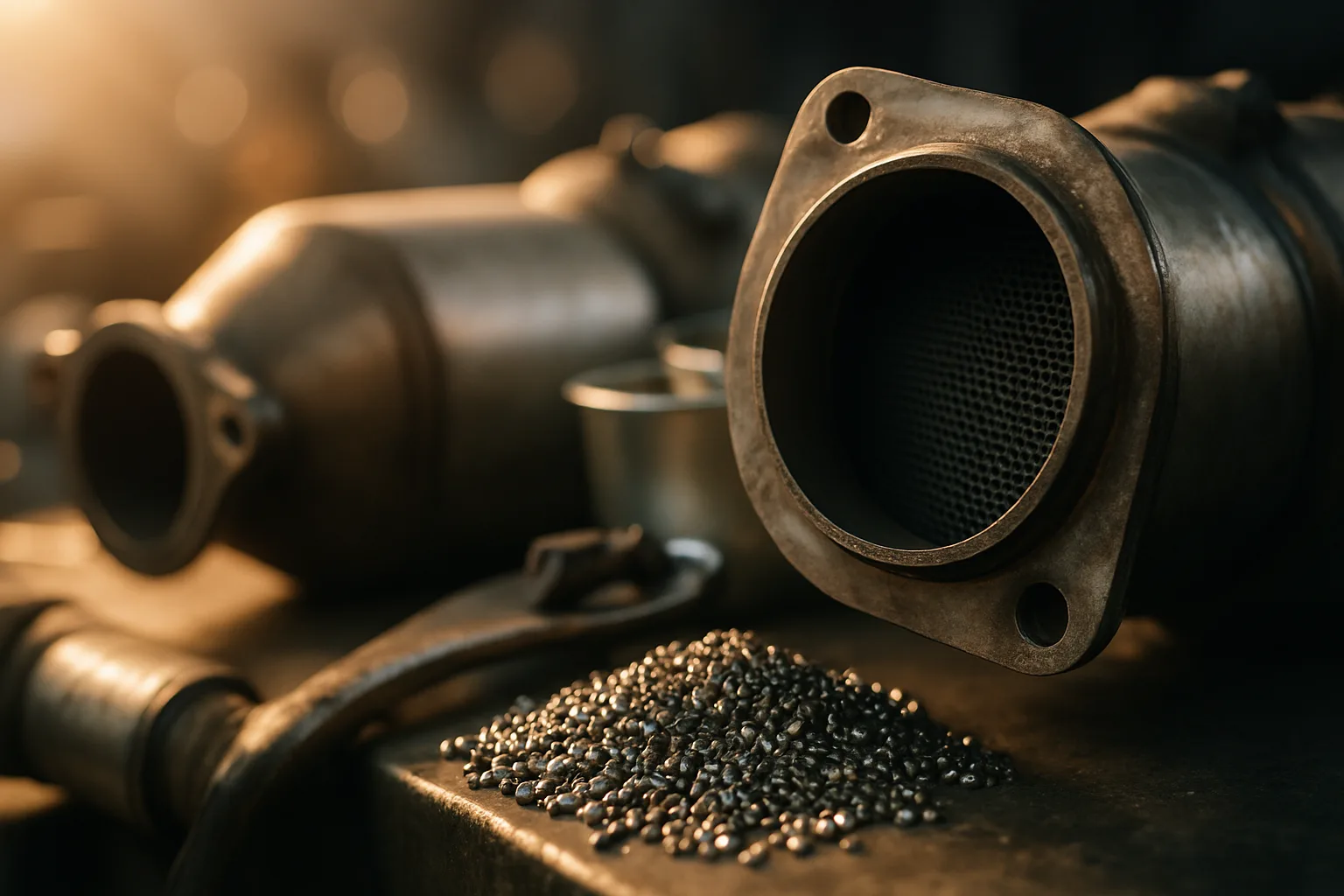
Inside every catalytic converter is a ceramic or metallic substrate coated with a precise mix of platinum group metals (PGMs). These metals catalyze the chemical reaction that converts exhaust gases into less harmful emissions. The amount and mix varies by vehicle make, model, engine size, and model year — which is exactly why two converters sitting side by side can have wildly different scrap values.
Here's a simplified breakdown of each metal's role:
- Palladium: Dominant in gasoline-engine converters. Historically the most price-volatile of the three. Palladium saw dramatic price swings in the early 2020s and remains heavily influenced by Russian supply (Russia produces roughly 40% of global palladium). Any geopolitical friction affecting Russian exports sends palladium markets into motion.
- Platinum: More common in diesel-engine converters. Platinum is mined primarily in South Africa. Labour actions, power outages at South African mines, and shifts in diesel vehicle adoption all affect platinum supply and pricing.
- Rhodium: Found in smaller quantities but extraordinarily concentrated in value. Rhodium prices have historically spiked to levels that make it the most valuable of the three on a per-gram basis. Supply is extremely limited, and demand from automakers keeps it volatile.
Understanding which metal is dominant in the converters you're holding gives you a real advantage. A load heavy with catalytic converters from older North American V8 trucks likely carries a different PGM profile than a batch pulled from compact imports. Read Canadian scrap catalytic converter guides to learn how to identify high-value units before you sell.
How the Palladium Price Today Flows Downstream to Your Yard
When traders talk about the palladium price today, they're referencing spot prices set on exchanges like the London Platinum and Palladium Market (LPPM) or the NYMEX futures market in New York. These prices update in real time during trading hours. Refiners who process scrap converters buy at spot-referenced rates, apply their assay and processing margin, and then build that into the prices they offer buyers and consolidators.
That process has a lag — and that lag is where sellers often lose. If palladium moved up significantly over the past two weeks but your local buyer is still quoting based on older internal benchmarks, you're leaving money on the table. Buyers working on thin margins have every incentive to be slow updating their buy prices upward and fast updating them downward.
This is exactly why competition matters. When you put your converters in front of multiple vetted buyers simultaneously — rather than calling one yard and accepting their number — you force the market to come to you. Platforms like SMASH Recycling — where verified buyers bid on your metal are built precisely for this. Instead of you chasing one buyer's quoted price, buyers compete. That competition reflects current market pricing more accurately than a single cold call ever will.
Global Demand Shifts: EVs, Emissions Rules, and What They Mean for Scrap Cat Prices Canada
The long-term trajectory of catalytic converter scrap value is shaped by one unavoidable reality: the global vehicle fleet is electrifying. EVs don't use catalytic converters. As EV penetration grows, the future supply of scrap converters — already a finite resource — shrinks. That's a structural market dynamic every seller should understand, because it affects both short-term pricing and long-term strategy.
But here's the counterpoint: the transition is slower than headlines suggest. In 2026, the vast majority of vehicles on Canadian roads — including in Nova Scotia — are still internal combustion. Fleet turnover takes decades. The backlog of older ICE vehicles reaching end-of-life continues to feed the scrap converter market. Meanwhile, stricter emissions regulations in Europe and Asia are actually increasing the PGM loading per converter in newer vehicles, meaning the converters coming off today's cars are often richer in precious metals than those from a decade ago.
What this means for sellers right now:
- Newer converters (from 2018 and later vehicles) often carry higher PGM content and command stronger prices.
- Hybrid vehicles use converters too — and in some cases, high-value ones.
- The secondary market for PGMs remains robust. Recycled metal from scrap converters supplies a meaningful share of global PGM demand.
- Demand from industrial applications (fuel cells, electronics, chemical processing) adds a non-automotive floor under PGM prices.
For yards and individual sellers in Sydney, Nova Scotia and across the Maritimes, this means the window for strong catalytic converter scrap value remains open — but the market rewards sellers who are informed and move strategically, not those who sell into one buyer's back pocket.
What Sellers in Sydney and Across Nova Scotia Need to Watch
If you're holding scrap converters in Sydney or anywhere across Nova Scotia, a few practical indicators are worth monitoring before you sell:
- PGM spot prices: Check palladium, platinum, and rhodium spot prices before any significant sale. Free resources and commodity tracking sites update these daily. A week of rising palladium can meaningfully change your payout.
- Buyer appetite in the region: Buyer activity in Atlantic Canada fluctuates. Consolidators sourcing for refiners may be more aggressive in certain windows — often tied to refinery throughput schedules and metal demand cycles.
- Unit identification: Know what you have before you quote. VIN-based lookup tools and serial number tracking (features built into platforms like SMASH) allow you to document and identify converter types accurately, which gives buyers more confidence and can tighten bid spreads.
- Volume timing: Selling a larger, well-documented load versus dribbling out units individually often produces better per-unit returns. Buyers price risk. A documented, photo-verified load of 50 converters carries less uncertainty than an unlabelled bag of five.
The old way — phone one buyer, take the number, move on — works against you in a volatile market. The smarter play is to get a fair price for your scrap catalytic converters in Canada by putting your load in front of multiple buyers at once. That's how price discovery actually works.
How to Sell Scrap Catalytic Converters Online With Real Market Leverage
The ability to sell scrap metal online has fundamentally changed the economics of the scrap converter market for individual sellers and smaller yards. A decade ago, geography was destiny. If you were in Cape Breton, your options were limited to whoever was physically accessible. Today, a verified online platform connects you to buyers across the country — buyers who are actively competing for inventory.
SMASH is built for exactly this. No subscription fees. No lock-in. Vetted buyers. Auction format that creates genuine competition. Auto-invoicing and documentation tools that make the transaction clean and auditable. For sellers managing multiple loads — or yards tracking converter inventory across VINs and serials — the inventory and photo documentation tools reduce disputes and increase buyer confidence.
For context: the catalytic converter scrap price in Ontario, British Columbia, or Nova Scotia shouldn't be dramatically different if buyers are genuinely competing for your metal at current market rates. Regional pricing gaps often persist because sellers aren't putting their loads in front of a wide enough buyer pool. Online platforms close that gap.
Documentation matters more than most sellers realize. A converter with a confirmed VIN, clear photos, and accurate weight commands more buyer attention than an unverified unit. Buyers price uncertainty — meaning more documentation usually means tighter, more competitive bids. That's not theory. That's how auctions work.
If you're ready to stop guessing and start selling with the market behind you, it's worth exploring what competitive bidding actually returns on your next load. Find the best Canadian scrap cat prices and see where the market sits right now — get a free quote at best-scrap-cat-prices.ca.
Frequently Asked Questions
Q: What makes catalytic converter scrap value go up or down?
Catalytic converter scrap value is tied directly to the spot prices of platinum, palladium, and rhodium — the precious metals inside the converter substrate. When these metals rise on global commodity markets, scrap converter payouts typically follow. Geopolitical events, mine supply disruptions, and shifts in automotive emissions regulations all influence PGM prices. The specific metals and quantities in a converter also vary by vehicle, so not all converters move equally.
Q: Where can I check the palladium price today before selling my converters?
Palladium spot prices are publicly available on commodity tracking platforms and financial market sites updated during trading hours. Checking the price before a significant sale gives you a baseline to evaluate whether a buyer's quote is tracking the current market. If a buyer's offer feels low relative to recent price movement, that's a signal to get competing bids — which platforms like SMASH make straightforward.
Q: Is it worth selling catalytic converters online if I'm based in Sydney, Nova Scotia?
Yes. Online platforms connect you to buyers across Canada, removing the geographic limitation of selling only to local yards. For sellers in Sydney and across Nova Scotia, this means access to a wider buyer pool and genuine price competition — rather than a single take-it-or-leave-it quote. Well-documented loads with photos and accurate unit identification tend to attract stronger bids regardless of where you're located.
Q: How does the catalytic converter scrap price in Ontario compare to Nova Scotia?
Regional price differences exist but should narrow when sellers access competitive buyer pools. Historically, larger markets like Ontario had more active buyer competition, which could produce better per-unit pricing. Online auction platforms help level this playing field by connecting sellers in Atlantic Canada with buyers from across the country who are bidding in real time on current PGM market values.
Q: Do newer catalytic converters have higher scrap value than older ones?
Generally, yes — though it depends on the vehicle. Stricter emissions regulations have pushed automakers to increase PGM loadings in converters on vehicles produced from the mid-2010s onward. Converters from certain hybrid vehicles and larger-displacement engines often carry particularly strong PGM content. Identifying what you have before selling — using VIN lookup or serial tracking tools — helps ensure you're not underselling high-value units.
Follow SMASH on LinkedIn for ongoing scrap metal market updates, PGM price commentary, and industry news relevant to yards and sellers across North America.
Disclaimer: Precious metal prices and catalytic converter scrap values fluctuate daily based on global market conditions. All pricing referenced in this article is general in nature. Always check current rates before selling.