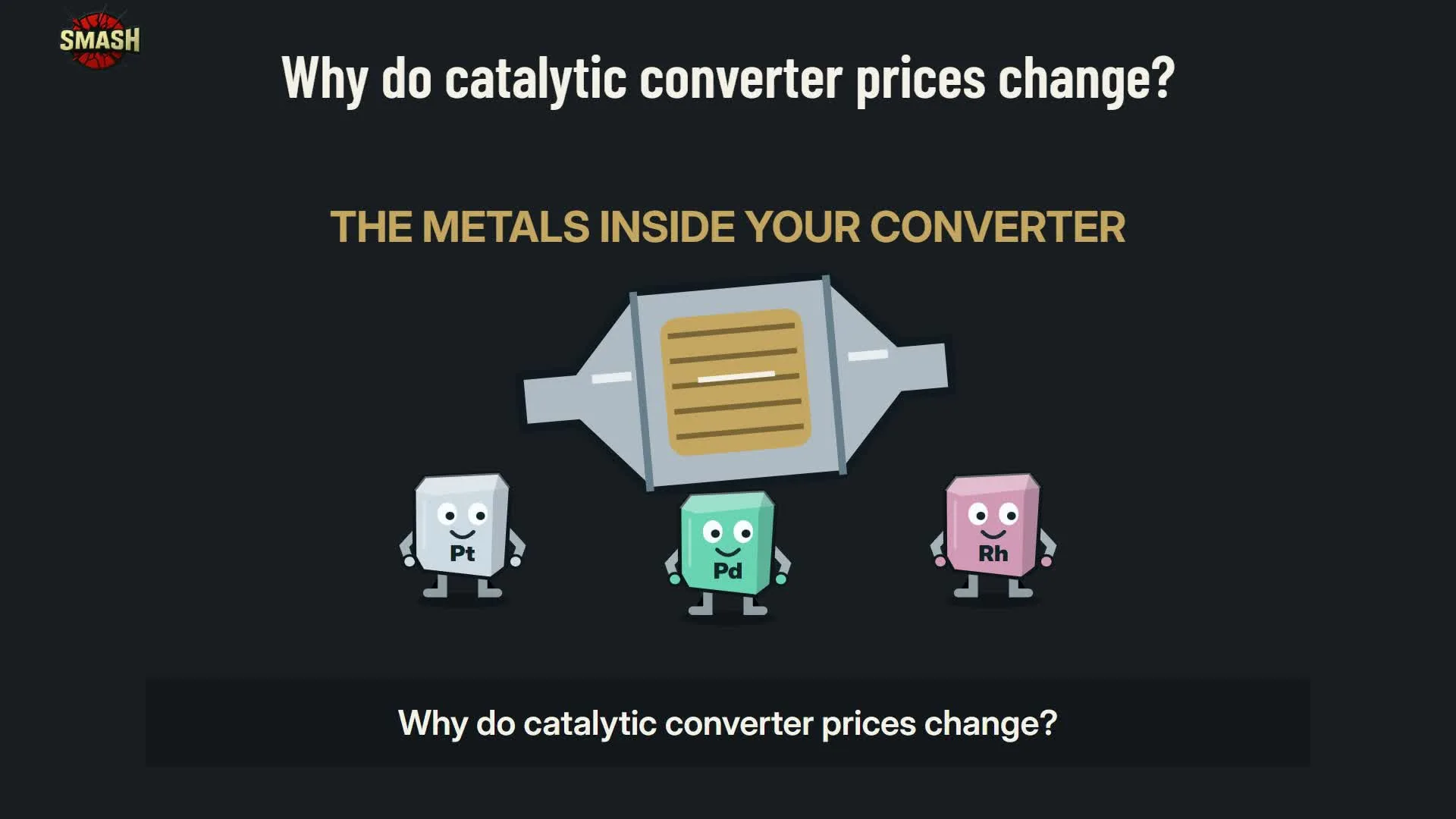
Catalytic converter prices change as the markets for platinum, palladium and rhodium move. These three metals are a starting point—not a complete price for every converter.
Pt — Platinum · Pd — Palladium · Rh — Rhodium
These platinum group metals (PGMs) help catalytic converters treat engine exhaust. They share a job, but each has its own demand, supply and price. A move in one metal does not tell the whole story for your unit.
Video transcript
Why do catalytic converter prices change? Meet the three metals behind much of a converter’s value.
Platinum, palladium, and rhodium help catalytic converters clean exhaust. But each metal has its own market.
Vehicle demand matters. Gasoline cars and hybrids still use exhaust catalysts. Battery-only cars have no tailpipe catalyst.
Supply matters too. Mine output and recycled converters both feed the market. More recovered metal can change the balance.
Investment flows can shift platinum demand. And automakers can change the platinum and palladium mix in new catalyst designs.
For Canadian sellers, exchange rates affect the Canadian-dollar value. Your converter's metal content and condition matter too.
So a market headline is only part of your quote. Photograph the converter and its markings. Request a current quote at Best Scrap Cat Prices dot C A.
Cars change demand
Gasoline vehicles and hybrids still need exhaust treatment. A battery-only vehicle has no engine exhaust, so it does not need a tailpipe catalytic converter. That makes the mix of vehicles being built important—not just the total number of cars sold. Battery-only vehicle basics, while Johnson Matthey's May 14 outlook explains why hybrids that recharge from an external power supply and range-extended vehicles still use PGM catalysts.
Mine supply and recycling both matter
Newly mined metal is only part of supply. Metal recovered from used converters returns to the market too. Higher prices can encourage stored scrap to move through collection and processing.
Recent producer news also needs context. In its October 23 production report, Valterra said third-quarter output of PGM metal contained in concentrate was lower than a year earlier. Its larger fall in refined output mainly reflected maintenance timing, and year-to-date refined output was broadly unchanged. One quarterly headline is not a measure of the entire market.
Investment flows can change the balance
Platinum is used outside cars and is also held by investors. Buying and selling by those investors can change the amount of metal available.
The World Platinum Investment Council's September 9 report changed its platinum outlook from a deficit to a surplus, largely because of a lower investment-demand forecast. It also expected platinum recycling to grow. Those are dated forecasts, not completed full-year results or a promise about the next price move.
The three metals can take different paths
Johnson Matthey's May outlook anticipated possible small surpluses in palladium and rhodium as recycling recovered and gasoline-vehicle demand softened. Its platinum outlook differed from the later WPIC forecast. Read the metal, date and assumptions before treating any forecast as the answer.
The Canadian dollar adds another moving part
International PGM benchmarks are commonly quoted in USD. These market benchmarks are not Canadian CAD converter offers. Canadian offers are quoted in CAD for the actual unit. A Canadian-dollar comparison also depends on the exchange rate. With the USD metal value held constant, a weaker Canadian dollar raises its Canadian-dollar equivalent; a stronger Canadian dollar lowers it. This is a currency conversion relationship, not a guaranteed change in a buyer's offer. Bank of Canada rates show Canadian dollars per unit of foreign currency.
Your converter still needs its own quote
A market price per ounce does not tell a buyer how much recoverable metal is in your converter. The type, metal content and condition matter. Two similar-looking units can contain different amounts or mixes of these metals.
Start with clear photos of your whole converter and any readable markings. Add the vehicle make if known and your Canadian postal code.
Request a current converter quoteSources checked November 4, 2026. Market forecasts can change. The cartoon is an original illustration with synthetic narration; it does not depict actual inventory or a real transaction.
Music: Carefree — Kevin MacLeod (incompetech.com), licensed CC BY 4.0. Edited excerpt, lowered beneath narration, with fades.