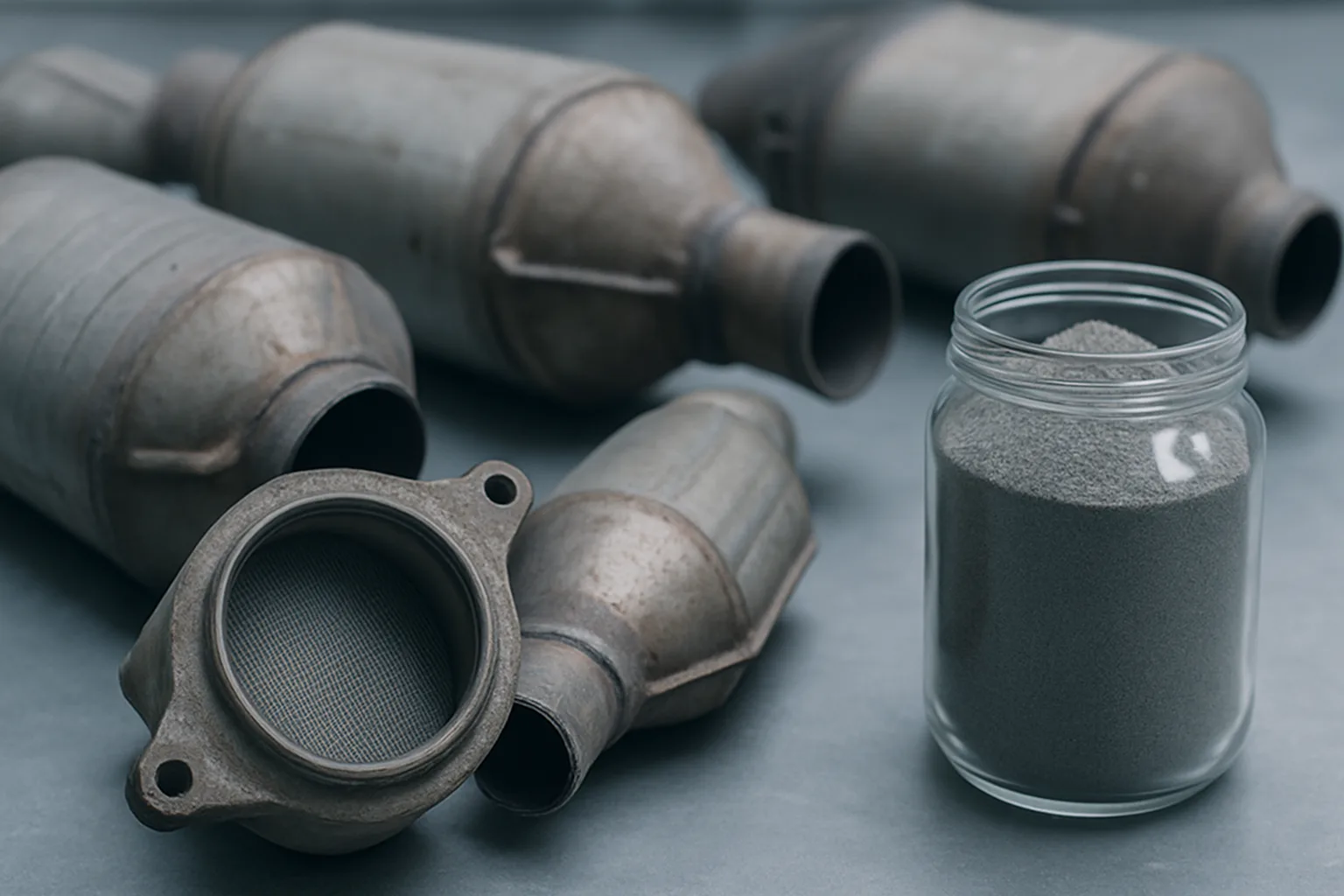
Rhodium Costs More Than Gold — Here's Why That Changes Everything for Your Scrap Cats
Most sellers focus on the platinum price today when they're trying to figure out what their scrap catalytic converters are worth. That's understandable — platinum gets the headlines. But if you're ignoring rhodium, you're leaving serious money on the table. Rhodium regularly trades at multiples of platinum's price, and a single gram hiding in your converter can swing your payout dramatically. Understanding why rhodium commands such a premium is the first step to getting a fair return on every load you move.
This isn't just chemistry trivia. The precious metal breakdown inside a catalytic converter determines its real-world value. Buyers know this. The question is whether you do too.
What Makes Rhodium So Valuable in a Catalytic Converter?
Every three-way catalytic converter contains a wash-coated ceramic or metallic substrate loaded with platinum group metals (PGMs): platinum, palladium, and rhodium. Each one does a different job. Platinum and palladium handle oxidation reactions — converting carbon monoxide and unburned hydrocarbons into CO₂ and water. Rhodium does something neither of them can do well on its own: it reduces nitrogen oxides (NOx) back into harmless nitrogen and oxygen.
That NOx reduction function is not optional. Emission regulations across North America and globally have tightened year over year. Automakers cannot meet those standards without rhodium. There is no cost-effective substitute that performs the same chemistry at the same efficiency. That hard industrial dependency is precisely what drives the price — and it's why rhodium has historically commanded a premium that dwarfs the other PGMs.
Here's the catch: rhodium is extraordinarily rare. It's produced almost exclusively as a byproduct of platinum and palladium mining in South Africa and Russia. Global annual production is measured in low single-digit tonnes. When automotive production ramps up or emissions standards tighten, demand spikes and supply simply cannot follow. That supply-demand imbalance has pushed rhodium to some of the highest per-ounce prices ever recorded for any industrial metal.
How Rhodium Content Affects Scrap Cat Prices in Canada
When a licensed processor assays your scrap catalytic converters, they're measuring exactly how many grams of platinum, palladium, and rhodium are recoverable from the substrate. Rhodium concentration varies widely by vehicle make, model, and converter generation. Some older domestic converters carry very little. High-output vehicles, late-model imports, and certain European platforms can carry substantially more rhodium relative to their overall size.
This is why a two-pound converter from one vehicle might pay out at a completely different rate than a two-pound converter from another. The weight alone tells you almost nothing. The PGM content — especially the rhodium percentage — tells you everything. A buyer quoting flat rates per unit without referencing PGM content is either guessing or pricing conservatively to protect their own margin.
If you're selling cats in Etobicoke or anywhere across Ontario, you want a buyer who's pricing based on actual assay data and live precious metal market rates, not a price sheet that was printed six months ago. The difference between a lazy flat rate and a proper PGM-based offer can be significant, especially on larger loads.
- Platinum: Handles oxidation; widely traded with liquid market pricing
- Palladium: Dominant in gasoline engines; highly price-volatile
- Rhodium: Handles NOx reduction; rarest, least substitutable, highest price ceiling
Platinum Price Today vs. Rhodium — Why Watching Only One Number Misleads You
Checking the platinum price today is a reasonable starting point. It gives you a directional sense of PGM market conditions. But platinum and rhodium do not move in lockstep. They respond to different supply chains, different end-use demand curves, and different mining dynamics. Rhodium can spike sharply when automotive production accelerates, even if platinum trades sideways. Palladium can drop while rhodium holds firm.
Experienced cat recyclers in Ontario track all three prices independently. If you're only watching platinum, you might misread the market on a load that's actually rhodium-heavy. A converter that looks unremarkable based on platinum values alone can carry a rhodium component that significantly changes the math.
The practical takeaway: when you're evaluating what your scrap cats are worth, you need a buyer or platform that accounts for all three PGMs at current market rates — not a simplified flat-rate structure that buries the rhodium value inside a rounded number. Platforms like SMASH Recycling — where verified buyers bid on your metal bring transparent, competitive pricing to exactly this problem. When multiple vetted buyers compete on your load, the rhodium value doesn't disappear into someone else's margin.
Why Competitive Auctions Reveal the Real Value of Rhodium-Rich Loads
Here's the problem with the single-buyer, one-phone-call model: the buyer already knows the rhodium content is valuable. You might not. That information gap is where margin gets extracted — from your pocket into theirs.
A catalytic converter auction format changes that dynamic. When multiple vetted buyers compete for the same load, they're each bidding based on their own assay capabilities and PGM market positions. The competition surfaces what the metal is actually worth in the current market. No single buyer gets to quietly absorb rhodium value you didn't know to ask for.
This matters more than ever in 2026, with PGM markets responding to shifting EV adoption curves, changing emissions legislation, and ongoing supply chain pressures in South African mining. The market is not static. A competitive auction run against live pricing reflects today's reality, not last quarter's assumptions.
For sellers in Etobicoke, Ontario, or anywhere else across Canada, the question is simple: are you getting a price based on what your cats are worth today, or a price based on what was convenient for the buyer to offer? To get a fair price for your scrap catalytic converters in Canada, you need buyers competing against each other — not a single offer with nowhere to push back.
What Sellers in Etobicoke and Across Ontario Should Know Before They Sell
If you're moving scrap cats in Etobicoke, the Toronto-area market is active. There are buyers, processors, and middlemen all operating in the same space. That activity is good — it means there's demand. But demand doesn't automatically mean transparency. Some buyers in high-volume markets get comfortable offering rates that reflect their preferred margin rather than actual PGM values.
Before you sell any load of catalytic converters in Ontario, run through this basic checklist:
- Know what you have. If you can identify the vehicle make, model, and year for your converters, do it. VIN-based lookup tools can help connect converter type to approximate PGM content ranges.
- Document everything. Photograph your cats before they leave your yard. Serial numbers, condition, and quantity matter. Good photo documentation also helps buyers price with confidence, which can improve offers.
- Track the platinum price today — and rhodium. Check current spot prices before any conversation with a buyer. You don't need to be an analyst. You just need to know the direction of the market.
- Get multiple offers. One offer is not a market. It's one opinion. Competition is how you discover real value.
- Work with vetted buyers. In Ontario and across Canada, not every buyer operates the same way. Vetted, accountable buyers who operate within a transparent platform give you recourse if something doesn't add up.
SMASH operates with exactly this model. Vetted buyers, documented inventory, competitive bidding. No subscription fees — SMASH only wins when the seller wins. If you want to find the best scrap cat prices in Canada, that structure matters.
The Long View: Rhodium, Emissions Regs, and Where Scrap Cat Values Are Heading
Rhodium's value is structurally tied to combustion engine regulation. As long as internal combustion engines are manufactured and emissions standards remain strict — which they are, globally, in 2026 — rhodium demand stays firm. The transition to electric vehicles is real and ongoing, but the existing fleet of combustion vehicles represents years of future scrap cat supply. Those vehicles will continue moving through the recycling stream for decades.
What this means for sellers: the scrap catalytic converter market is not going away. The PGM values locked inside those substrates remain real and recoverable. The sellers who learn to extract full value from that material — by understanding rhodium's role, tracking current PGM prices, and accessing competitive buyer markets — will consistently outperform those who rely on the first offer they get.
If you want to read Canadian scrap catalytic converter guides that break down exactly how to maximize your return load by load, the resources are there. The knowledge gap between a casual seller and an informed one is smaller than most people think — and the payout difference on a good load of rhodium-heavy cats can be significant.
Whether you're in Etobicoke, Calgary, or anywhere across the country, the process is the same: know your metal, document your inventory, and access real competition. That's how you stop guessing and start getting paid what your cats are actually worth. Get a free quote at best-scrap-cat-prices.ca and find out what competitive pricing actually looks like for your load.
Frequently Asked Questions
Q: How does the platinum price today affect what I get paid for my scrap catalytic converters?
Platinum is one of three precious metals recovered from converter substrates, alongside palladium and rhodium. Buyers use live spot prices for all three to calculate offers. A rising platinum price generally improves payouts on platinum-heavy converters, but rhodium movements can have an even larger impact depending on your specific converter types. Always check all three PGM prices before accepting an offer.
Q: Why is rhodium worth more than platinum or palladium?
Rhodium performs a unique chemical function — reducing nitrogen oxides — that neither platinum nor palladium can replicate efficiently. Global annual production is extremely low, measured in just a few tonnes per year, primarily from South African and Russian mines. That combination of irreplaceable function and limited supply creates sustained pricing pressure that regularly puts rhodium above both platinum and palladium per ounce.
Q: Where can I find a reliable catalytic converter buyer in Etobicoke or Ontario?
The best approach is to work with a platform that connects you to multiple vetted buyers simultaneously rather than a single local contact. This gives you competitive offers based on actual PGM content and current market rates. Sellers in Etobicoke and across Ontario can access transparent pricing through best-scrap-cat-prices.ca, where competitive bidding replaces the single-call guessing game.
Q: How does a catalytic converter auction work for sellers?
In a catalytic converter auction format, your documented inventory — photos, serial numbers, converter types — is presented to multiple vetted buyers who submit competing bids. The competition surfaces the market rate for your specific material rather than locking you into one buyer's preferred margin. SMASH uses this model to ensure sellers benefit from genuine price discovery rather than a single take-it-or-leave-it offer.
Q: Do scrap cat prices in Canada differ from catalytic converter pricing in other markets?
PGM spot prices are set globally, so the underlying metal values are consistent internationally. However, local buyer competition, transportation costs, processing fees, and currency exchange all affect net payout. Canadian sellers benefit from accessing buyers who operate in the Canadian market with CAD pricing and local logistics, rather than routing material through cross-border channels that can erode margins.
Disclaimer: Precious metal prices including platinum, palladium, and rhodium fluctuate daily based on global market conditions. All pricing information in this article is general in nature. Always verify current spot prices and obtain multiple quotes before selling your scrap catalytic converters.
Follow SMASH on LinkedIn for ongoing scrap metal market insights, PGM price updates, and industry news across North America.