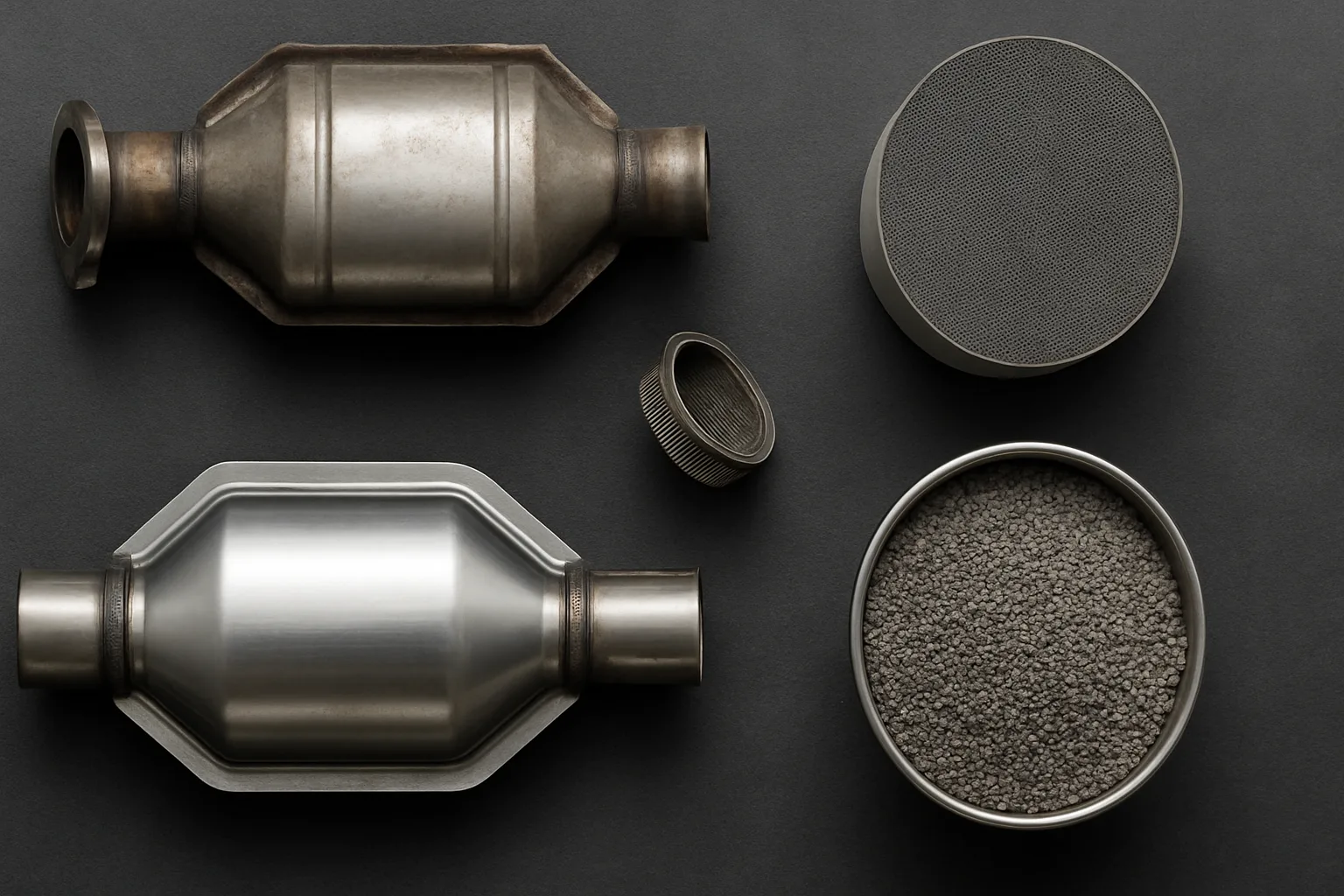
Most Windsor scrap yards treat every catalytic converter the same. They shouldn't — and neither should you.
The difference between an OEM catalytic converter and an aftermarket unit isn't just a manufacturing detail. It's often the difference between a payout that covers your costs and one that makes the haul worthwhile. If you've ever pulled cats off a load and wondered why two converters that look nearly identical are worth completely different amounts, this is the answer.
Understanding how scrap catalytic converter prices Windsor yards and buyers calculate value starts with one thing: precious metal content. And that content varies dramatically between OEM and aftermarket units — by design.
What Makes OEM and Aftermarket Cats Fundamentally Different
OEM stands for Original Equipment Manufacturer. These are the converters installed at the factory, engineered to meet strict emissions standards for a specific vehicle over its full lifespan — often 150,000 to 200,000 kilometres or more. Automakers build OEM cats to last, which means loading the substrate with higher concentrations of platinum, palladium, and rhodium.
Aftermarket converters are replacement units, sold and installed when the original fails. They meet current emissions regulations — but only the minimum required. Manufacturers keep costs down by using less precious metal loading in the ceramic or metallic substrate. That's not a flaw; it's the product doing exactly what it was designed to do. It just means it's worth significantly less when it comes time to scrap it.
Here's the practical difference:
- OEM converters typically carry higher platinum group metal (PGM) loadings — sometimes two to three times higher than aftermarket equivalents
- Aftermarket converters often use cheaper substrate configurations and lower PGM concentrations
- Some aftermarket cats use a single-brick substrate where the OEM used two, further reducing recoverable metal
- OEM units are vehicle-specific; aftermarket units are often designed to fit multiple applications, which means no single vehicle's PGM profile is optimised
This is why experienced catalytic converter buyers Ontario-wide can look at a unit, check the serial number, and immediately quote a very different price than what the person next to you got for a physically similar-looking cat.
How Buyers Price Cats — and Why OEM Units Command a Premium
Scrap cat pricing isn't arbitrary. Legitimate buyers — including those operating through a catalytic converter auction format — base their bids on assay data. Assay is the process of sampling and testing a batch of converters to determine the actual PGM content: how many grams of platinum, palladium, and rhodium are recoverable per unit.
Because buyers have access to historical assay data for thousands of converter types, they can often price a unit before it's even cracked open — purely based on the OEM part number or serial. That data doesn't lie. An OEM cat from a 2019 Ford F-150 has a known PGM profile. An aftermarket replacement for the same truck has a different, almost always lower, profile.
Several factors drive the final price on any given unit:
- PGM spot prices — palladium and rhodium have historically been volatile; current market rates on September 1, 2026 apply to every quote you receive today
- Recovery rates — not all PGM in a substrate is recoverable; smelters work at specific efficiency percentages
- Substrate condition — cracked, burned, or rattled-out cats lose recoverable material and are priced accordingly
- OEM vs aftermarket status — as explained above, this affects the base PGM loading before any condition factor applies
- Volume — buyers pay more per unit when they're moving larger quantities; a yard selling a full load of sorted cats has more leverage than a seller with three mixed units
This is exactly why leaving money on the table by selling unsorted loads — or by relying on a single buyer's quote — is a mistake. More on that below.
Windsor Yards and the Single-Buyer Problem
Windsor sits in the heart of Ontario's most active automotive corridor. With a long history tied to vehicle manufacturing and assembly, yards in this area regularly process catalytic converters from everything — domestic trucks, imported sedans, commercial vans. That's an opportunity. The question is whether sellers in Windsor are actually capturing the value available to them.
The old model — one phone call, one quote, take it or leave it — doesn't account for the difference between your OEM Toyota Prius cat (one of the highest-value converters in the scrap market) and an aftermarket unit from the same model year. A buyer offering a flat rate per cat is either averaging down your premium units or counting on you not knowing the difference. Neither outcome benefits you.
Platforms like find the best price for your scrap in Canada through SMASH solve this directly. Instead of a single buyer setting the price, vetted buyers compete for your inventory. When buyers know what they're bidding on — documented units, serial numbers captured, OEM vs aftermarket identified — they bid with confidence. That competition is where price discovery happens. You don't need to guess what your load is worth when the market tells you.
For Windsor sellers with consistent cat volume, this matters every single week. If you're moving 20, 50, or 100 units at a time, the spread between a single-buyer flat rate and a competitive auction result adds up fast.
Sorting Your Inventory — The Step Most Sellers Skip
Before any cat leaves your yard, sorting by OEM versus aftermarket is the single most impactful thing you can do to protect your return. Mixing premium OEM units into a general pile gets them priced at the average — not at their actual value.
Here's a practical sorting approach:
- Capture the serial number — every OEM cat has a manufacturer-stamped serial or part number. Photograph it. This alone unlocks accurate pricing data.
- Note the vehicle source — if you know the make, model, and year, that context helps buyers confirm the OEM status even when the serial is worn or partially legible
- Identify aftermarket units visually — aftermarket cats often have generic housings, universal fitment stamps, and thinner, lighter shells. They feel different in the hand.
- Document substrate condition — shake each unit. A rattle means the substrate has broken apart. Price it accordingly and separately from intact units.
- Use photo documentation — platforms that support photo uploads (both ends of the converter, the serial, the housing) give buyers confidence to bid higher
SMASH's inventory tool supports serial tracking and photo documentation at the unit level. That means when your load goes to buyers, they're not guessing — they're bidding on verified, documented converters. That confidence shows up in the bids. If you want to get a fair price for your scrap catalytic converters in Canada, documented inventory is where it starts.
Using a Catalytic Converter Scrap Price Chart — What It Actually Tells You
A catalytic converter scrap price chart is a reference tool, not a guarantee. These charts list converter types — often organised by manufacturer part number or vehicle application — alongside a price range based on current PGM spot rates and historical assay data. They're useful for setting expectations, but they're a starting point, not a final number.
What a chart won't tell you:
- Whether your specific unit is in the condition the chart assumes
- Whether the buyer quoting you is using current assay data or outdated pricing
- What a second or third buyer would pay for the same unit
- How today's PGM spot prices shift the actual recovery value versus last week's chart
This is why the chart is a floor, not a ceiling. Real competition — through a proper catalytic converter auction process — reveals what buyers will actually pay today, with current market data factored in. For sellers in Windsor and across Ontario, that competitive transparency is what separates a fair deal from leaving money behind.
Want to go deeper on pricing data and market movement? Read Canadian scrap catalytic converter guides for up-to-date information on what drives converter values and how to navigate changing PGM markets.
Finding Legitimate Catalytic Converter Buyers Near Windsor
Searching for catalytic converter recycling near me in the Windsor area will return a mix of results — local yards, brokers, and national platforms. Not all of them are equal. The key questions to ask any buyer before you hand over your inventory:
- Do they price by unit type, or do they offer flat rates per kilogram?
- Do they require documentation (serial numbers, photos, vehicle source)?
- Are they offering a single quote, or does your load go to competitive bidding?
- How are payouts handled — cash, cheque, electronic transfer?
- Are they a direct smelter customer, a broker, or a middleman?
Vetted catalytic converter buyers Ontario processors who operate through competitive platforms answer these questions clearly. Buyers who resist documentation or push for unsorted loads at flat rates are often working the information gap against you.
Windsor scrap metal services through best-scrap-cat-prices.ca connect you with buyers who price on actual content — not guesswork. Whether you're clearing a single vehicle or moving a yard's worth of sorted inventory, the process is the same: document, sort, compete, get paid.
If you're ready to stop guessing and start getting competitive quotes on your converter inventory, find the best scrap cat prices in Canada and see what your load is actually worth today.
Disclaimer: Catalytic converter scrap prices fluctuate daily based on platinum, palladium, and rhodium spot prices. Always check current rates before finalising any sale.
Frequently Asked Questions
Q: Why is my aftermarket cat worth so much less than the OEM unit from the same car?
Aftermarket converters are built to meet minimum emissions standards at the lowest production cost. That means significantly less platinum, palladium, and rhodium in the substrate compared to the original factory unit. Since scrap value is based almost entirely on PGM content, less precious metal means a lower payout — sometimes by 50% or more.
Q: How do scrap catalytic converter prices Windsor buyers determine what to pay?
Legitimate buyers price cats using assay data — historical and current test results showing how much recoverable PGM is in each converter type. They cross-reference your unit's serial number against this data, then apply current spot prices for platinum, palladium, and rhodium. Condition factors (cracked substrate, burned housing) adjust the final number downward.
Q: Does it matter if my catalytic converter has a rattle when I shake it?
Yes — significantly. A rattle means the ceramic substrate has fractured. When the substrate breaks apart, PGM-bearing material escapes or becomes unrecoverable during smelting. Buyers will price rattled cats lower than intact units of the same type. Keep them separate from your good inventory and disclose the condition upfront.
Q: Is there a catalytic converter scrap price chart I can use to check Windsor values?
Price charts are a useful reference — they list converter types alongside price ranges based on current PGM rates. However, they're a starting point, not a final quote. Your unit's actual condition, current spot prices, and what competitive buyers are willing to pay today will all affect the real number. Use charts to set a baseline, then let competition set the actual price.
Q: How do I know if I'm getting a fair price for my cats in Windsor?
The simplest test: get more than one quote. A single buyer sets the price on their terms. When multiple vetted buyers bid on your documented inventory — serial numbers captured, OEM status identified, condition noted — the market sets the price instead. That's where fair price discovery actually happens, and it's the core of how SMASH operates.
Stay current on scrap metal market trends and PGM pricing — follow SMASH on LinkedIn for regular industry updates and converter market insights.