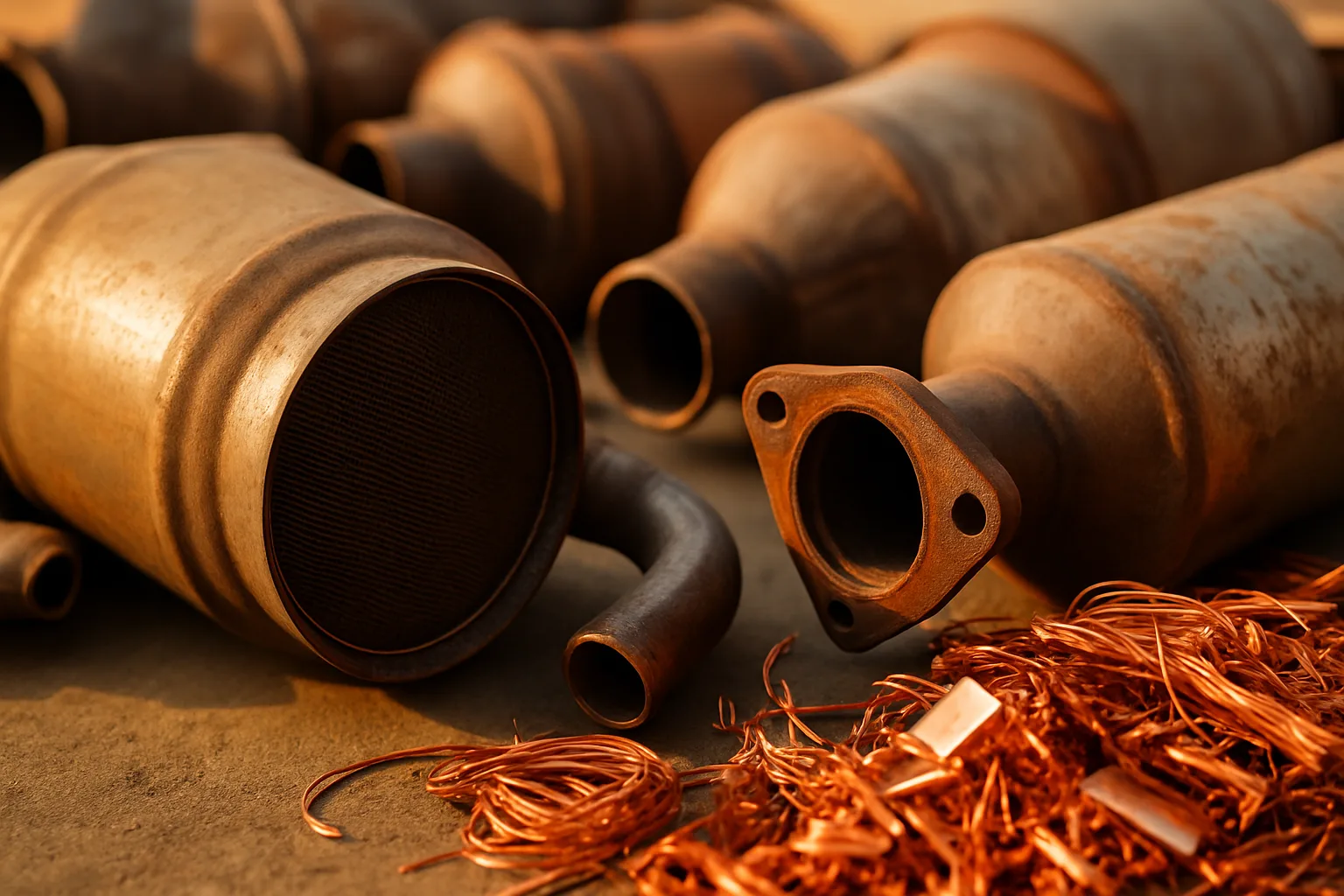
Why Hybrid Catalytic Converters Are Worth More at the Scrap Yard
Most scrap sellers know that catalytic converters hold value. Fewer know that hybrid vehicle cats are in a category of their own — and if you're pulling one off a Toyota Prius, Ford Escape Hybrid, or Honda Accord Hybrid without knowing that, you might be leaving serious money on the table. Understanding catalytic converter scrap value starts with understanding what's actually inside the unit you're selling.
This guide breaks down why hybrid cats are chemically different, why that matters to buyers, and how sellers in New Westminster and across British Columbia can make sure they're getting a fair return on what they pull.
What Makes a Hybrid Catalytic Converter Different from a Standard Unit
A conventional gasoline engine runs hot, runs hard, and runs constantly. Its catalytic converter operates at high sustained temperatures, which means the washcoat — the ceramic or metallic substrate coated with precious metals — reaches its optimal reaction temperature quickly and stays there. Hybrid engines are different. They shut off and restart constantly, run at lower temperatures during electric-only operation, and produce more incomplete combustion events during cold starts.
To compensate for this, hybrid manufacturers load their catalytic converters with higher concentrations of precious metals — primarily palladium and platinum, with rhodium in the mix. The higher loading ensures the converter can do its job even when the engine hasn't fully warmed up. The result for the scrap seller is a unit that contains meaningfully more recoverable precious metal content than a standard converter from a comparable gasoline-only vehicle.
- Palladium: The dominant metal in most modern hybrid cats. Palladium is critical for oxidizing hydrocarbons and carbon monoxide during low-temperature engine cycles.
- Platinum: Often paired with palladium in hybrid washcoats. Provides thermal stability across the wider temperature swings hybrid engines produce.
- Rhodium: Used in smaller quantities but commands the highest price per troy ounce. Handles nitrogen oxide conversion.
When you're looking at a scrap cat from a hybrid, you're looking at a unit engineered to carry more of these metals by design. That engineering decision is what drives higher catalytic converter scrap value for hybrid units compared to their conventional counterparts.
The Palladium Factor — Why Precious Metal Prices Shape What You Get Paid
If you follow the scrap cat market at all, you already know that palladium price today has a direct line to what buyers will offer you at the yard. Palladium is the most abundant precious metal in modern catalytic converters, and hybrid units carry more of it per unit than standard cats. That concentration is exactly why hybrid converters consistently sit at the top of any serious catalytic converter scrap price list.
Precious metal markets move daily. Palladium, platinum, and rhodium are traded on global commodity exchanges, and what happens in those markets — driven by automotive production forecasts, refinery capacity, geopolitical supply pressures, and shifting demand from the electric vehicle sector — flows directly into what a processor is willing to pay for your cores. A hybrid cat from a high-demand vehicle like the Prius or RAV4 Hybrid carries a premium not because of brand sentiment, but because assay results from processed lots back up the higher metal content consistently.
What this means practically: if you're selling hybrid cats without identifying them separately, you may be getting blended pricing that dilutes their actual value. Buyers who know what they have pay attention to this. You should too. Platforms that let you find the best scrap cat prices in Canada give you the tools to separate your inventory properly before you sell — so you're not averaging down on your best units.
How to Identify a Hybrid Catalytic Converter Before You Sell
You don't need a spectrometer to know you're working with a hybrid cat. There are practical ways to identify these units before they leave your yard or your vehicle.
Check the vehicle first. If the donor vehicle is a hybrid — look for the "Hybrid" badge, a dual drivetrain under the hood, or a high-voltage warning label — your catalytic converter is likely a high-value unit. Common hybrid platforms to watch for include:
- Toyota Prius (all generations)
- Toyota RAV4 Hybrid and Camry Hybrid
- Honda Accord Hybrid and Insight
- Ford Escape Hybrid and Fusion Hybrid
- Lexus RX450h and other Lexus hybrid SUVs
- Chevrolet Volt (plug-in hybrid)
Look at the converter itself. Hybrid cats are often physically smaller than you'd expect for the engine size — because they're designed for efficiency, not volume. Some hybrid systems use multiple converters: a close-coupled unit near the manifold and a downstream unit. Both can carry significant precious metal content. Don't discard secondary converters as low-value without getting them assessed.
Use serial numbers and VIN data. A proper serial or part number cross-referenced against a reliable price database will tell you far more than a visual inspection alone. This is where documentation discipline pays off. When you get a fair price for your scrap catalytic converters in Canada, a platform that supports serial tracking and photo documentation puts you in a much stronger position with buyers — because buyers can verify what you're selling before they bid.
Selling Hybrid Cats in New Westminster and British Columbia — What the Local Market Looks Like
Sellers in New Westminster and across British Columbia operate in one of the more active scrap cat markets in Canada. The Lower Mainland's density of automotive recyclers, the volume of trade through the Port of Vancouver, and the concentration of hybrid vehicles on the road — BC has historically had some of the strongest hybrid adoption rates in the country — means there's real buyer interest in hybrid converter inventory.
But "buyer interest" doesn't automatically mean "best price." The traditional approach — calling one buyer, taking their number, moving on — gives you a data point, not a market. A single quote from a single buyer tells you what that buyer wants to pay, not what the market will bear for your specific units. Hybrid cats with documented serial numbers, clean photos, and accurate lot descriptions attract better offers. Competitive bidding, where multiple vetted buyers see your inventory at the same time, is what actually reveals the market.
This is exactly the problem SMASH was built to solve. smashrecycling.ca connects sellers with vetted buyers across North America through an auction format — no subscription fees, no guessing, no single-buyer bottleneck. When buyers compete on your hybrid cat inventory, you see what it's actually worth. That's not a pitch. That's how price discovery works.
If you're in New Westminster and pulling hybrid converters regularly, separating your hybrid inventory from your standard cats before you list is one of the simplest ways to improve your return. SMASH supports the kind of detailed inventory documentation — photos, serial numbers, vehicle source data — that makes hybrid units easier for buyers to assess and bid on confidently.
Documentation and Inventory Discipline — The Step Most Sellers Skip
Here's where a lot of sellers lose money without realizing it: they mix high-value hybrid cats with lower-grade standard units, sell the lot at a blended price, and walk away thinking they did fine. They didn't. The hybrid units subsidized the mediocre ones.
Good documentation separates winners from average sellers in this market. If you want to maximize catalytic converter scrap value, build a habit around the following:
- Photograph every unit. Front, back, end openings. A buyer assessing a lot remotely needs to see what they're buying. Clean photos with the serial number visible build trust and support better offers.
- Record serial numbers at the point of removal. Once cats are in a bin together, it's much harder to separate them accurately. Do it while the unit is still in your hand.
- Note the source vehicle. Year, make, model, and whether it's a hybrid or plug-in hybrid. A Prius cat and a Corolla cat are not the same — buyers know this, and your documentation should reflect it.
- Group by grade. Hybrid cats in one lot, domestic foil cats in another, aftermarket cats separated out. Mixing grades hurts you.
- Keep a consistent process. Consistency means your lot descriptions become reliable, and reliable sellers attract repeat buyers who are willing to bid confidently.
Want to go deeper on the process? Read Canadian scrap catalytic converter guides that cover grading, documentation, and how to present your inventory to get the best result.
What Scrap Sellers Need to Know About the Hybrid Cat Market in 2026
The hybrid vehicle market in Canada has continued to grow through 2026. More hybrids on the road means more hybrid cats eventually entering the scrap stream — and the buyers processing those units know exactly what they're worth at the refinery level. The information asymmetry between a well-informed buyer and a seller who doesn't know what they're holding is real, and it costs sellers money every day.
Precious metal markets remain volatile. Palladium in particular has seen continued price movement tied to EV transition timelines, mining supply constraints, and shifting automotive production patterns globally. What this means for scrap sellers in New Westminster and beyond: the value in your hybrid cats is real, but it fluctuates. Timing matters. Selling into a competitive bidding environment — rather than a single-call negotiation — gives you the best chance of capturing the market at its current level rather than one buyer's margin target.
Disclaimer: Precious metal prices and catalytic converter scrap values fluctuate daily based on commodity market conditions. Always check current rates before selling.
If you're ready to stop guessing and start seeing real market offers for your hybrid converter inventory, it starts with knowing what you have and putting it in front of the right buyers. SMASH makes that process straightforward — vetted buyers, auction format, no subscription fees. Find the best Canadian scrap cat prices and get a free quote at best-scrap-cat-prices.ca.
Frequently Asked Questions
Q: Why do hybrid catalytic converters have higher scrap value than regular ones?
Hybrid engines cycle on and off frequently and operate at lower temperatures during electric-only driving. To maintain emissions performance across those variable conditions, manufacturers load hybrid catalytic converters with higher concentrations of palladium, platinum, and rhodium — the three precious metals that drive catalytic converter scrap value. More metal per unit means more recoverable value at the refinery.
Q: How do I know if the catalytic converter I have is from a hybrid vehicle?
Start with the source vehicle. If it carries a hybrid badge, has a high-voltage warning label, or is a known hybrid platform (Prius, RAV4 Hybrid, Escape Hybrid, etc.), the converter is likely a high-value hybrid unit. You can also cross-reference the serial number on the converter itself against a reliable price database. When in doubt, document the unit with photos and serial numbers before selling — buyers will tell you what it grades out at.
Q: Where can I sell scrap catalytic converters in New Westminster, British Columbia?
Sellers in New Westminster have access to local scrap yards, but for the best results on hybrid and high-grade converter inventory, consider selling through a platform that brings multiple buyers to your lot simultaneously. Competitive bidding reveals the actual market price rather than a single buyer's offer. Platforms like SMASH connect sellers with vetted buyers across North America — and there are no subscription fees to list.
Q: Does palladium price today affect what I get for my hybrid catalytic converter?
Yes, directly. Palladium is the primary precious metal in most modern hybrid catalytic converters, and buyers price your units against current spot values. When palladium prices rise, hybrid cat values rise with them. When prices dip, returns follow. This is why it's worth tracking commodity markets and, where possible, selling into a competitive bidding environment that reflects current market conditions rather than a buyer's fixed internal pricing.
Q: Should I sell hybrid catalytic converters separately from standard ones?
Absolutely. Mixing hybrid cats with lower-grade standard units in a single lot typically results in blended pricing — which averages down the value of your best units. Sort your inventory by grade before selling. Hybrid cats from high-demand platforms like the Prius or Lexus RX450h should be documented separately with photos and serial numbers. This simple step consistently supports better offers from buyers who know what they're bidding on.
Follow SMASH on LinkedIn for scrap metal market updates, industry news, and catalytic converter pricing insights: linkedin.com/company/scrap-metal-auction-sales-hub.