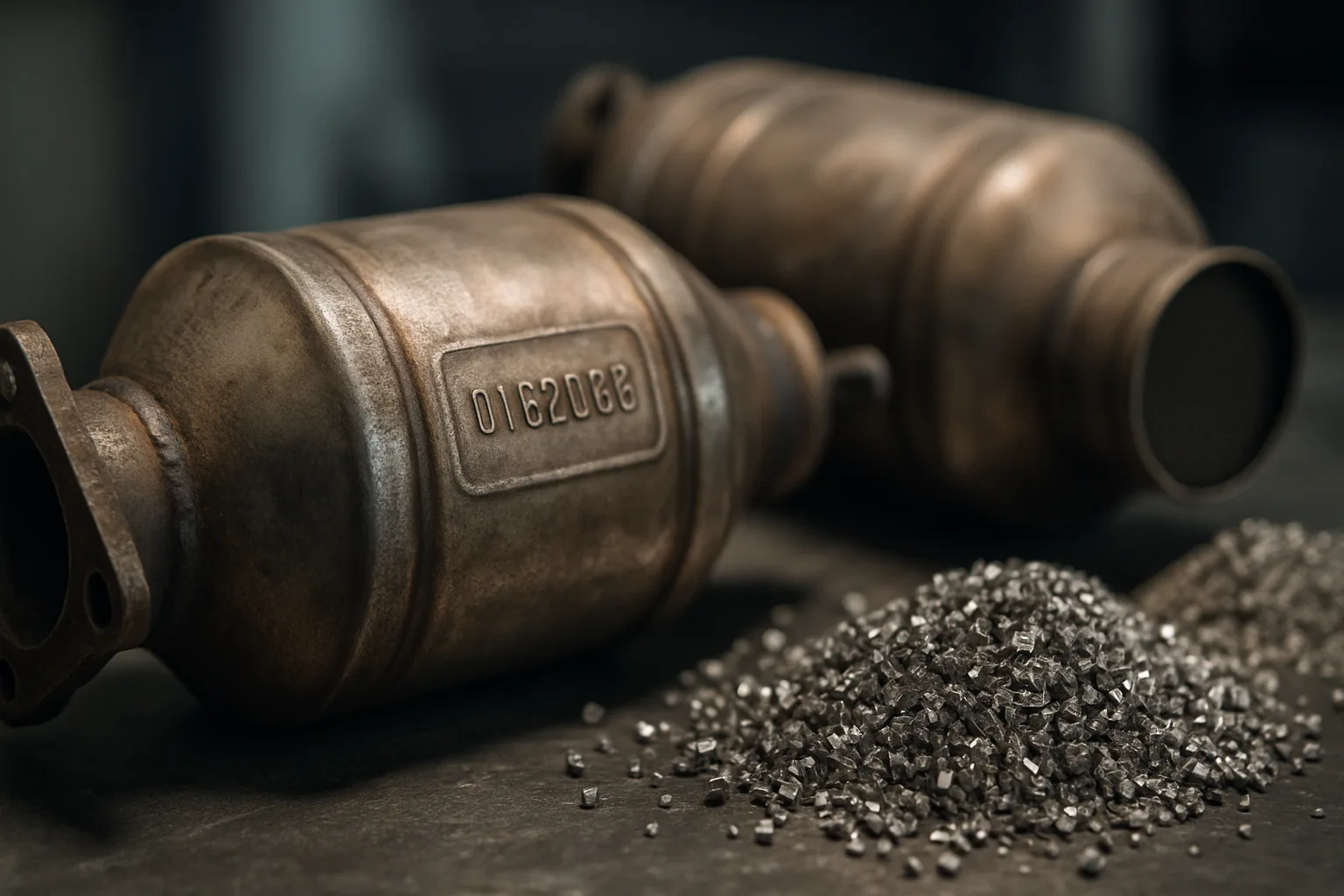
Most scrap yards won't tell you this: the difference between a low-ball offer and a fair one often comes down to a string of letters and numbers stamped on your cat. That serial number isn't just a manufacturer reference — it's a roadmap to the precious metals inside. Platinum, palladium, and rhodium loadings vary dramatically from one converter to the next, and a buyer who can't identify your serial number is either guessing or hoping you don't know better. If you're trying to get the best scrap cat prices in Canada, understanding how to read a catalytic converter serial number is one of the most practical skills you can have.
This guide breaks down exactly how serial number identification works, what it means for your payout, and how to make sure you're not leaving money behind when you sell.
---Why the Serial Number Matters More Than the Metal You Can See
A catalytic converter's value isn't in its shell — it's in the ceramic or metallic substrate inside. That substrate is coated with a precise ratio of platinum group metals (PGMs): platinum, palladium, and rhodium. The platinum price today moves constantly based on global commodity markets, and the same goes for palladium and rhodium. Your cat's serial number is how the industry traces what's actually in there.
Without a readable serial number, buyers have to default to visual identification or generic pricing tables — neither of which favours the seller. A well-documented serial number, on the other hand, lets processors cross-reference a database of assay results that tells them the exact PGM content per unit. More confidence in the data means better price discovery. That's not a theory — it's how the wholesale market actually works.
Think of it this way: two Honda cats sitting side by side might look identical. One could carry twice the platinum loading of the other simply because of a model year or trim difference. The serial number is the only reliable way to tell them apart.
---Where to Find the Serial Number on a Catalytic Converter
Serial numbers are typically stamped, laser-etched, or stickered directly onto the converter's heat shield or body. The location depends on the manufacturer and vehicle platform, but here are the most common spots to check:
- Top of the heat shield — most common location on Japanese OEM converters (Toyota, Honda, Subaru)
- End cone or inlet/outlet pipe — common on European makes (BMW, Mercedes, Volkswagen)
- Underside of the body — found on some GM, Ford, and Chrysler applications
- Welded-on tag or stamped directly into the metal — typical on aftermarket and direct-fit converters
If a converter has been exposed to heavy heat, road debris, or years of corrosion, the number can be difficult to read. Use a wire brush or fine-grit sandpaper to clean the area before trying to photograph it. Natural light or a flashlight held at a shallow angle will help raise the contrast on stamped characters. For Nanaimo scrap metal services, photographing your serial numbers before you show up — or before you list — puts you in a much stronger negotiating position.
---How to Decode a Catalytic Converter Serial Number
Serial numbers vary by manufacturer, but most follow recognizable patterns. Here's what the common formats look like and how to interpret them:
OEM (Original Equipment Manufacturer) Converters
OEM cats typically carry part numbers tied to the vehicle's make, model, year, and engine variant. A Toyota part number like 89465-02110 can be cross-referenced directly in PGM processor databases to return a known assay value. The more complete the number, the more accurate the lookup. Partial numbers or corroded digits force processors to bracket the result, which usually means a lower offer to cover the uncertainty.
Aftermarket Converters
Aftermarket cats (brands like Davico, Walker, or MagnaFlow) use their own part numbering systems. These generally carry lower PGM loadings than OEM equivalents because they're built to meet minimum emissions thresholds, not to match the original substrate quality. That doesn't mean they're worthless — it means they need accurate identification to get a fair price rather than an inflated or deflated one.
Foreign / Universal Converters
Universal or "foreign" cats are often the most difficult to identify. They may carry numeric-only codes or region-specific markings that don't appear in standard North American databases. If you're dealing in volume and regularly encounter foreign cats, working with a platform like SMASH Recycling — where verified buyers bid on your metal gives you access to buyers who specialize in these harder-to-ID units.
---How Serial Number Identification Affects Price Discovery When Platinum Prices Are Moving
The platinum price today is a live variable. When PGM markets shift — and they shift frequently based on mining output, auto industry demand, and currency fluctuations — even a well-documented cat will see its offer price move. That's normal. What's not acceptable is a price that's wrong because the cat wasn't properly identified in the first place.
Here's a practical example of how identification quality affects your outcome:
- Unreadable or missing serial number: Buyer uses a conservative generic estimate. You get the floor, not the market.
- Partial serial number: Buyer brackets between two possible unit types. You get an average at best.
- Complete, verified serial number: Buyer cross-references assay data. You get a price tied to the actual PGM content.
This is exactly why photo documentation and serial tracking matter. When you find the best scrap cat prices in Canada, you're not just finding a buyer — you're finding a buyer who will use your documentation to make you a better offer. Platforms that use serial tracking and photo documentation reduce the information gap that keeps sellers from getting fair value.
For sellers across British Columbia — including those moving loads out of Nanaimo and the surrounding Vancouver Island region — accurate serial documentation is especially important when selling remotely or shipping to a processor that can't physically inspect your inventory before bidding.
---Building a Simple System for Documenting Your Cats Before You Sell
You don't need specialized equipment to document converters properly. A consistent process protects you whether you're selling one unit or a pallet of 50.
Step-by-Step Documentation Process
- Clean the converter body. Remove surface rust, road grime, and any debris obscuring the serial number area.
- Photograph the serial number close-up. Use your phone. Make sure the image is in focus and the characters are fully visible.
- Photograph the whole unit. Show both inlet and outlet pipes, the heat shield, and any visible stamps or tags.
- Note the source vehicle if known. Year, make, model, and engine size help cross-reference even when a serial is partially damaged.
- Record the weight. Gross weight of the unit, not just the shell.
- Keep records by lot. If you're selling multiple cats together, document them as a group but photograph each one individually.
SMASH supports serial tracking and photo documentation as part of the listing process. When verified buyers can see your documentation before they bid, you get more competitive offers — not because the metal changed, but because the confidence in the data improved. More buyers means better price discovery. That's how the platform is designed to work.
If you're operating in Nanaimo or anywhere across British Columbia and you've been selling cats through a single local contact without documenting serial numbers, it's worth reconsidering that workflow. You may be leaving real money on the table every single time.
---Why Using a Scrap Metal Auction Platform Changes the Game for Cat Sellers
The old way of selling scrap cats goes like this: one phone call, one buyer, one number. Take it or leave it. That model works fine for the buyer. It doesn't work for you.
A scrap metal auction platform flips that dynamic. When multiple vetted buyers compete on your documented inventory, the price reflects the actual market instead of one buyer's margin target. That's especially valuable when the platinum price today is elevated — competitive bidding ensures you capture more of that upside rather than handing it to a middleman.
For sellers looking to get a fair price for your scrap catalytic converters in Canada, the combination of proper serial documentation and auction-based selling is the most reliable path to consistent, defensible pricing. No subscription fees. No guesswork. Just competition.
Want to go deeper on the Canadian market? Read Canadian scrap catalytic converter guides to understand how PGM pricing, grading, and buyer selection all connect to your final payout.
---Frequently Asked Questions
Q: How do I look up my catalytic converter's value using the serial number?
Start by photographing the serial number clearly, then search it through a reputable converter database or submit it directly to a buyer or platform that uses serial tracking. The lookup will return an estimated PGM content, which is then priced against the current platinum, palladium, and rhodium spot rates. Keep in mind the platinum price today changes daily — your quote reflects current market conditions, not a fixed value.
Q: What if my catalytic converter's serial number is worn off or unreadable?
You can still sell it, but expect buyers to use conservative generic pricing. To recover some ground, provide the source vehicle's year, make, model, and engine size — that narrows the possible unit types significantly. Clear photos of the converter's overall shape, inlet/outlet diameter, and any remaining markings will also help experienced buyers make a better identification.
Q: Are there good catalytic converter buyers in Nanaimo, British Columbia?
Yes, there are local buyers operating on Vancouver Island, including in Nanaimo. That said, local options don't always offer the most competitive pricing because there's no competitive pressure on a single buyer. Using an auction-based platform gives you access to vetted catalytic converter buyers in British Columbia and beyond, which typically results in better price discovery — especially on high-value OEM units.
Q: Does the platinum price today affect what I'll get for my scrap cat?
Directly, yes. Platinum is one of the three primary PGMs priced into your converter, alongside palladium and rhodium. When platinum markets are up, well-identified cats with documented serial numbers benefit immediately. When markets are soft, accurate identification is even more important — it's the difference between getting the real floor and getting below it due to estimation error.
Q: How is selling on a scrap metal auction platform different from calling a local yard?
A local yard gives you one offer — their offer. A scrap metal auction platform puts your documented inventory in front of multiple vetted buyers who compete against each other. More competition means the price reflects the market rather than one buyer's margin target. Platforms like SMASH also support serial tracking, photo documentation, and auto-invoicing, which removes ambiguity from the transaction on both sides.
---If you've been selling cats without reading the serial numbers first, you've been flying blind in a market that rewards documentation. Clean the unit, photograph the number, know what you have — then sell into competition, not into a single phone call. Ready to see what your cats are actually worth? Find the best Canadian scrap cat prices and get a free quote at best-scrap-cat-prices.ca.
Prices for platinum, palladium, and rhodium fluctuate daily based on global commodity markets. Always verify current rates before finalizing any transaction.
Stay current on scrap metal market conditions and catalytic converter pricing trends — follow SMASH on LinkedIn for regular industry updates and insights.