Most scrap yards will quote you a price for your catalytic converter without explaining a single thing about how they arrived at that number. If you've ever wondered why two buyers can give you wildly different quotes for the same converter — or why scrap catalytic converter prices Coquitlam sellers are offered can swing by hundreds of dollars — the answer lives inside the assaying and smelting process. Understanding what happens to your cat after it leaves your hands puts you in a much stronger position to get paid what it's actually worth.
This isn't theory. This is the real process that determines the dollar figure on your check.
---What's Actually Inside a Catalytic Converter Worth Money
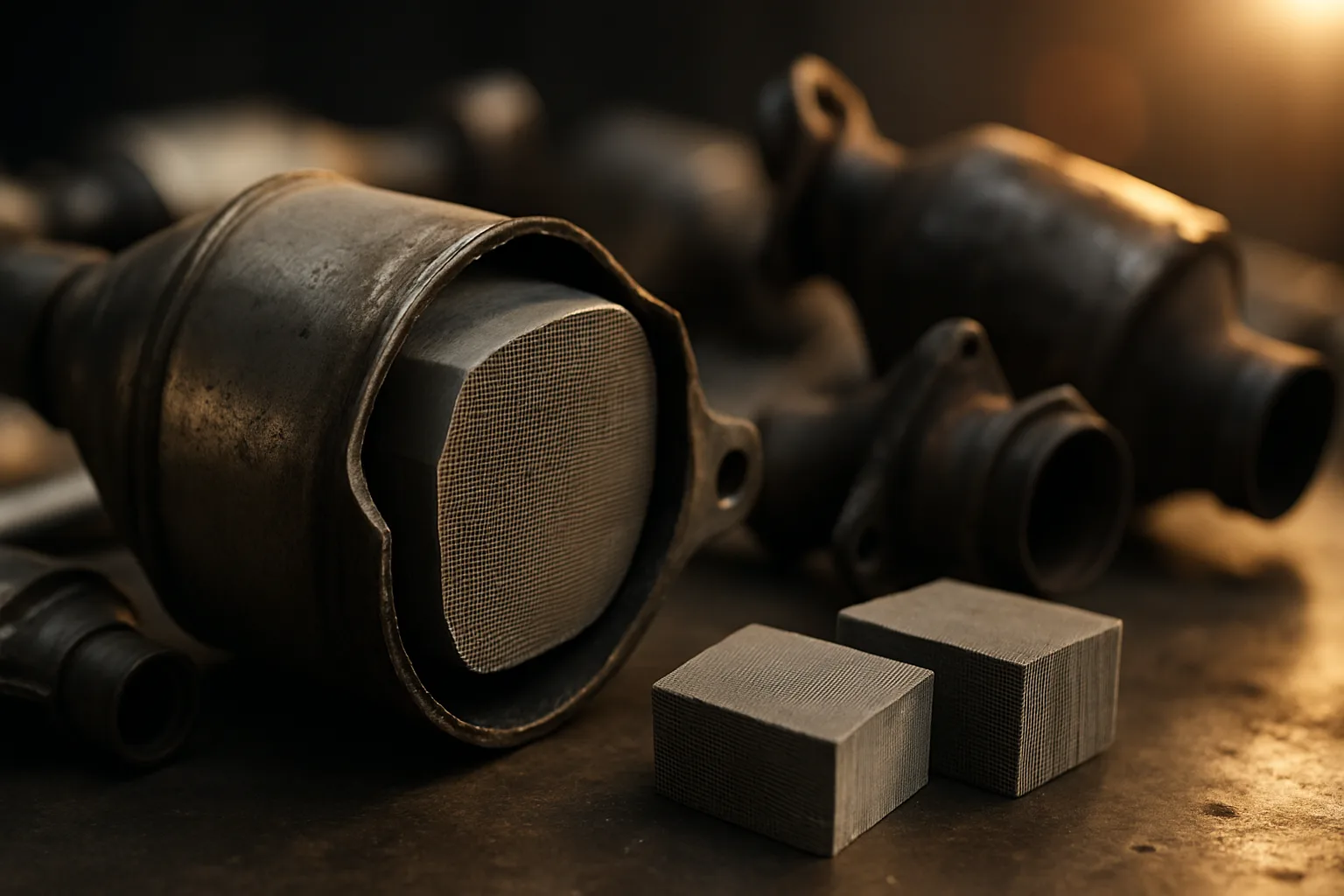
Before you understand assaying, you need to understand what's being assayed. A catalytic converter doesn't look valuable from the outside. It's a steel or stainless shell, usually shaped like a canister or brick, bolted into your exhaust system. Inside is a ceramic or metallic honeycomb substrate — and that substrate is where the value lives.
The honeycomb is coated with a wash of platinum group metals (PGMs): platinum, palladium, and rhodium. These metals act as catalysts to convert harmful exhaust gases into less harmful emissions. They survive extreme heat, don't react with most chemicals, and are incredibly rare. That's why they're worth extracting — and why the scrap value of a cat can range from a few dollars to well over a thousand, depending on the make, model, and which PGMs are present.
- Platinum (Pt): Used heavily in diesel converters. Prices fluctuate with industrial demand.
- Palladium (Pd): Dominant in gasoline converters. Has seen dramatic price volatility over the past several years.
- Rhodium (Rh): The rarest of the three. Even tiny amounts can significantly affect a converter's value.
The grade of the converter — which PGMs it contains, and in what concentration — is what assaying determines. A VIN lookup or serial number check can give you a ballpark estimate before the converter is even opened. That's exactly the kind of transparency platforms like Canada's B2B scrap recycling marketplace SMASH are built around: documented, verifiable data before the bidding starts.
---The Assaying Process: How Buyers Determine What Your Cat Is Worth
Assaying is the scientific analysis that measures exactly how much of each PGM is present in a converter's substrate. It's the foundation of every legitimate cat converter price — and the step that too many sellers never see or hear about. When you find the best scrap cat prices in Canada, you're ultimately finding buyers who base their offers on real assay data, not gut feeling.
Here's how the process runs from start to finish:
- Decanning: The steel shell is cut open and the ceramic or metallic substrate is removed. This is done mechanically — either by hand or with a hydraulic decanner. The substrate is fragile, so handling matters.
- Crushing and milling: The substrate is crushed into a fine powder. This homogenizes the material so that any sample taken represents the whole lot accurately. Larger processors handle thousands of units at once — known as a "lot" — to reduce the statistical error in any single unit's assay.
- Sampling: A precise sample is pulled from the milled powder. Both the processor and, ideally, the seller retain split samples for independent verification. This is called a "split sample" or "umpire sample" — it protects both parties.
- Fire assay or ICP analysis: The sample goes through laboratory analysis. Fire assay is the traditional method — melting the sample with flux to separate precious metals. Inductively Coupled Plasma (ICP) spectrometry is the modern standard — it's faster, highly accurate, and measures PGM concentrations in parts per million (ppm).
- Settlement: Once the assay results come back, the settlement value is calculated: PGM concentration × weight of total substrate × current spot price, minus processing and refining fees. That final number is what you get paid.
The critical takeaway: the assay result is the truth. A buyer who quotes you without assay data is either guessing or using outdated averages. Neither serves you well.
---Smelting and Refining: Turning PGM Powder Into Payable Metal
After assaying, the actual metal recovery happens through smelting. The milled substrate — now confirmed to contain X ppm of platinum, palladium, and rhodium — gets processed through a smelter to physically extract those metals.
In a typical PGM smelter, the crushed material is combined with a collector metal (often copper or iron) and heated to extremely high temperatures. The PGMs, being dense, migrate into the collector metal as it melts. The ceramic and other waste materials form a slag that floats on top and is separated. What remains is a PGM-rich alloy called a matte or doré, depending on the process.
That matte then moves to a refinery — sometimes the same facility, sometimes a separate one — where chemical processes isolate platinum, palladium, and rhodium individually to high purity levels. These refined metals are then sold on the spot market to industrial buyers: automotive manufacturers, electronics companies, jewelry producers, and chemical processors.
The entire smelting and refining cycle takes time — typically several weeks from the moment your converter arrives at the processor. This is why many cat buyers offer two pricing structures: a quick "street price" based on estimated grade (paid fast, lower), or a "return" price based on actual assay and smelting results (takes longer, higher potential). Knowing which structure a buyer uses — and whether they share assay documentation — matters enormously if you're selling volume.
---Why Assay Transparency Directly Affects Cat Converter Prices in Coquitlam
If you're selling cats in Coquitlam or anywhere across British Columbia, the gap between what you're offered and what your converters are actually worth often comes down to one thing: information asymmetry. The buyer knows the assay data. You don't. That's a negotiating environment that historically favors the buyer.
This is where a catalytic converter auction model fundamentally changes the equation. Instead of one buyer with proprietary assay data making you a take-it-or-leave-it offer, multiple catalytic converter buyers in British Columbia compete for your material — each bringing their own knowledge, processing relationships, and pricing to the table. Competition surfaces the real market. It doesn't guarantee a higher number, but it does make the market visible.
Platforms like SMASH are built for exactly this scenario. Sellers can document their inventory with photos, serial numbers, and VIN-linked grade data before listing. Vetted buyers — not random cold callers — place competitive bids. Auto-invoicing and documentation trail the transaction from listing to settlement. For yards in Coquitlam moving regular volume, this kind of structure isn't a luxury. It's just smarter business. To get a fair price for your scrap catalytic converters in Canada, you need buyers competing — not one buyer deciding.
---How to Use Assay Knowledge Before You Sell
You don't need a lab to use assay logic to your advantage. A few practical moves can meaningfully improve your position before you get a single quote.
- Pull the serial number or VIN: Most converters have a serial or part number stamped on the body. OEM converters often have VIN-linked grade data available through industry databases. Knowing whether you have a high-grade or low-grade unit before you call a buyer changes the conversation.
- Photograph the substrate: If a buyer is decanning on-site, document the substrate condition before crushing. Damaged or depleted substrates (from oil contamination, overheating, or physical damage) yield lower PGM content — and that affects price legitimately. Knowing the condition prevents surprises.
- Understand lot sizing: Assay accuracy improves with lot size. If you have 10 converters versus 100, the economics of getting an independent assay are different. Selling individually on estimated grade makes more sense at low volumes; lot-based assay returns make sense at scale.
- Ask about split samples: Any serious processor will allow a retained sample for independent verification. If a buyer refuses, that's information too.
- Check spot prices: PGM spot prices move daily. Palladium and rhodium in particular have a history of sharp moves. Knowing whether the market is up or down this week isn't insider knowledge — it's public data from commodity exchanges, and it affects your timing.
For more guidance on navigating the Canadian scrap cat market, read Canadian scrap catalytic converter guides that cover everything from grading to pricing timelines.
---The Bottom Line for Sellers in Coquitlam
The scrap catalytic converter market rewards sellers who understand what they're selling. Assaying and smelting aren't back-of-house technicalities — they are the mechanism that turns your converter into a dollar amount. When you understand that process, you can evaluate quotes intelligently, ask the right questions, and choose buyers who operate transparently.
Whether you're an individual seller in Coquitlam clearing out a few units, or a recycling yard in British Columbia moving consistent monthly volume, the principles are the same: documented inventory, competitive buyers, and assay-backed pricing produce better outcomes than a single phone call to a single buyer who controls all the information.
If you're ready to stop guessing and start selling with actual market data behind you, head over to best-scrap-cat-prices.ca for a free quote. The process is straightforward, the buyers are vetted, and the pricing is grounded in real PGM values — not someone's margin target.
Disclaimer: Catalytic converter prices fluctuate based on PGM spot prices, converter grade, and market conditions. Always check current rates before selling. The figures and ranges referenced in this article are illustrative only.
---Frequently Asked Questions
Q: How are scrap catalytic converter prices in Coquitlam determined?
Prices are based on the platinum group metal (PGM) content in your converter's substrate — platinum, palladium, and rhodium — measured through an assay process. Current spot prices for those metals, the weight of the substrate, and processing fees are all factored into the final settlement. Buyers in Coquitlam and across British Columbia may use either estimated grade pricing or actual assay-return pricing, so always clarify which model applies before you sell.
Q: What is a catalytic converter assay and why does it matter?
An assay is a laboratory analysis that measures exactly how many parts per million of each precious metal are present in your converter's substrate. It matters because it's the only accurate basis for pricing — anything else is an estimate. Sellers who request or understand assay documentation are in a much stronger position to evaluate whether a quote is fair.
Q: How long does the catalytic converter smelting and settlement process take?
From the time your converters reach a processor, the full assay and smelting cycle typically takes several weeks — often 30 to 60 days depending on the facility and lot size. Some buyers offer faster payment based on estimated grade, but that speed usually comes with a lower price. Understanding the tradeoff helps you decide what matters more: speed or maximum return.
Q: Is a catalytic converter auction a better way to sell cats in British Columbia?
For sellers with documented inventory and any meaningful volume, a competitive auction format consistently produces better price discovery than a single-buyer quote. Multiple vetted buyers bidding against each other surfaces the real market value of your material. Platforms like SMASH make this process structured and transparent — with photo documentation, serial tracking, and competitive bidding built in.
Q: What makes some catalytic converters worth more than others?
The type and concentration of platinum, palladium, and rhodium in the substrate is the primary driver. High-grade OEM converters from certain vehicle makes and models — particularly trucks, SUVs, and some European vehicles — contain significantly more PGMs than aftermarket or low-grade OEM units. Substrate condition also matters: a damaged, contaminated, or physically broken substrate yields less recoverable metal, which reduces the price regardless of the converter's original grade.
---Stay current on PGM market movements and scrap metal industry news — follow SMASH on LinkedIn for regular updates on catalytic converter markets and B2B scrap recycling trends across North America.