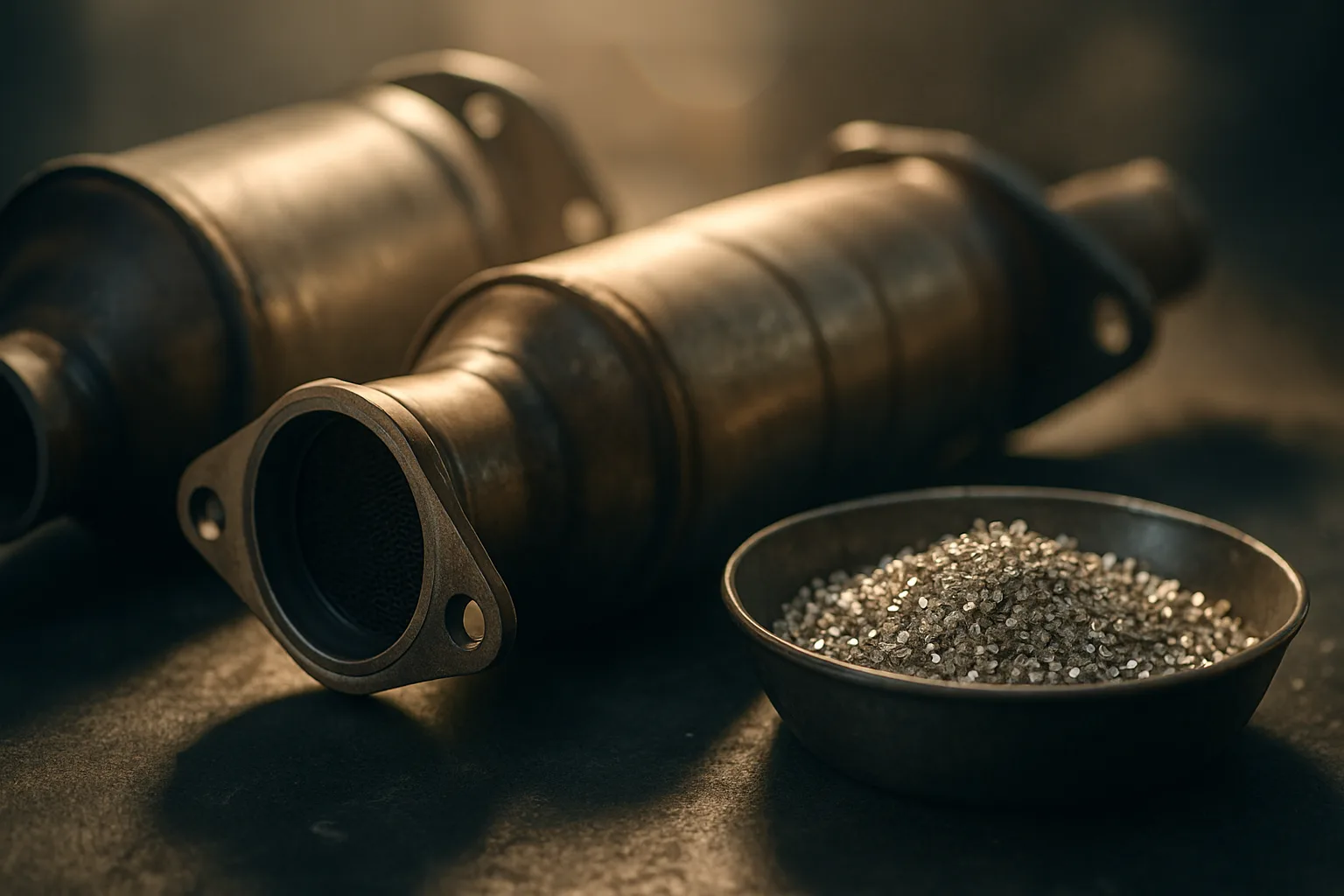
Most scrap yards treat catalytic converters like any other piece of metal. That's a mistake — and it's costing sellers real money. The OEM catalytic converter value sitting in your pile isn't just about weight. It's directly tied to global emissions policy, and those policies keep getting tighter. If you're selling scrap cats in Canada without understanding what's pushing prices, you're negotiating blind.
Here's the straight version: stricter emissions regulations mean automakers need more platinum group metals (PGMs) — platinum, palladium, and rhodium — to build converters that pass inspection. More industrial demand for PGMs means tighter supply from mines. Tighter mine supply means recycled PGMs from scrap converters become more valuable to refiners. And that value flows back to the seller — if you know how to capture it.
This article breaks down exactly how emissions rules connect to scrap cat prices, what it means for sellers in British Columbia, and how platforms like SMASH help you stop leaving money on the table.
---Why Emissions Standards Directly Affect OEM Catalytic Converter Value
Catalytic converters exist for one reason: to reduce harmful exhaust emissions. Inside every OEM converter is a ceramic or metallic honeycomb coated with PGMs. These metals trigger chemical reactions that convert carbon monoxide, hydrocarbons, and nitrogen oxides into less harmful compounds before they exit the tailpipe.
When governments tighten emissions thresholds — which they have done consistently through the 2020s — automakers respond by loading converters with more PGM content, not less. Hitting a tighter NOx limit requires a more active catalyst. A more active catalyst requires a higher PGM loading. Higher PGM loading in new vehicles means higher PGM content in scrap converters when those vehicles reach end of life. That's the direct line from regulation to recycling value.
Key emissions frameworks driving this in 2026 include:
- Euro 7 standards — Phasing in across Europe with significantly tighter particulate and NOx limits, pushing global OEM suppliers to increase PGM loadings across model lines
- EPA Tier 3 and California LEV III — U.S. standards that Canadian automakers and importers align to, affecting vehicle specs sold into British Columbia and across Canada
- Canada's own emissions regulations — Transport Canada aligns closely with U.S. federal standards, meaning Canadian vehicles carry the same converter specs and PGM content as their American counterparts
- Heavy-duty diesel mandates — Diesel trucks and commercial vehicles require diesel oxidation catalysts and diesel particulate filters, both of which carry meaningful PGM content
The result is a global recycling market hungry for PGMs recovered from scrap converters. Refiners actively compete to secure scrap cat supply. That competition is exactly what makes catalytic converter prices today more dynamic than most yard operators realize.
---5 Ways Tighter Emissions Rules Push Scrap Cat Prices Higher
Understanding the mechanism is one thing. Knowing what it means for your yard's revenue is another. Here are five concrete ways the regulatory environment shapes what your converters are worth right now.
-
Higher PGM content in newer OEM units
Vehicles manufactured from the mid-2010s onward consistently carry more platinum, palladium, and rhodium than older units. As those vehicles now enter the scrap cycle in volume, the average converter coming off the pile is worth more than it was five years ago. An OEM unit from a 2019 or newer vehicle isn't the same as a converter off a 2003 sedan — the PGM loading can differ significantly. -
Mine supply isn't keeping up with industrial demand
The majority of the world's palladium and platinum comes from South Africa and Russia. Both regions face ongoing supply constraints. When primary mine production can't meet demand from automakers and industrial users, refiners turn aggressively to secondary supply — meaning your scrap cats. Tight primary supply puts a floor under recycled PGM pricing. -
Electric vehicle transition is slower than projected
EV adoption in Canada has grown, but internal combustion engine vehicles still dominate new sales and the existing fleet. Millions of ICE vehicles remain on Canadian roads. That means catalytic converter production continues at scale, and scrap volumes from end-of-life ICE vehicles remain strong for years ahead. The "cats are dying out" narrative is premature for the scrap market. -
Diesel emissions rules generate new scrap cat categories
Tighter diesel regulations have created large secondary markets in diesel oxidation catalysts and diesel particulate filters — both of which carry PGM content and both of which are now common in commercial vehicle scrap. Yards that handle fleet equipment in Burnaby or anywhere across the Lower Mainland have access to this supply stream. -
Refiner competition increases buyer urgency
Refiners globally are competing to lock in scrap cat supply. That competitive pressure means buyers are motivated — but only if they can identify and verify what they're buying. Documented, graded inventory moves faster and attracts better bids. Guessing at converter type and PGM content is how sellers end up undervalued.
Why Identifying Your Converters Correctly Is Worth Real Money
Here's where most sellers lose value they didn't know they had. Not all catalytic converters are worth the same — not even close. An OEM converter off a late-model truck can be worth multiples of an aftermarket replacement unit. Foil-type converters differ from ceramic-substrate units. Diesel cats differ from gasoline cats. If you're lumping them together, you're averaging down your best pieces.
The way to avoid that is documentation and identification before you sell. This is where scrap metal inventory management stops being a back-office function and starts being a revenue driver. When you can show a buyer exactly what substrate type you have, what vehicle the converter came from, and what condition it's in — with photos and serial numbers to back it up — you remove their pricing cushion. They can't lowball an unknown. A documented load forces market-rate pricing.
SMASH builds this directly into the platform. Sellers use the inventory tool and VIN lookup to grade and document converters before they go to auction. Serial tracking and photo documentation give buyers confidence in what they're bidding on. More buyer confidence means more competitive bids. More competitive bids means better catalytic converter worth at scrap yard — and that's a direct outcome of documentation discipline, not luck.
If you want to get a fair price for your scrap catalytic converters in Canada, the work starts before the sale, not at the point of transaction.
---How the SMASH Scrap Metal Auction Changes the Pricing Equation
The traditional model for selling scrap cats is broken. You call one buyer. They quote you a price. You accept or walk. You have no idea if that price reflects the market or just reflects their margin target for the week. That's not a transaction — it's a guess with one data point.
The SMASH scrap metal auction model replaces that guess with competition. Multiple vetted buyers see your documented inventory and bid against each other. That competition is what reveals the actual market. One buyer quoting you isn't the market — it's one opinion. Several buyers competing for your load is the market.
For sellers in Burnaby and across British Columbia, this matters because local market access has historically been limited. Your closest buyer isn't necessarily your best buyer. SMASH connects you to vetted buyers across North America, which means your Burnaby yard isn't capped by whoever happens to be local. The best bid wins, regardless of geography.
No subscription fees. SMASH only wins when the seller wins. Auto-invoicing and BOL documentation are built in, so the paperwork side of a cross-regional sale doesn't become a headache. If you're ready to find the best scrap cat prices in Canada, the platform is built for exactly that outcome.
---What British Columbia Scrap Cat Sellers Should Know About Catalytic Converter Prices Today
PGM prices fluctuate. Palladium, platinum, and rhodium all trade on commodity exchanges, and their spot prices move with industrial demand, geopolitical supply factors, and currency shifts. That means catalytic converter prices today are not the same as they were six months ago, and they won't be the same six months from now. Timing matters — and so does knowing what drives the swings.
For sellers in Burnaby and the surrounding Lower Mainland, a few practical realities apply:
- British Columbia's vehicle fleet skews toward newer, cleaner vehicles due to provincial emissions and inspection requirements — which often means higher PGM content per unit in the local scrap stream
- Commercial vehicle traffic through the Port of Metro Vancouver generates diesel cat and DPF supply that carries real value if identified and sold correctly
- Local buyers aren't always the most competitive — national and cross-border buyers on auction platforms often bid higher for well-documented lots
- Aftermarket cats and OEM cats must be kept separate and sold separately — mixing them destroys value on your best pieces
For current pricing, always check live rates before you sell. Prices fluctuate with PGM spot markets and should be verified at point of transaction. The right platform gives you visibility into what buyers are actually willing to pay — not what one local contact tells you the market is doing.
If you want to stay sharp on market movements and selling strategy, read Canadian scrap catalytic converter guides for ongoing insights.
---Finding the Right Buyer for Scrap Cats in Burnaby and Beyond
Searching for catalytic converter recycling near me is a reasonable starting point — but local availability shouldn't be the ceiling on your price. The best buyer for your load of scrap cats might be in another province or across the border. What matters is that they're vetted, competitive, and working with accurate information about what you're selling.
SMASH was built to solve exactly that problem. The platform connects sellers to verified buyers who compete on documented inventory. You don't need to cold-call processors or wonder if your price is fair. You put your documented load in front of multiple buyers and let competition do the work. That's how price discovery is supposed to work.
Whether you're clearing a single load out of a Burnaby yard or managing ongoing converter volume across multiple locations in British Columbia, the process is the same: document it properly, get it in front of competitive buyers, and let the auction format reveal the real market rate. If you want to find the best price for your scrap in Canada, that's the model that delivers.
Ready to stop guessing? Get a free quote at best-scrap-cat-prices.ca and find out what your converters are actually worth in today's market.
---Frequently Asked Questions
Q: How do emissions regulations affect OEM catalytic converter value in Canada?
Tighter emissions standards require automakers to use higher concentrations of platinum group metals in OEM converters to meet NOx and particulate limits. Higher PGM loading in new vehicles means more recoverable value when those vehicles reach end of life and the converters enter the scrap stream. Canadian vehicles largely follow U.S. federal and California emissions specs, so this effect applies directly to the Canadian scrap cat market.
Q: What are catalytic converter prices today based on?
Scrap cat prices are driven primarily by the spot prices of platinum, palladium, and rhodium on commodity markets. The specific converter type, substrate condition, and whether the unit is OEM or aftermarket also affect value significantly. Prices fluctuate regularly — always verify current rates before completing a sale, as values can shift meaningfully week to week.
Q: Is catalytic converter recycling near me in Burnaby competitive with national buyers?
Local buyers in Burnaby and the Lower Mainland are a starting point, but they're not always the most competitive option. Auction platforms like SMASH connect British Columbia sellers with vetted buyers across North America, which typically introduces more competition and better price discovery than a single local quote. Your location limits your logistics options, not your buyer pool.
Q: How do I know what my catalytic converter is worth at a scrap yard?
Value depends on the converter's PGM content, which varies by make, model, year, and whether the unit is OEM or aftermarket. Identifying the converter correctly — using serial numbers, VIN lookup, and substrate documentation — before you sell gives buyers the information they need to bid accurately. Undocumented, ungraded cats almost always get priced conservatively, meaning you absorb the buyer's uncertainty in your sale price.
Q: Does the SMASH scrap metal auction work for catalytic converter sellers in British Columbia?
Yes. SMASH is designed for scrap sellers across North America, including British Columbia yards. Sellers document their inventory using the platform's tools — photo documentation, VIN lookup, serial tracking — then put documented loads in front of vetted buyers who compete in an auction format. No subscription fees apply; SMASH only earns when the seller completes a sale.
---Follow SMASH on LinkedIn for ongoing scrap metal market updates, PGM price insights, and catalytic converter industry news.