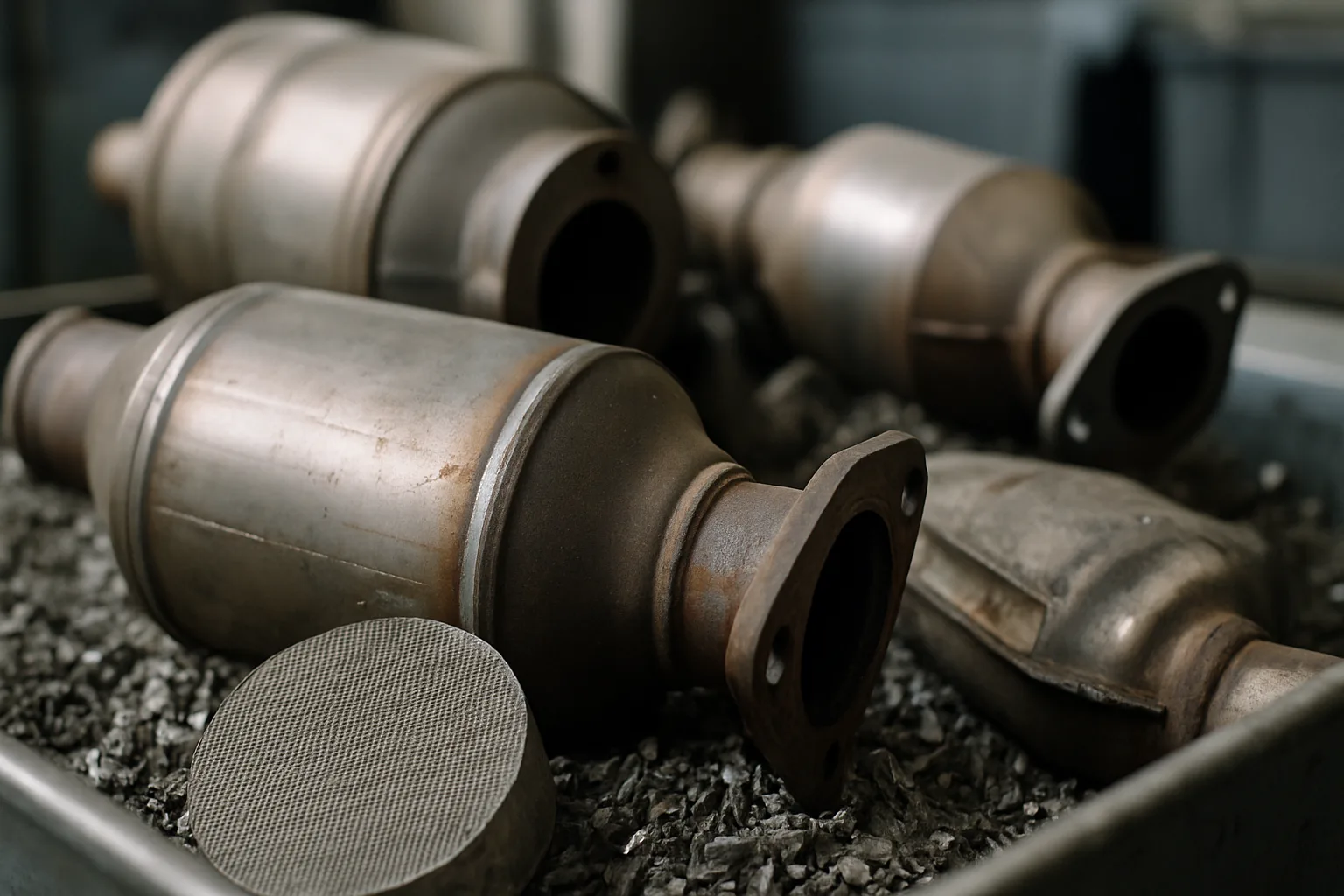
Most scrap yards give you a number. Few explain where it comes from. If you've ever wondered why two converters that look identical can be worth completely different amounts, the answer is sitting on a commodities exchange right now — in the form of platinum, palladium, and rhodium. Understanding how these metals move is the difference between leaving money on the table and walking away with a fair price.
The platinum price today is not a number a buyer makes up. It's pulled from live spot markets, cross-referenced against your specific converter's known precious metal content, and then discounted based on processing costs and margin. That's the formula — and once you understand it, you can evaluate any offer you receive.
Whether you're a yard operator in Etobicoke sitting on a pile of cats, or a private seller with a single converter pulled off a Honda, this breakdown matters. Let's get into it.
---The Three Metals That Determine Scrap Catalytic Converter Value
Every catalytic converter contains a ceramic or metalite substrate coated with a washcoat of precious metals. That washcoat is where the value lives. The three primary metals are platinum (Pt), palladium (Pd), and rhodium (Rh) — and each one trades independently on global commodity markets.
Here's why that matters for sellers:
- Platinum (Pt): Historically the headline metal, platinum is used more heavily in diesel converters. It catalyzes the oxidation of hydrocarbons and carbon monoxide. Platinum prices fluctuate with industrial demand, automotive production cycles, and investment flows.
- Palladium (Pd): The dominant metal in gasoline-engine converters. Palladium saw extreme price swings in the early 2020s and remains volatile. It handles oxidation in petrol applications and is often present in higher concentrations than platinum in modern cats.
- Rhodium (Rh): The most volatile of the three — and sometimes the most valuable by weight. Rhodium handles NOx reduction (the conversion of nitrogen oxides). Even small amounts of rhodium can represent a significant share of a converter's total value.
The exact ratio of these metals varies by vehicle make, model, engine size, and year of manufacture. A large-displacement truck converter isn't worth more just because it's bigger — it's worth more because the substrate holds a different precious metal profile. That's why serial number tracking and VIN lookup tools exist. They let buyers and sellers reference actual assay data instead of guessing.
---How the Platinum Price Today Feeds Into Your Quote
When a buyer quotes your catalytic converter, they start with live spot prices for platinum, palladium, and rhodium. Those prices update in real time during market hours. Then they apply what's called a return percentage — the share of the recovered metal value they're willing to pass on to the seller after accounting for smelting, assay, logistics, and margin.
This is where the old single-buyer model breaks down. If you call one yard in Etobicoke and take the first number you hear, you have no way of knowing whether that return percentage is 70%, 80%, or somewhere lower. You don't know what spot price they're using. You don't know if they're offering you today's rate or a rate they cached from three days ago when the market was lower.
Transparency in this calculation is rare — but it's exactly what competitive quoting forces. When multiple buyers are bidding on the same load, they're all starting from the same spot prices. The competition happens at the return percentage level. That's meaningful. To find the best scrap cat prices in Canada, you need more than one number to compare.
Keep in mind: precious metal markets move daily, and sometimes sharply. The platinum price today may be meaningfully different from what it was last week. Always check current rates before accepting any offer — a disclaimer worth taking seriously, not just printing in small type.
---Why Converter Identity Matters as Much as Metal Prices
Here's a variable most first-time sellers don't account for: two converters from the same vehicle platform but different model years can have wildly different precious metal loadings. Manufacturers adjust washcoat recipes based on emissions standards, cost of metals, and engineering updates. A 2019 unit might have a heavier rhodium load than a 2023 unit from the same model line — or vice versa.
This is why serious buyers use serial number databases and VIN-based lookup tools. The serial number stamped or engraved on the converter body maps to published assay data — actual lab results showing average platinum, palladium, and rhodium content for that specific part number. When a buyer has access to that data, they can price accurately. When they don't, they either lowball to hedge their risk or they guess — and guessing rarely benefits the seller.
Platforms that include photo documentation requirements add another layer. A clear photo of the serial number eliminates ambiguity, prevents disputes after the fact, and gives buyers confidence to bid competitively. Documented inventory isn't just good practice — it demonstrably helps price discovery. If you want to get a fair price for your scrap catalytic converters in Canada, documentation is step one.
For yards in Etobicoke and across Ontario running high volumes, this documentation discipline compounds quickly. Consistent serial tracking means cleaner records, faster buyer decisions, and fewer post-sale disputes.
---The Auction Model vs. the Phone Call: What Changes for Sellers
The traditional model for selling scrap cats looks like this: you call a buyer you've always used, they give you a price, you load the truck. Maybe you call two buyers if you're motivated. That's the ceiling on price discovery — two data points.
A catalytic converter auction flips the dynamic entirely. Your documented load goes out to multiple vetted buyers simultaneously. They all see the same photos, the same serial numbers, the same weight and condition information. They bid against each other. The competitive pressure to win the load is what drives the offer toward actual market value rather than away from it.
This isn't theoretical. It's basic economics: more buyers competing for the same supply means better price discovery for the seller. That's the premise behind platforms like SMASH — the scrap metal auction platform built to find the best price for your scrap in Canada. The auction format doesn't guarantee a specific outcome, but it does guarantee you're not leaving the room before anyone else gets a chance to bid.
For a seller in Etobicoke with a recurring volume of cats coming through the yard, switching from single-buyer pricing to an auction model is a structural change — not a one-time transaction. You build a history, buyers build confidence in your loads, and the process gets faster and more consistent over time. SMASH handles the auto-invoicing and documentation side, which removes friction from every deal.
To understand more about how the process works from a Canadian seller's perspective, read our Canadian scrap catalytic converter guides — there's a lot of context that makes a difference at the yard level.
---Regulatory Context in 2026: What Ontario Sellers Need to Know
Catalytic converter theft and resale regulation has tightened significantly across North America over the past several years, and Ontario is no exception. In 2026, scrap yards and buyers operating in the province are required to maintain documented records of converter transactions — including seller identification, vehicle source information where available, and serial number logging.
This isn't just compliance overhead. It's a direct input into how buyers assess risk when pricing a load. A well-documented lot of cats — with clear photos, serial numbers, and chain-of-custody records — is a lower-risk purchase for a buyer. Lower risk often translates into stronger bids. The inverse is also true: undocumented loads create liability concerns that buyers price into their offers defensively.
For sellers operating at volume in Ontario, getting your documentation process right isn't optional anymore. It's table stakes. The good news is that the same tools that help you stay compliant — photo capture, serial tracking, VIN lookup — are the same ones that make your loads more attractive to competitive buyers.
If you're selling cats in Etobicoke or anywhere else in Ontario and you're not yet tracking serials, that's the first thing to fix. The infrastructure is available. The buyers who pay the best prices expect it.
---How to Use Spot Prices to Evaluate Any Offer You Receive
You don't need to be a commodity trader to sanity-check a scrap cat offer. Here's a practical framework:
- Look up today's spot prices. Platinum, palladium, and rhodium spot prices are publicly available from commodities exchanges and financial data sites. The platinum price today is not a secret.
- Reference the serial number. If you know the converter's part number, published assay databases will show approximate precious metal content (in grams per unit). Multiply grams by spot price to get theoretical gross value.
- Assess the return percentage offered. Divide the offer you received by the theoretical gross value. That percentage tells you what the buyer is actually returning to you. Industry return rates vary, but knowing where your offer sits gives you leverage in conversation.
- Get a second number. One offer is not a market. Two offers reveal a spread. Three offers start to define the actual market for your load.
- Document everything before you ship. Once a converter leaves your yard, your ability to dispute a grade or serial number mismatch drops to near zero.
This process sounds like extra work. The first time, it is. By the tenth load, it's habit — and it's the difference between guessing and knowing what your inventory is worth.
If you're ready to stop guessing and start getting competitive quotes, the place to start is simple: find the best Canadian scrap cat prices — get a free quote at best-scrap-cat-prices.ca. No subscription, no obligation — just documented, competitive pricing based on what the market will actually pay today.
---Frequently Asked Questions
Q: How does the platinum price today affect what I get paid for my scrap catalytic converter?
Buyers calculate converter value by multiplying the precious metal content (platinum, palladium, rhodium) by current spot prices, then applying a return percentage to account for processing costs and margin. When the platinum price today rises, offers on platinum-heavy converters (typically diesel units) rise proportionally. Spot prices update in real time, so the offer you get today may differ from what you'd receive tomorrow.
Q: Are there catalytic converter buyers in Etobicoke who use competitive pricing?
Yes. The market for scrap cats in Etobicoke has access to both local buyers and online auction platforms that connect sellers to vetted buyers across Ontario and beyond. Using a competitive quoting platform rather than a single buyer typically produces better price discovery, since buyers are competing against each other rather than setting the price unilaterally.
Q: What's the difference between a catalytic converter scrap yard price and an auction price?
A scrap yard price is a single buyer's offer — built to protect their margin and reflect their current inventory position. An auction price emerges from competition among multiple buyers, all working from the same documented load information. The auction format doesn't guarantee a higher number, but it does mean more buyers have had the opportunity to bid, which generally produces more accurate market pricing.
Q: Do I need the serial number to sell a scrap catalytic converter in Ontario?
In 2026, Ontario regulations require documented records for converter transactions, and serial number logging is increasingly standard practice for compliant buyers. Beyond compliance, having the serial number allows buyers to reference assay data and price your converter accurately — which tends to result in stronger offers. Missing serials increase buyer risk, which they typically price in by reducing their bid.
Q: Why do palladium and rhodium prices matter more than platinum for some converters?
Most gasoline-engine converters are palladium-dominant — they carry more palladium by weight than platinum. Rhodium, while present in smaller amounts, is among the most valuable precious metals per gram and can represent a significant share of total converter value. The specific metal mix depends entirely on the vehicle's make, model, and year — which is why serial number identification matters so much in accurate pricing.
---Follow SMASH on LinkedIn for scrap metal market updates, precious metal price movements, and industry news relevant to yards and sellers across North America.