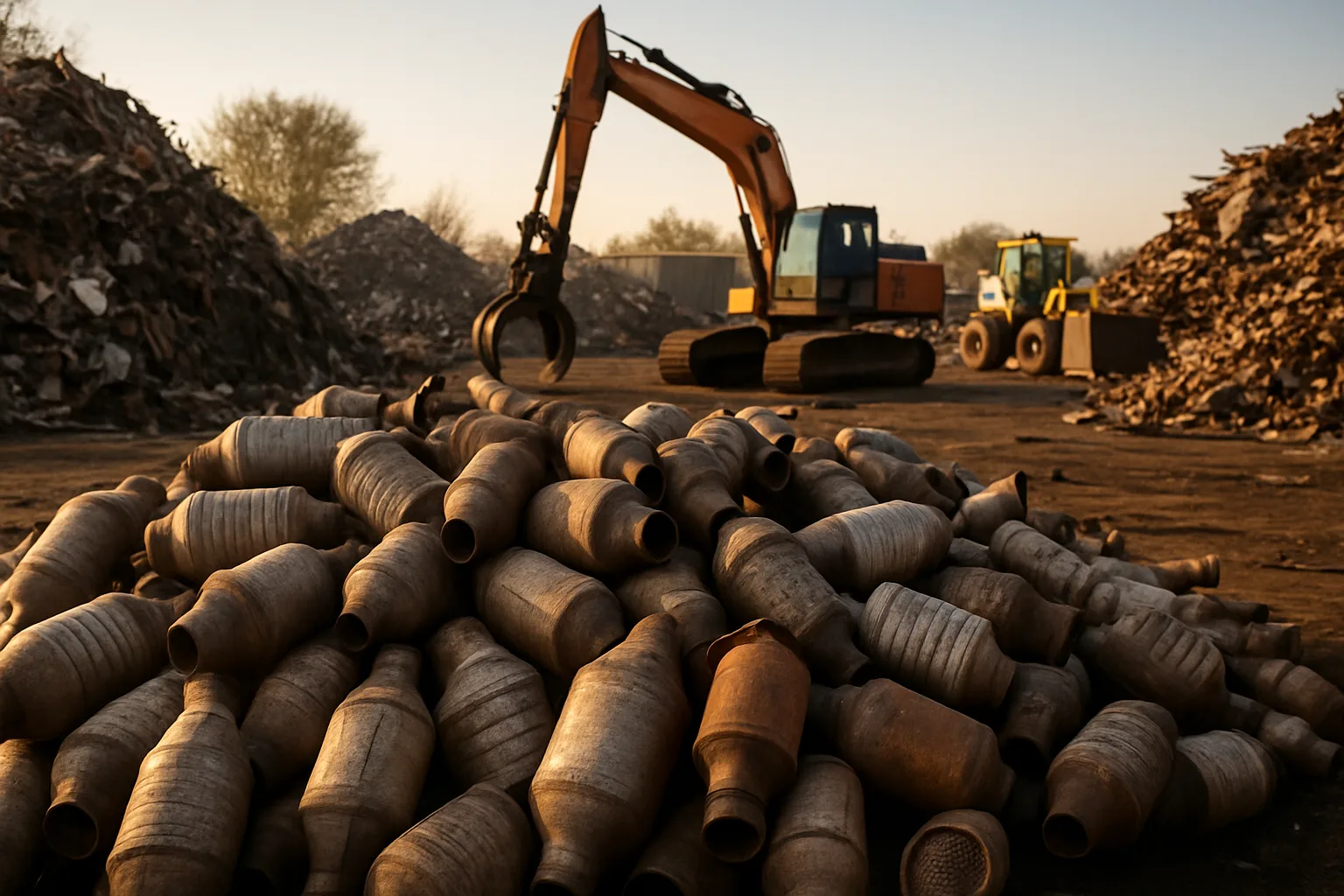
Most scrap yards treat all catalytic converters the same. Toss them in a bin, get a flat rate, move on. But if you're selling cats without knowing whether you have foil-style or bead-style units — and why that distinction matters — you're leaving real money on the table. With rhodium price today still commanding serious attention in the precious metals market, understanding what's inside your converter isn't optional. It's how you get paid fairly.
This guide breaks down the difference between foil and bead catalytic converters, what each type contains, and how sellers in Winnipeg and across Manitoba can make smarter decisions when it's time to move inventory.
---Foil vs. Bead: The Basic Breakdown
Catalytic converters work by running exhaust gases over a substrate coated with precious metals — primarily platinum, palladium, and rhodium. The substrate is the structure inside the converter that holds those metals. There are two common substrate designs you'll encounter in the scrap market: ceramic foil (metallic foil) and ceramic bead.
Foil-style converters use a thin, corrugated metallic substrate — typically made from a stainless steel or iron-chromium alloy — rolled into a honeycomb configuration. These are common in European and some Asian imports, as well as certain diesel applications. They're lighter than traditional ceramic converters. From the outside they can look similar, but the metallic substrate is physically more durable and doesn't crumble the way ceramic does.
Bead-style converters use small ceramic or alumina beads — think of them like a canister filled with marbles — coated with precious metals. You'll find these more often in older domestic vehicles and certain industrial or off-road equipment. When you cut one open, the beads pour out. They're a distinctly different processing challenge compared to honeycomb ceramic or foil substrates.
Both types contain recoverable platinum group metals (PGMs). The critical difference is how much they contain, how concentrated those metals are, and what a processor will actually pay for them.
---OEM Catalytic Converter Value: What Drives the Price on Both Types
When a refiner or buyer prices a catalytic converter, they're pricing the PGM content — not the steel shell. OEM catalytic converter value is tied directly to three variables: the type and volume of precious metals in the substrate, current spot prices for platinum, palladium, and rhodium, and the efficiency of recovery during processing.
Here's what you need to know about each metal:
- Rhodium — The highest-value PGM by far. Rhodium price today fluctuates significantly based on supply constraints (primarily South African mining output) and automotive demand. It's used in three-way catalysts to reduce nitrogen oxides (NOx).
- Palladium — Heavily used in gasoline vehicle catalysts. Prices have been volatile through the mid-2020s as EV adoption shifts the demand curve.
- Platinum — More common in diesel converters. Typically lower in price than palladium or rhodium but still significant in volume.
Foil-style converters tend to have a higher surface area-to-volume ratio, which can mean more efficient catalytic action — but it doesn't automatically mean higher PGM loading. Actual PGM content varies by manufacturer, vehicle application, and emissions standard the converter was designed to meet. Bead-style units, particularly older ones, can carry meaningful PGM content but often at lower concentrations per unit weight compared to modern honeycomb or foil designs.
The bottom line: don't assume one style is always worth more than the other. Get a proper assay or use a platform that gives you real price discovery — not a flat-rate guess.
---Identifying What You Have Before You Sell
Before you find the best scrap cat prices in Canada, you need to know what you're actually selling. Misidentifying a converter type — or selling a foil-style unit at ceramic pricing — is a common and costly mistake.
Here's a practical way to identify what you have:
- Shake the unit. Bead converters often rattle — you can hear and feel the beads moving inside the canister. Foil-style and ceramic honeycomb units do not rattle.
- Check the weight. Foil substrate converters tend to be lighter than equivalent-sized ceramic units. Bead converters can be heavier due to the mass of the substrate material.
- Look at the end face. If the face of the substrate is visible, foil/metallic converters show a corrugated metallic sheen. Ceramic honeycomb has a matte, porous surface. Beads are opaque — you won't see through the substrate face.
- Use VIN or part number lookup. If you're pulling cats from a vehicle you're scrapping, the VIN gives you make, model, year, and engine — which narrows down the converter type significantly. SMASH's platform includes a VIN lookup tool that helps with exactly this.
- Photograph and document. Serial numbers, manufacturer marks, and physical photos help buyers verify what they're bidding on. Documented inventory gets better price discovery — that's just how the market works.
Sellers in Winnipeg running volume — pulling cats from shredder feed, end-of-life vehicles, or auto recycling operations — benefit most from systematic identification. Sorting before listing means buyers bid with confidence, and confident buyers bid higher.
---What Foil and Bead Converters Are Actually Worth in the Current Market
Let's be direct: specific prices change daily. Anyone giving you a hard number without checking live PGM spot prices — including rhodium price today — is guessing. What we can do is give you realistic context.
Foil-style converters from European imports (BMW, Mercedes, Audi, Volkswagen) and certain Japanese models tend to command stronger pricing when PGM content has been verified. They're processed differently than ceramic — refiners use a specific process to handle the metallic substrate — so make sure the buyer you're working with actually processes foil, not just ceramic. Some buyers discount foil units simply because they don't have the right processing setup.
Bead-style converters are less common in modern vehicles but still show up in older North American inventory and equipment. They can be harder to price quickly because the bead-to-PGM ratios vary more than honeycomb or foil units. Buyers may apply a broader spread on bead pricing, which is another reason competitive bidding matters.
A few real-world reference points to keep in mind:
- Small or "low-grade" foil units may fall in the lower pricing tier — similar to domestic economy cars.
- High-grade foil units from premium European vehicles can price significantly above the average domestic cat.
- Bead converters are often priced conservatively by single buyers. Getting multiple bids can reveal whether you're being underpaid.
- Damaged, de-canned, or spent converters — regardless of type — price lower. Physical condition matters.
Disclaimer: Catalytic converter scrap prices fluctuate daily based on PGM spot prices. Always check current rates before selling. The figures above are general context, not guaranteed pricing.
---Why Sellers in Manitoba Should Stop Relying on a Single Buyer
Here's the problem with the old way of selling: you call one buyer, they quote you a price, and you either take it or walk away. That buyer knows what rhodium, palladium, and platinum are trading at right now. You might not. That information gap costs sellers money — every single day.
Winnipeg and the broader Manitoba market have solid scrap infrastructure, but competition for specialty items like foil and bead converters isn't always deep locally. A single-buyer approach for less common converter types can mean your unit gets priced at generic rates because the buyer doesn't specialize or simply doesn't want to negotiate.
This is exactly the problem that platforms like smashrecycling.ca are built to solve. When you list documented inventory — properly identified foil or bead units with photos, serial tracking, and accurate descriptions — vetted buyers compete. Competition reveals the market. A buyer who specializes in European foil converters may bid significantly more than a generalist yard because they know what they have and they can process it efficiently.
You can also get a fair price for your scrap catalytic converters in Canada by moving away from verbal quotes and toward documented, competitive sales. Whether you're selling five units or five hundred, the process is the same: document what you have, get multiple eyes on it, and let the bids tell you what the market actually thinks it's worth.
For Manitoba sellers who want to Winnipeg scrap metal services without committing to a subscription or long-term contract, SMASH operates on a no-subscription model — you only pay when you sell. That structure keeps things honest.
---How to List Foil and Bead Converters for Maximum Price Discovery
Good listings get better bids. It's that simple. Here's how to sell catalytic converters Manitoba — or anywhere in Canada — in a way that gives buyers what they need to bid aggressively.
Document the substrate type clearly. Call it out — foil or bead — so buyers self-select. A buyer who doesn't process foil units won't bid; a buyer who does will bid more confidently.
Include photos of the face and shell. Show the substrate condition. Buyers want to see that the substrate isn't destroyed, de-canned improperly, or contaminated.
Include VIN or application data if available. A foil converter from a 2019 BMW 3 Series prices differently than an unknown foil unit. Application data gives buyers confidence to move up their bid.
Note any damage or defects. Cracked substrates, missing baffles, or physical damage should be disclosed. Misrepresentation kills trust and future deals.
Group similar units together. If you have ten foil converters from similar applications, listing them as a lot often attracts more buyer interest than ten individual listings. Volume buyers want volume.
If you want to sell scrap metal online efficiently and stop leaving money on the table, the documentation step is non-negotiable. Buyers can't bid on what they can't evaluate. Give them the information, and you'll see the difference in what they offer.
For more guidance on navigating the Canadian scrap converter market, read Canadian scrap catalytic converter guides covering pricing, regulations, and how to maximize your returns.
---Frequently Asked Questions
Q: What is the rhodium price today and how does it affect my scrap cat value?
Rhodium prices change daily based on mining supply, industrial demand, and global market conditions. Because rhodium is one of the highest-value PGMs in catalytic converters, even moderate price swings can shift your converter's value meaningfully. Always check live spot prices before selling — and use a platform that prices your cats against current market data, not last week's rates.
Q: Are foil catalytic converters worth more than ceramic ones?
Not automatically. Foil converters from premium European vehicles often carry higher PGM loading, but a high-grade ceramic converter from the right application can outvalue a low-grade foil unit. What matters is the actual PGM content and what a specialized buyer is willing to pay for it. Get multiple bids to find out.
Q: Where can I sell scrap catalytic converters in Winnipeg?
You have local yard options in Winnipeg, but local competition for specialty types like foil and bead converters can be limited. Using an online platform that connects you with vetted buyers across Canada — like SMASH — can expose your inventory to buyers who specialize in specific converter types and pay accordingly.
Q: How do I identify a bead-style catalytic converter?
Shake it — bead converters rattle because the loose ceramic beads shift inside the canister. They also tend to feel heavier than foil or ceramic honeycomb units of the same external size. If you're unsure, photograph the face of the substrate or use a VIN lookup to confirm the converter application.
Q: Is there a used catalytic converter price lookup tool I can use?
Yes. SMASH's platform includes VIN lookup and serial tracking tools that help identify converter applications and support accurate pricing. This is especially useful when you're processing multiple units and need to sort high-value from low-value inventory before listing. Documented inventory consistently attracts better bids than mystery lots.
---Whether you're running a recycling yard in Winnipeg, pulling cats from end-of-life vehicles across Manitoba, or building out your scrap converter operation, knowing what you have is the first step to getting paid properly for it. Foil and bead converters aren't niche anymore — they're in the inventory of any operation handling volume, and the difference between a flat-rate offer and a competitive bid can be significant. If you want to sell catalytic converters Manitoba at prices that reflect what the market actually values, start with documentation, get multiple bids, and use tools built for this industry. When you're ready, find the best scrap cat prices in Canada and get a free quote at best-scrap-cat-prices.ca.
Stay sharp on scrap metal market trends — follow SMASH on LinkedIn for industry updates, PGM market insights, and news that affects what your inventory is worth.