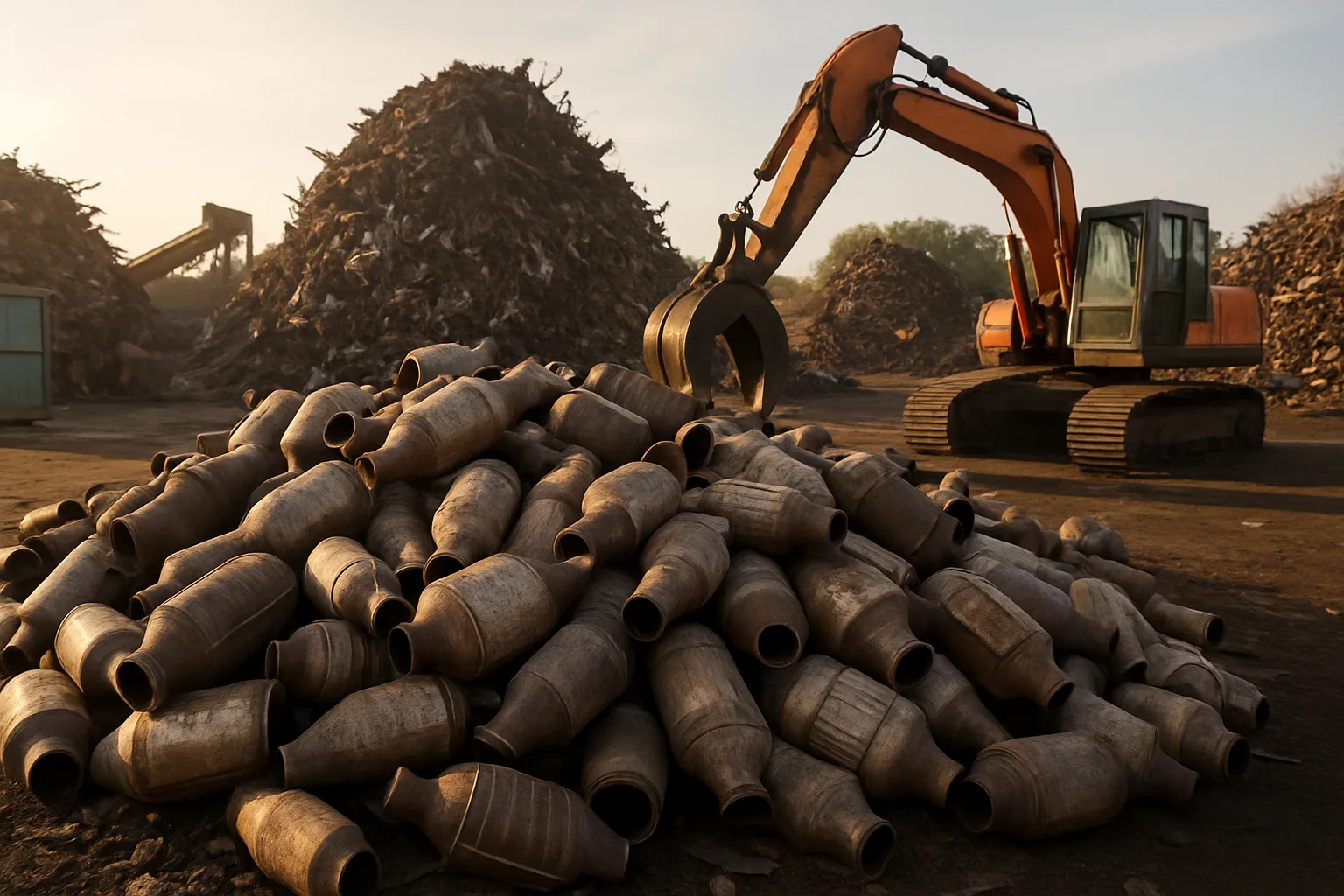
Rhodium Costs More Per Ounce Than Gold. Here's Why That Matters for Your Scrap Cats
Most scrap yards talk about platinum and palladium when they explain OEM catalytic converter value. That's fair — both metals move the needle on what a buyer will pay. But rhodium is the metal that can take a mid-grade cat and make it worth serious money. If you're selling scrap catalytic converters in Canada and you don't understand rhodium, you're probably leaving money on the table.
This guide breaks down what rhodium is, why it commands such an extreme price, and how that affects what you should expect when you bring a load of cats to market — whether you're operating a recycling yard in Brandon, Manitoba or sourcing converters across the province.
What Are Platinum Group Metals and Why Do Catalytic Converters Use Them?
Catalytic converters exist for one reason: to scrub toxic exhaust gases before they leave a vehicle's tailpipe. To do that job, the converter's internal substrate needs to trigger chemical reactions — turning carbon monoxide, hydrocarbons, and nitrogen oxides into carbon dioxide, water vapor, and nitrogen. That's not a job for common metals.
Platinum group metals (PGMs) — platinum, palladium, and rhodium — are uniquely suited to this. They act as catalysts, meaning they drive chemical reactions without being consumed themselves. They also survive extreme heat cycles that would destroy almost any other material. That combination of chemical reactivity and thermal durability is why automakers have relied on PGMs since catalytic converters became standard equipment in the 1970s.
- Platinum (Pt): Handles oxidation reactions. Common in diesel converters.
- Palladium (Pd): Highly effective in gasoline engines. Dominant in three-way catalytic converters.
- Rhodium (Rh): Targets nitrogen oxide (NOx) reduction. Critical for meeting modern emissions standards.
All three show up in varying concentrations depending on the vehicle manufacturer, engine type, model year, and emissions regulation the vehicle was built to meet. That variation is exactly why OEM catalytic converter value isn't uniform — two converters sitting in the same bin can have dramatically different precious metal loads.
Why Rhodium Commands the Highest Price Per Ounce
Rhodium is extraordinarily rare. It's one of the rarest stable elements on earth, produced almost entirely as a byproduct of platinum and nickel mining. The primary source is South Africa's Bushveld Complex, and global annual production is measured in tens of tonnes — a fraction of gold or silver production. When supply is that tight, price volatility is the norm, not the exception.
Demand, meanwhile, hasn't softened. Stricter global emissions regulations — Euro 7 in Europe, Tier 3 standards in North America, China 6b — have pushed automakers to load more rhodium into converters to hit NOx targets. More rhodium per vehicle, fewer tonnes mined per year: that equation keeps the price floor elevated even in down markets.
What does that mean practically? A converter from a late-model vehicle built to tight emissions standards may contain a small but meaningful concentration of rhodium. That fraction can account for a substantial portion of the unit's total scrap value — sometimes more than the platinum and palladium combined, depending on market conditions on a given day. If you want to find the best scrap cat prices in Canada, understanding rhodium's role in your specific units is non-negotiable.
How Rhodium Content Varies Across OEM Catalytic Converter Types
Not every converter is loaded with rhodium equally. OEM choices vary by manufacturer, emissions tier, and application. Understanding the general patterns helps you assess a load before you take it to a buyer.
Three-way catalytic converters (TWC) — found in virtually all modern gasoline passenger vehicles — use all three PGMs. Rhodium's role in NOx reduction makes it a standard inclusion, though loading varies. European and Japanese OEM units built to tighter emissions targets often carry higher rhodium concentrations than older North American-spec converters.
Diesel oxidation catalysts (DOC) use primarily platinum. Rhodium concentration is low to negligible. If your load is heavy on DOCs from diesel fleet vehicles — common in agricultural and commercial sectors you'd find across Manitoba — temper your rhodium expectations on those units specifically.
High-load OEM converters from luxury manufacturers and performance vehicles can carry elevated PGM totals across the board, including rhodium. These units often require serial number tracking and precise identification to get accurate valuations.
- Know your converter types before you price a load
- OEM units generally outperform aftermarket replacements in PGM content
- Serial number and VIN lookup tools give you category data before any negotiation
- Photo documentation of foil condition and substrate integrity matters — damaged substrate means lost metal
Platforms like SMASH support serial tracking and photo documentation at the inventory stage, so buyers see exactly what they're bidding on. That transparency tends to produce better price discovery than a cold call where neither side has full information.
Catalytic Converter Prices Today: What Drives Daily Fluctuations
If you've checked catalytic converter prices today and found that the numbers shifted since last week, you're experiencing the reality of PGM-linked pricing. Scrap cat values aren't set by a fixed schedule — they track spot prices for platinum, palladium, and rhodium on global commodity markets, refreshed continuously.
Several factors move the market on any given day:
- Rhodium spot price: Volatile and disproportionately impactful on high-rhodium units. A meaningful swing in the rhodium market can change a converter's value significantly.
- Palladium trends: Palladium has historically spiked due to supply constraints from Russian mining disruptions and EV-transition speculation. Watch both metals.
- Refinery processing demand: When refineries have capacity and are actively bidding, competition improves. When they're backed up, prices tighten.
- Currency exchange: CAD/USD fluctuations affect Canadian sellers. PGMs price in USD globally; your net return in Canadian dollars shifts accordingly.
- Load volume and quality: Buyers pay better for clean, well-documented, full loads. Partial, unsorted, or damaged units get discounted.
This is exactly why getting one quote from one buyer — the old way — leaves you exposed. You have no idea whether that single number reflects the actual market or the buyer's margin preference on a slow day. The right move is to put your load in front of multiple vetted buyers at the same time. That's what a SMASH scrap metal auction does. Competition between buyers produces price discovery. One phone call doesn't.
If you're a yard operator in Brandon or elsewhere in Manitoba, you can compare scrap metal bids from Canadian buyers without leaving your yard. No subscription fees. SMASH only wins when you win.
Why a B2B Scrap Metal Marketplace Changes the Game for Cat Sellers
The traditional cat-selling workflow looks like this: you accumulate a load, call the buyer you've always used, take a number, and move on. That buyer knows your local market. They know you don't have five other buyers lined up. They price accordingly.
A B2B scrap metal marketplace like SMASH flips that dynamic. Your load gets documented — photos, serial numbers, weights, condition notes — and vetted buyers compete for it in an auction format. You're not guessing at market value; the bids tell you what the market actually looks like that day. More buyers means better price discovery. Documented inventory gives buyers more confidence to bid aggressively.
This matters especially for high-rhodium units, where the delta between a lazy offer and a competitive bid can be significant. If you're selling OEM cats with meaningful PGM content and you're not running them through a competitive process, the math isn't working in your favor. To get a fair price for your scrap catalytic converters in Canada, you need to put your load in front of the market — not just one buyer who happened to answer the phone.
For yard operators sourcing or selling in Brandon and across Manitoba, SMASH also handles the documentation side: auto-invoicing, packing lists, BOLs, and GST/HST handling built into the process. Less admin friction. Faster settlements.
How to Maximize OEM Catalytic Converter Value Before You Sell
Getting the best return on your scrap cats isn't just about timing the rhodium market. It's about how you prepare and present your load. Buyers price in risk. Remove the risk, and they price higher.
Steps that improve your return:
- Sort your load by converter type. Don't mix three-way converters with DOCs or DPFs. Sorted loads are easier to value accurately.
- Document serial numbers. OEM serial numbers allow buyers to look up precise PGM data for that unit. Unknown units get discounted for uncertainty.
- Photograph substrate condition. Intact substrate means intact metal. Cracked or melted substrate reduces recoverable PGMs — and buyers will price that in.
- Use a VIN lookup where possible. VIN data ties a converter to its original vehicle spec, confirming OEM status and expected PGM loading.
- Know your weights. Accurate per-unit or per-lot weights help buyers calculate values quickly and confidently.
- Avoid letting converters sit unsold too long. Rhodium prices are volatile. A load sitting in the yard while you wait for a better offer is a price risk.
Want to read Canadian scrap catalytic converter guides that break down these topics in more detail? The blog covers OEM identification, pricing factors, and how to navigate the Canadian cat market across different regions.
The scrap cat market rewards preparation and competition. Rhodium is the wildcard metal that can shift a load's value significantly — but only if you know what you have and you're selling it to buyers who are genuinely competing for it. Don't leave that on the table.
Whether you're running a recycling operation in Brandon, managing a multi-location yard across Manitoba, or buying and reselling cores across Canada, SMASH gives you the tools and the buyer network to move cats at real market rates. If you're ready to stop guessing and start selling with actual price data, head to best-scrap-cat-prices.ca for a free quote and find out what your load is worth today.
Disclaimer: Catalytic converter prices fluctuate daily based on PGM spot prices. All values referenced in this article are general in nature. Always check current market rates before finalizing a sale.
Frequently Asked Questions
Q: Why does rhodium affect OEM catalytic converter value more than platinum or palladium?
Rhodium is significantly rarer than platinum or palladium and prices accordingly. Because modern OEM converters are designed to meet strict NOx emissions standards, they require rhodium specifically — no other metal does that job as efficiently. Even a small concentration of rhodium in a converter can account for a large share of its total scrap value when the spot price is elevated.
Q: Where can I find catalytic converter buyers near me in Brandon, Manitoba?
Local buyers exist in and around Brandon, but "near me" shouldn't mean your only option. Using a platform like SMASH connects you to vetted buyers across Canada competing for your load — often producing better results than a single local offer. Distance matters less when the sale happens digitally with proper documentation.
Q: Do catalytic converter prices today change based on rhodium market swings?
Yes, directly. PGM-linked scrap cat pricing refreshes based on daily spot prices for rhodium, palladium, and platinum. Rhodium is the most volatile of the three, so high-rhodium OEM units see the biggest price swings. Checking current rates before you sell — not just the price you got last month — is essential.
Q: Are OEM catalytic converters worth more than aftermarket replacements for scrap?
Generally yes. OEM converters are built to the original vehicle manufacturer's specifications, which typically means higher PGM loading than budget aftermarket units. Serial number lookup and VIN verification can confirm OEM status and give buyers the confidence to bid at the higher end of the range.
Q: How does a B2B scrap metal marketplace like SMASH help me get better prices for scrap cats in Canada?
SMASH puts your documented load in front of multiple vetted buyers simultaneously in an auction format. Competition between buyers produces actual market pricing instead of a single buyer's preferred margin. No subscription fees — SMASH only earns when the seller does, which keeps the incentives aligned with your outcome.
Stay current on scrap metal markets and catalytic converter pricing by following SMASH on LinkedIn — industry updates, PGM market insights, and practical guidance for scrap metal professionals across North America.